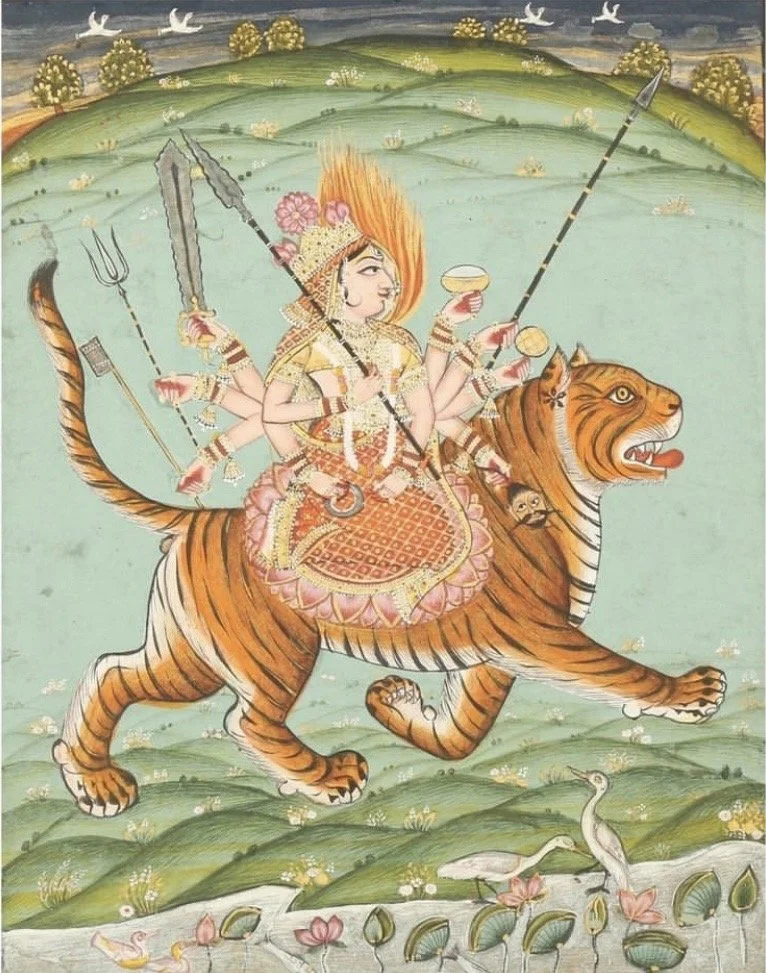
Padminī Ekādaśī

PADMINĪ EKĀDAŚĪ

Pinterest

पद्मिनी एकादशी | 05.26

Falling on the eleventh lunar day of the bright half of Adhika Māsa — the intercalary month received by Viṣṇu as Purushottama — this Ekādaśī arises only when the lunar calendar itself expands. It appears once every 32 months at most, and some years not at all. That rarity is not incidental. It is the teaching.

The Story

In the Treta Yuga, King Kṛtavīrya ruled the kingdom of Māhiṣmatī with righteousness and care for his people. He had performed powerful yajñas, given generously in dāna, and fulfilled every outer duty of dharma. And yet, across a hundred wives, across years of prayer, no son came to carry the lineage forward. The weight of that absence followed him everywhere.

Unable to remain still in his grief, he left the palace. His first queen, Padminī, went with him into the forest. Not as a passive companion but as a seeker in her own right. Together they undertook severe austerities for years. Still, no blessing came.

It was Padminī who moved what the years of tapas could not.

In the forest, she encountered the sage-consort Anasuya, who perceived what the queen and king had not yet understood: that the specific timing of their observance had been missing. Anasuya revealed to Padminī the hidden power of this Ekādaśī — the one that only opens when time itself expands, within Adhika Māsa.

Padminī received the vrata vidhi with full attention and observed it exactly as instructed.

She fasted completely. She remained awake through the night in vigil. She held unbroken remembrance of Hari. Lord Viṣṇu appeared before her.

He turned to her husband and said: Ask for what you desire. Your queen’s devotion has moved me.

The king asked for a son — one who could not be defeated by gods, serpents, or demons. The boon was granted. In time, Queen Padminī gave birth to Kartavīryārjuna, a warrior so formidable that even Rāvaṇa could not overcome him.

This is the lineage of this day. Not passive waiting, but a queen’s precise and disciplined love moving karma itself.

The Significance

Padminī Ekādaśī carries a quality distinct from the 24 regular Ekādaśīs of the year. Because it falls within Adhika Māsa — itself already understood as a sattvic and spiritually amplified period, a “time outside time” — this observance is considered doubly potent in the tradition.

Adhika Māsa is the lunar calendar’s correction, the extra month inserted approximately every 32 months to realign the lunar and solar years. In the Purāṇic understanding, this month belongs to Viṣṇu as Purushottama — the supreme, beyond the ordinary count. What is offered here carries amplified karmic weight. Even subtle acts of restraint, remembrance, and inner stillness register more deeply than usual.

Pinterest

The Traditional Themes of this Ekādaśī:

Purification of karmic residue — particularly subtle attachments, memory imprints, and relational entanglements that have outlasted their purpose.

Dhārmic realignment — a recalibration back to one’s own right path during a window where the field itself is more receptive.

Inner restraint as grace — fasting, night vigil, and devotional recitation not as force, but as a quiet clearing.

Ekādaśī has long been understood within the tradition as a tithi uniquely suited for vrata, japa, and inward practice. As the Moon’s influence upon the body’s jala-tattva lessens, the system naturally becomes lighter, quieter, and more receptive to subtle states of awareness. For this reason, fasting on Ekādaśī is not approached merely as dietary restraint, but as a refinement of prāṇa itself — a temporary withdrawal from density in service of remembrance.

The Practice

The practice is simple in form. Its depth is in the sincerity brought to it. Fast from grains and beans. Those who cannot fast fully may observe a fruit and water fast, or reduce food to one simple meal taken with intention.

Chant the names of Hari throughout the day — Viṣṇu Sahasranāma, nāma japa, or simply the continuous inner repetition of Om Namo Bhagavate Vāsudevāya.

Remain awake through the night of Ekādaśī in remembrance. Sleep on this night is traditionally said to break the vrata.

Break the fast the following morning, on Dvādaśī, after sunrise.

ॐ नमो भगवते वासुदेवाय ॥

Tithi:

5/25 — 16:41 PST through 5/26 — 18:25 PST

5/26 — 5:11 IST through 5/27 — 6:22 IST

Vrata is traditionally observed on the day when the Ekādaśī tithi is present at sunrise in your location.

Gaṅgā Daśamī: The Descent of Gaṅgā Devī

GAṄGĀ DAŚAMĪ

Artwork: King Bhagīratha and the Goddess Gaṅgā, Jaipur, 18th century | Sotheby’s

05.25.26

This sacred observance falls upon the Daśamī tithi, the tenth lunar day of the waxing Moon in Jyeṣṭha, commemorating the Gaṅgāvatāraṇa — the descent of Gaṅgā Devī from the celestial realms into Earth.

Her descent did not arise casually, nor through the merit of kings alone, but through generations of unresolved karma carried within the Ikṣvāku lineage.

The story begins with King Sagara, whose sixty thousand sons followed the consecrated horse of the Aśvamedha yajña into the subterranean realms. There, beside the horse, sat Ṛṣi Kapila immersed in samādhi — absorbed in the stillness born of immeasurable tapas.

Blinded by pride, the princes accused the Ṛṣi of theft and disturbed his meditation.

Kapila opened his eyes.

In that single glance, charged with the fire of perfected tapas, all sixty thousand were reduced to ash. Their bodies perished instantly, yet their souls remained suspended — neither liberated nor returned to the ancestral realms.

Sagara’s grandson Aṃśumān sought the counsel of Kapila and learned that only the waters of Gaṅgā could release them. He could not bring her down. His son Dilīpa also failed. At last the undertaking passed to Dilīpa’s son, Bhagīratha.

Renouncing the throne, Bhagīratha entered the Himālayas and undertook austerities for thousands of years until Brahmā granted Gaṅgā’s descent.

Yet another obstacle remained.

Shiva Bearing The Descent Of The Ganges River - C. 1740

The force of Gaṅgā descending from the celestial realms would have shattered the Earth itself. Bhagīratha therefore turned to Śiva, the great ascetic, Mahākāla, Lord of Time, beseeching him to receive her.

Śiva consented.

Gaṅgā descended with immense force into his jaṭā, where her currents became bound within the labyrinth of his matted locks. Only after long ages did Śiva gently release her streams upon the Earth.

Bhagīratha walked before her across mountains, forests, and sacred lands until at last her waters reached the ashes of his ancestors in Pātāla.

The moment Gaṅgā touched them, sixty thousand souls were liberated.

For this reason she is worshipped on Gaṅgā Daśamī as Daśa Hara — “She who removes ten sins” — dissolving accumulated impurities of thought, speech, and action.

The phrase Bhāgīratha prayatnam, “Bhagīratha’s effort,” remains in Bhāratiya tradition as the measure of unwavering and seemingly impossible endeavour undertaken in devotion.

Artowrk: Pinterest

What this observance reveals is that certain prayers move across generations. Aṃśumān and Dilīpa carried it. Bhagīratha completed it — Through sustained tapas, the impossible was finally drawn from heaven into Earth.

May we remember what is worthy of such perseverance.

Oṁ Gaṅgāyai Namaḥ | Jaya Bhāgīrathī

Saturn Enters Revatī: The Wealthy Star

SATURN ENTERS REVATĪ

05.17.26 - 10.10.26

What would it mean to stop resisting what is already ending?

Śani’s transit through Revatī (Piseces) Nakṣatra carries a profound teaching around completion, surrender, and vairāgya—the sacred art of non-attachment born through lived experience.

As the final Nakṣatra of the zodiac, Revatī governs endings, dissolution, safe passage, and the crossing between worlds. Ruled by Pūṣan—the nourisher, protector of travelers, keeper of flocks, and guide of souls through unseen terrain—Revatī carries Kṣīradyāpani Śakti, “the power to nourish, protect, and foster.” Its nourishing current is symbolized through kṣīra, milk: that which sustains life gently, quietly, and continuously.

Yet Saturn’s movement through Revatī reminds us that true nourishment is not always indulgent. Sometimes it arrives through simplification. Through exhaustion. Through the gradual dissolution of what can no longer be carried forward.

Revatī is deeply connected to oceans, vastness, migration, transport, and the longing to cross beyond ordinary boundaries. Symbolized by the fishes and resting within the final waters of the zodiac, it often carries an affinity toward the sea, music, creativity, healing, pilgrimage, and spiritual seeking itself—the soul searching across lifetimes for what is enduring beneath the changing tides of experience.

Artwork: Pinterest

Śani here matures through time. Through karma exhausted rather than avoided. Through the recognition that stability cannot ultimately be found in status, identity, praise, possessions, or external certainty. Saturn is often feared because he reveals where attachment governs perception. Yet his nature is not punishment, but precision. He illuminates where fear, resistance, and grasping prevent deeper alignment with reality.

In its highest expression, Revatī points toward genuine renunciation—not rejection of life, but release of false identification. A mind unmoved by gain or loss, palace or hut, recognition or obscurity. This is the deeper current of vairāgya and the quiet dignity Śani seeks to cultivate

There is also movement within this transit. Revatī governs transport, transition, and passage from one state into another. As Śani casts its gaze toward Aśvinī, the first Nakṣatra, endings and beginnings become mysteriously intertwined. What first appears as delay, restriction, or dissolution may ultimately become redirection.

Practically, this transit asks for patience, conservation of energy, grounded routines, humility, and constructive action over reaction. Simplify where possible. Tend carefully to what is essential. Saturn responds well to steadiness, sincerity, and the willingness to work with reality rather than against it.

To understand Śani more deeply is to recognize that he is not separate from time, karma, restraint, or the intelligent architecture of life itself. Resistance intensifies suffering. Alignment restores peace.

All My Relations, Tulsi

Artwork: Pinterest

Saturn’s Transit Dates


May 17th: Saturn enters Revatī (Pisces)

July 27th: Saturn retrogrades in Revatī 

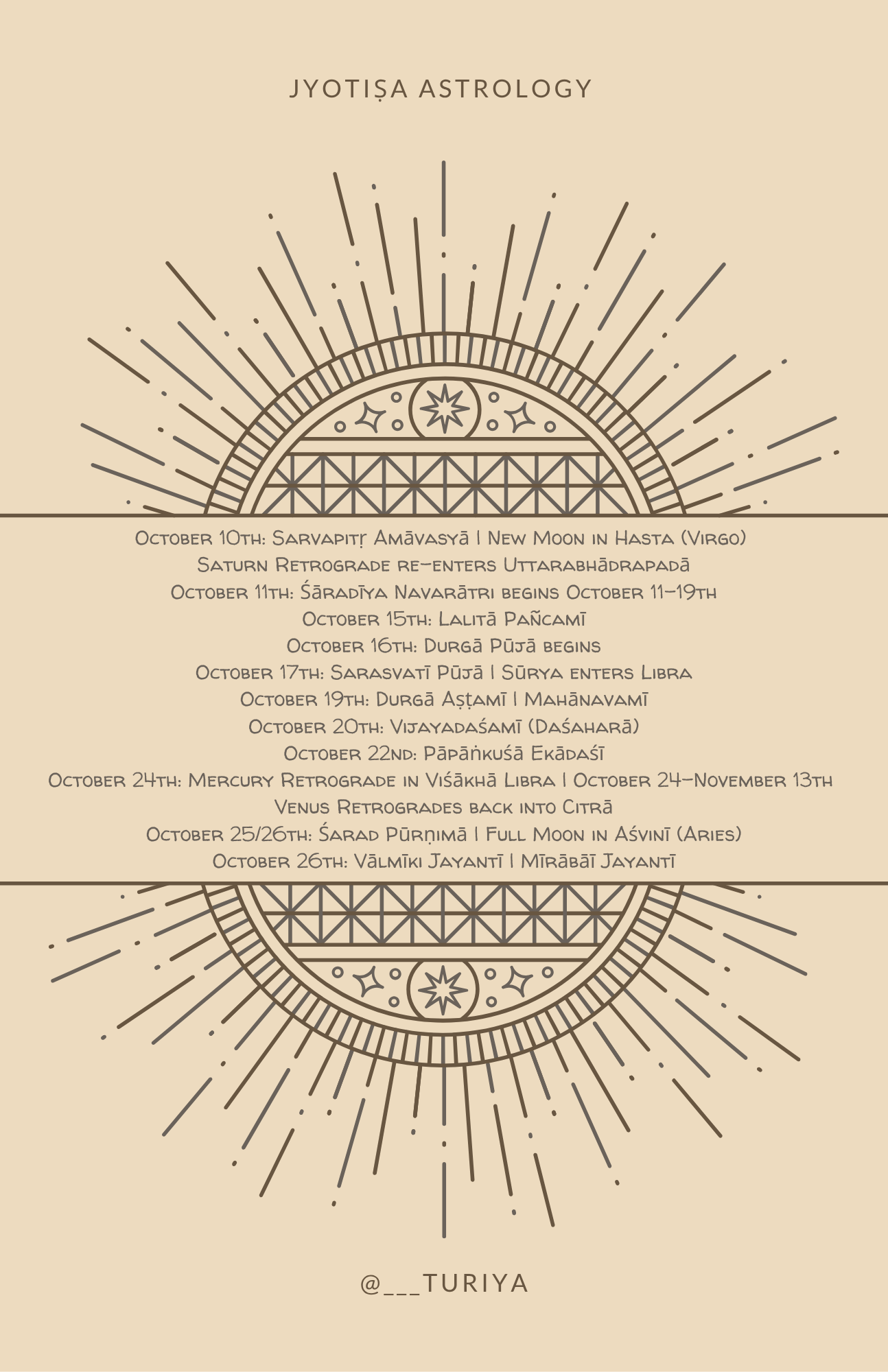
October 10th: Saturn Retrograde re-enters Uttarabhādra

December 11th: Satturn direct in Uttarabhādra 

February 7th, 2027: Saturn re-enters Revatī 

Adhika Purusottama Māsa: A Sacred Month of Inner Recalibration

Adhika PuruSottama Māsa

Artwork: Pinterest

05.17–06.15

Approximately every thirty-three months, an additional lunar month arises within the Vedic calendar, Adhika-māsa, also known as Purusottama Māsa and Malamāsa in ancient times.

A sacred interval outside ordinary time.

While the lunar year moves according to the phases of the Moon, the solar year follows the path of the Sun. Over time, a subtle divergence emerges between these two celestial rhythms. Adhika-māsa appears to restore balance—to reconcile the sacred relationship between lunar and solar time.

Yet beyond calendrical adjustment, this month has long been regarded as deeply auspicious for spiritual refinement, restoration, and inward recalibration.

It is a pause within the current of becoming.

Known as the thirteenth month — the one that stands outside the ordinary cycle, belonging neither fully to one year nor the next. A month that exists between —and it is precisely this that makes it sacred.

Yet this month carries something deeper than astronomical necessity. The Purāṇas tell us that Adhika Māsa once had no presiding deity — no lord, no festivals, no name of its own. It was considered inauspicious, even orphaned among the months. 

In grief, the month itself approached Viṣṇu, lamenting its incompleteness. Moved by compassion, Viṣṇu claimed it as his own — bestowing upon it his most exalted name: Puruṣottama, the Highest Self. He declared it not merely auspicious but the most potent of all months for spiritual practice, more sacred than any other in the calendar. The month that was cast out became the most beloved.

A month traditionally devoted to simplification, prayer, pilgrimage, mantra, sacred study, nourishing the body, and returning awareness toward what is essential.

The tradition offers specific practices for this sacred interval — not as obligation, but as invitation. Devotionally, this is a month to recite the Viṣṇu Sahasranāma, to offer lamps, flowers, and tulasī to Viṣṇu daily, to tend the tulasī plant with reverence, and to read or listen to the Bhāgavata Purāṇa. The month carries two Ekādaśīs — both potent for fasting, inward turning, and deepening one’s relationship with the divine.

Artwork: Pinterest

For practice, Puruṣottama Māsa is considered especially auspicious for beginning or deepening a sādhana — whatever discipline you have been waiting to establish, this month holds unusual potency for it. Japa is particularly supported, especially Viṣṇu mantras such as Om Namo Bhagavate Vāsudevāya. 

Prāṇāyāma, Yoga Śāstra study, and any sincere inward discipline find fertile ground here.

In the realm of lifestyle, the tradition invites simplification — of diet, reducing tamasic foods and unnecessary consumption, quieting excess speech, withdrawing from the constant current of screens and stimulation. Charitable giving is considered especially meritorious this month, the merit of any offering said to be multiplied. To give, to fast, to study, to pray — these are not austerities here but acts of alignment.

This year, Adhika-māsa begins under the New Moon in Kṛttikā Nakṣatra (Taurus)—the birth star of the Moon and lunar mansion governed by Agni, the sacred fire.

Kṛttikā carries the power to purify, refine, and illuminate through discernment—burning away excess to reveal what is essential.

A potent threshold for recalibration, nourishment, and refining what we are taking in physically, mentally, emotionally, and spiritually.

And so this Adhika Māsa holds a particular potency — Agni’s discerning fire meeting Viṣṇu’s boundless compassion. What the fire refines, devotion receives. What is burned away reveals not absence, but belonging. Like the month itself, what has felt cast aside or incomplete may find, in this sacred interval, its truest name.

A beautiful time to replenish prāṇa, refine one’s sādhana, and listen more deeply.

ॐ नमो भगवते वासुदेवाय ॥