New Moon Solar Eclipse in Dhaniṣṭhā: The Star of Symphony

New Moon Solar Eclipse in Dhaniṣṭhā

Artwork: Pinterest

February 17th

Eclipse season commences with the new moon in the Vedic lunar mansion of Dhaniṣṭhā (sidereal Aquarius), the Star of Symphony. Expect disciplined ambition and the culmination of long-term goals.

This cycle presents an upbeat cadence tempered by sobriety — urging us to awaken and move one-pointedly toward what truly matters. This eclipse occurs with five planets in Aquarius — the Sun and Moon joined by three additional grahas (mercury, venus and Rāhu) intensifying the field of delivery.

The points where the Sun and Moon intersect the ecliptic plane, positioned exactly 180 degrees apart, are known as the lunar nodes — Rāhu and Ketu in Jyotiṣa. These shadowy grahas, often called the great awakeners, govern eclipses and symbolize the eternal dance between light and darkness. They confront us with what has been concealed, disrupt stagnant patterns, and offer the opportunity to awaken to deeper truths along our journey.

Solar eclipses expose that which has been hidden from view and set the tone as an omen of the energies for the next six months. A spiritual culmination unfolds, signaling transformative endings and the potential for new beginnings — inviting introspection, healing, and the initiation of new creative endeavors. This cycle urges us to refine our inner compass, untangle and release an old karmic pattern.

Dhaniṣṭhā, zenith of Martian energy, is traced across the night sky by four luminous stars in Delphinus, arranged in a perfect rhombus — Śiva’s ḍamaru poised beneath the canopy of stars. As the drum of Mahākāla, keeper of time, its beat measures the birth and dissolution of worlds. In the ancient telling, when its cadence shifts, the old order falls away and a new one is born. We are no longer standing at the threshold; we are dancing to a new drummer.

Dhaniṣṭhā lands between Capricorn and Aquarius, both rāśis of Śani. Ruled by the Aṣṭa Vasus — elemental deities of abundance (Vasu meaning “wealth” or “brightness”) — it carries Kṣepayitrī Śakti, the power to bestow fame and prosperity. Activated by Maṅgala, it contains his uccha point and, in certain traditions, is remembered as a birth star of both Guru and Budha.

What is revealed now invites you to reassess and consciously redesign the physical architecture of your life with greater awareness. Accelerated spiritual growth becomes possible when we allow ourselves time to introspect. Some pattern has been attempting to surface for completion and healing. Create space to meet it with steadiness.

We have been preparing the soil through the discipline and inward focus of Sūrya in Makara — now we enter a time of action.

Like the drum itself — hollow, receptive, precisely tuned, neither too tight nor too loose — this affluent asterism teaches that the pulse flows through what is emptied. When we become a conduit for Source, when we become as a hollow bone, the rhythms of the universe move through us more effortlessly.

As the drum shifts hands and the cadence changes, step into receptivity. Trust in the presence of the Unknown and attune your awareness to the shifting pulse. Act when the rhythm calls.

During eclipse windows, for most, it is traditionally advised to postpone major auspicious undertakings such as marriage or business ventures. However, it is an ideal time for sādhanā.

Eclipses stir duality to initiate purification — a necessary process through which self-knowledge is deepened and stabilized. Any turbulence you feel is part of this alchemy.

During this eclipse window, keep life simple. Stay grounded. Rest. Reflect on what is being revealed and what needs untangling.

The ancients taught that any practice undertaken during an eclipse bears fruit a thousandfold. In this sacred window, they consumed less — physically and mentally — to keep their channels clear. With the Sun and Moon — our sources of prāṇa — obscured, this becomes a potent time for:

  • Mantra chanting

  • Meditation & breathwork

  • Prayer & fasting

  • Turning inward, rather than outward

It is also recommended to bathe before and after the eclipse to cleanse both body and mind, allowing for a smoother energetic transition.

Trust that this cycle serves as an initiation, sowing the seeds of transformation that will blossom in divine timing, guiding you into the next phase of your journey.

Pay close attention if you have major planets — your Sun, Moon, or Lagna — in Dhaniṣṭhā. This cycle may bring sudden change, an unanticipated turning point, or the revelation of something deeper within. Also take note if you are currently running a dāśā or antar dāśā of Rāhu, Ketu, Sun, Moon, or Maṅgala.

All My Relations, Tulsi

ॐ तत्पुरुषाय विद्महे
महादेवाय धीमहि
तन्नो रुद्रः प्रचोदयात् ॥

Om Tatpuruṣāya Vidmahe
Mahādevāya Dhīmahi
Tanno Rudraḥ Prachodayāt ॥

New Moon: Dhaniṣṭhā (Aquarius)
February 17th | 06:01 AM CST | 17:32 IST

Eclipse Timing:
3:56–8:27 AM CST | 15:26–19:57 IST

"In order to establish order, disorder has to be shaken; and for shaking to remain under control, we who are at the basis, at the level of Para, have to be Para – that is, unreachable by the surface turmoil. In that integrated state, the fast moving chaos and change will pass away in a steady manner.

So, we have to be very steady. We have to be very careful not to get upset by little or big things. If we lose our basis, our dignity, the phase transition will take much longer.

Don't give importance to things which may upset us. This is a very precious time for the world. Everything depends on how our awareness is; just don't let it be shaken. Our awareness is the basis of all these transformations. More than ever before, time demands we remain completely ourselves. It is a very tender, delicate time for us - we should not become angry, indifferent, or sad; we should just be like an ocean. The evolutionary power is waking up.

We shake it, then leave it; then after some time shake it again. Each time a new level of purity, awakening, is added.”

~ Maharishi Mahesh Yogi

Mahāśivarātri: The Great Night of Lord Śiva

MAHĀŚIVARĀTRI

Painting from Mankot, Himachal Pradesh, c. 1700–1725. Held at the Philadelphia Museum of Art.

February 15th

Mahāśivarātri, observed on the Caturdaśī tithi (14th lunar day) of the Kṛṣṇa Pakṣa (dark half) in the Māgha or Phālguna month, is one of the most spiritually activated days in the Vedic calendar. This night is celebrated as the great night of Lord Śiva, where he performs his heavenly dance and relieves us from our karmic burdens.

It is said that any spiritual practices performed on this day, including mantra recitation (especially Śiva mantras), fasting, and deep meditation, are enhanced a thousandfold during this auspicious time. The late hours of the night, in particular, are said to be charged with intense spiritual potency. Whoever fasts on this day, Lord Śiva will relieve you of the poisons and karmic debts accumulated in this life and all previous incarnations.

Mahāśivarātri is a profound and sacred observance dedicated to Lord Śiva, the eternal consciousness that dissolves illusion and grants liberation. Śiva is revered as Ādi Yogi—the first yogin, the primordial teacher of yoga—who embodies both the origin of the path and its culmination in absolute freedom.

He is also honored as Ādi Vaidya—the first physician—source of Āyurveda and the healing sciences, revealed in sacred dialogue to Pārvatī, through whom this wisdom descended into the world. The timing of Mahāśivarātri is deeply significant, as the waning moon symbolizes the dissolution of the ego, inviting seekers to surrender to the infinite stillness of Śiva.

The timing of Mahāśivarātri is deeply significant, as the waning moon symbolizes the dissolution of the ego, inviting seekers to surrender to the infinite stillness of Śiva. 

One perspective views this night as the moment when Śiva entered deep meditation, embodying the stillness that dissolves all illusions. It is believed that on this night, the cosmic energies align in a way that makes it highly conducive for inner awakening and meditation.

Mahāśivarātri is also believed to be the sacred night when Lord Śiva and Goddess Pārvatī were united in divine marriage. This marks the cosmic union of Śiva—the embodiment of pure consciousness—and Śakti—the dynamic force of creation. Their union is symbolized in the divine dance of Śiva, an eternal cycle of creation, preservation, and destruction, where stillness and movement coexist in harmony. This dance represents the interplay of the infinite and the finite, the unchanging and the ever-changing, reflecting the unity of opposites in the universe.

Devotees observe Mahāśivarātri with jāgaraṇa (night-long vigil), abhiṣeka (ritual bathing of the Śiva Liṅgam), and chanting of the Pañcākṣarī mantra—"Oṁ Namaḥ Śivāya." Fasting, silence, and deep contemplation allow one to align with Śiva's transcendental essence, shedding layers of karma and moving closer to mokṣa (liberation).

This night is a gateway to the formless, where the dissolution of duality reveals the pure consciousness that pervades all. It is a night of transformation, where the aspirant, like the moon waning into darkness, merges into the luminous presence of Śiva—the Supreme Reality.

Artowrk: Pinterest

ॐ नमः शिवाय | Oṁ Namaḥ Śivāya 🔱

The Chaturdashi Tithi (the 14th lunar day required for Mahāśivarātri) begins on the afternoon of the 15th and lasts until the afternoon of the 16th:  Chaturdashi Tithi Begins: 17:05 PM IST on Feb 15, 2026. Chaturdashi Tithi Ends: 17:34 PM IST on Feb 16, 2026.

Main Midnight Puja (Nishita Kaal): 12:09 AM to 1:01 AM on Feb 16. * Fast-Breaking (Parana): 6:59 AM to 3:24 PM on Feb 16. 

Pulse of the Stars: Vidyā & Chai

Join us for our monthly New Moon gathering for a deep dive into Mahāśivarātri, the New Moon in Dhaniṣṭā (Aquarius) and preparation for upcoming eclipse season, mercury retrograde

RSVP: tulsibagnoli@gmail.com

Join the Vidyā & Chai WhatsApp Community

Full Moon in Āśleṣā: The Embracing Star

Full Moon in Āśleṣā

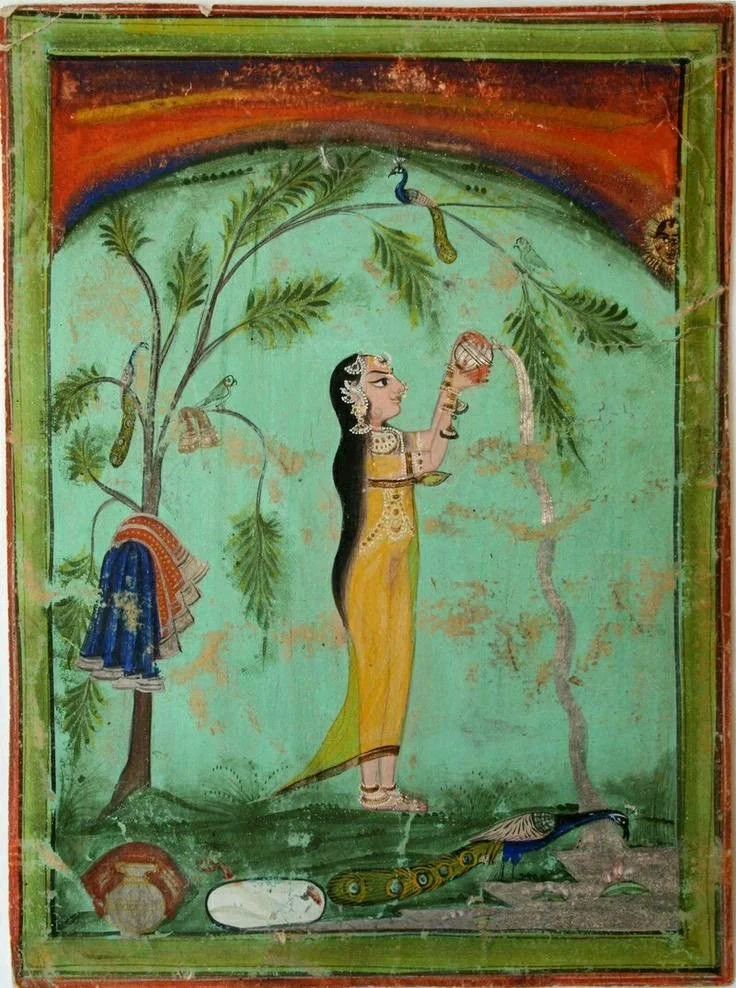
Artowrk: Rita Dixit Indian Miniatures Asavari Ragini: A Painted Melody Murshidabad, Bengal, India c. 1780

The Full Moon (Pūrṇimā) of Māgha (Jan/Feb) rises in the Vedic lunar mansion of Āśleṣā (आश्लेषा). Situated from 16°40′–30° of Kāraka Rāśi (Cancer), the embracing and entwining star appears as a coiling ring of stars in the constellation Hydra. It marks an alchemical threshold where viṣa (poison) becomes amṛta (nectar), drawing awareness toward the subtle work of inner transformation.

Āśleṣā, one of Ketu’s birth stars and the nīca point of Maṅgala (Mars), initiates the gaṇḍānta juncture — the karmic knot between water and fire, Mokṣa and Dharma. Its Devatās are the Nāgās (Sarpas), guardian serpent beings of primordial wisdom. Its animal yoni is the male cat — a nocturnal guardian of thresholds, moving in silence between worlds, master of stillness, instinct, and unseen passage.

Artowrk: Pinterest

Āśleṣā holds the energy of Viṣāśleṣaṇa Śakti — the power to inflict poison, to penetrate and bind at a subtle level — revealing how venom, when rightly handled, becomes medicine, mirroring the inner path where shadow is transmuted into healing. Just as the coiled energy at the base of the spine yearns to merge with its beloved in the crown, Āśleṣā stirs the curiosity to delve deeper and unite with one's desired outcome, weaving disparate elements into coherence and granting true inner authority through the patient art of alchemy.

Āśleṣā is linked with Ādi Śeṣa and Sage Patañjali, pointing to the serpent power of consciousness that binds and releases. Its medicine lies in yoga, mantra, and disciplined inner awareness — the same forces that can entangle the mind become, when refined, the means of profound purification and healing of citta, speech, and body.

What old skin is ready to be shed?

Lalitā Jayantī

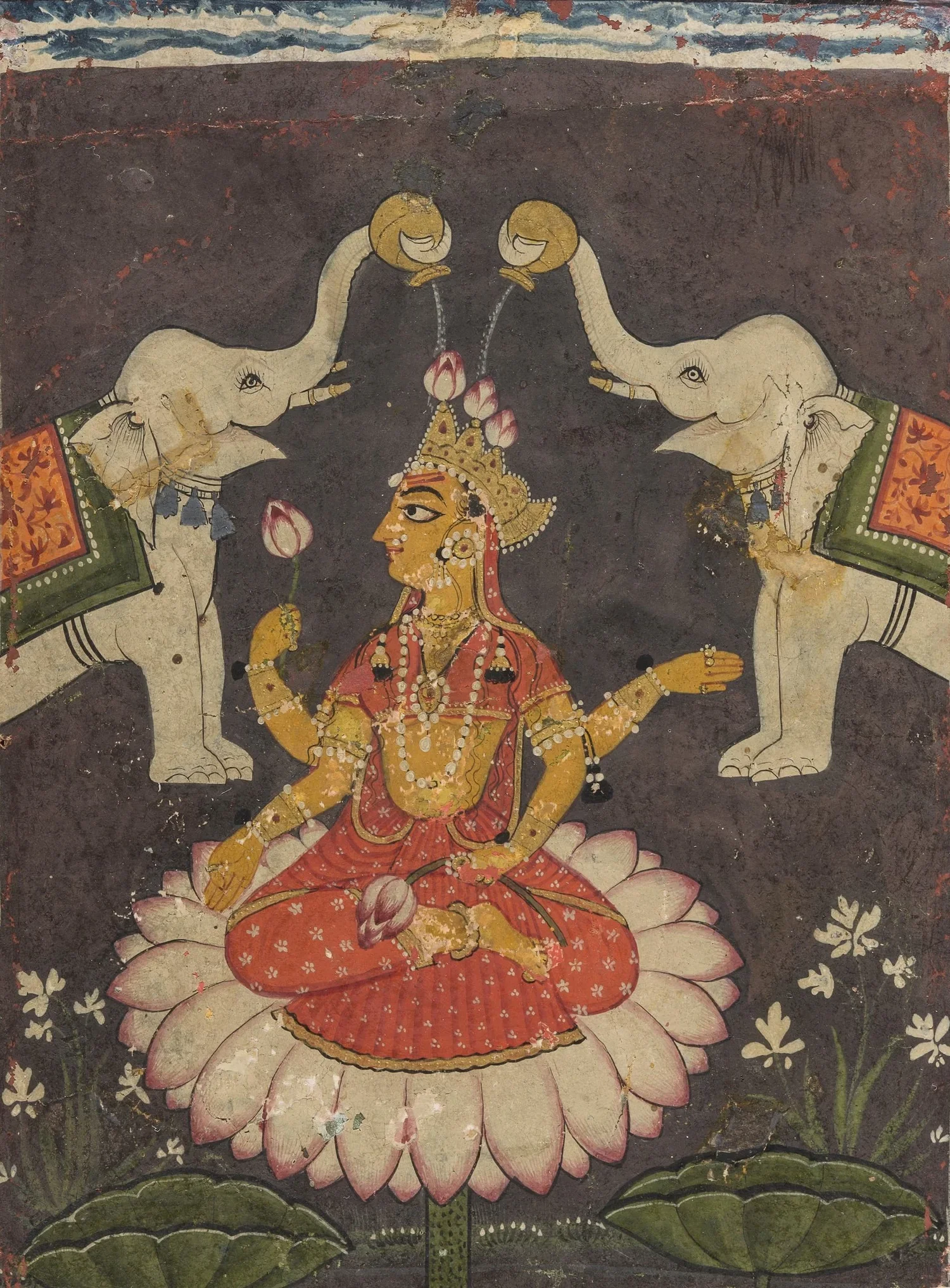
Artwork: Mahāvidyā Tripura Sundarī National Museum, New Delhi 

Lalitā Jayantī commemorates the appearance of the Goddess in her supreme form as Mahāvidyā Tripura Sundarī, the third of the Daśa Mahāvidyās — “Beauty of the Three Cities,” harmonizing the three worlds and the three states of consciousness — who embodies supreme beauty, clarity, and the power of refined discernment. 

This observance honors her as Lalitā (the playful one), Śoḍaśī (ever-perfect youth), Kāmakṣī (she whose gaze bestows grace), and Rājarājeśvarī (the Supreme Empress, sovereign of sovereigns), the radiant fullness of consciousness abiding in effortless grace and wisdom.

All my Relations, Tulsi

Full Moon Timing: 02.01.26 14:09 PST | 02.02.26 3:39 AM IST 

The degree to which a person can grow is directly proportional to the amount of truth he can accept about himself without running away.” 

― Leland Val Van De Wall