Eclipse Season: A Field Guide

Eclipse Season

August 12th & 27/28th

Eclipse season commences on August 12th with the new moon in the Vedic lunar mansion of Aśleṣā (Cancer), the Embracing and Entwining Star. Expect deep alchemical transformation and the surfacing of what has long been hidden.

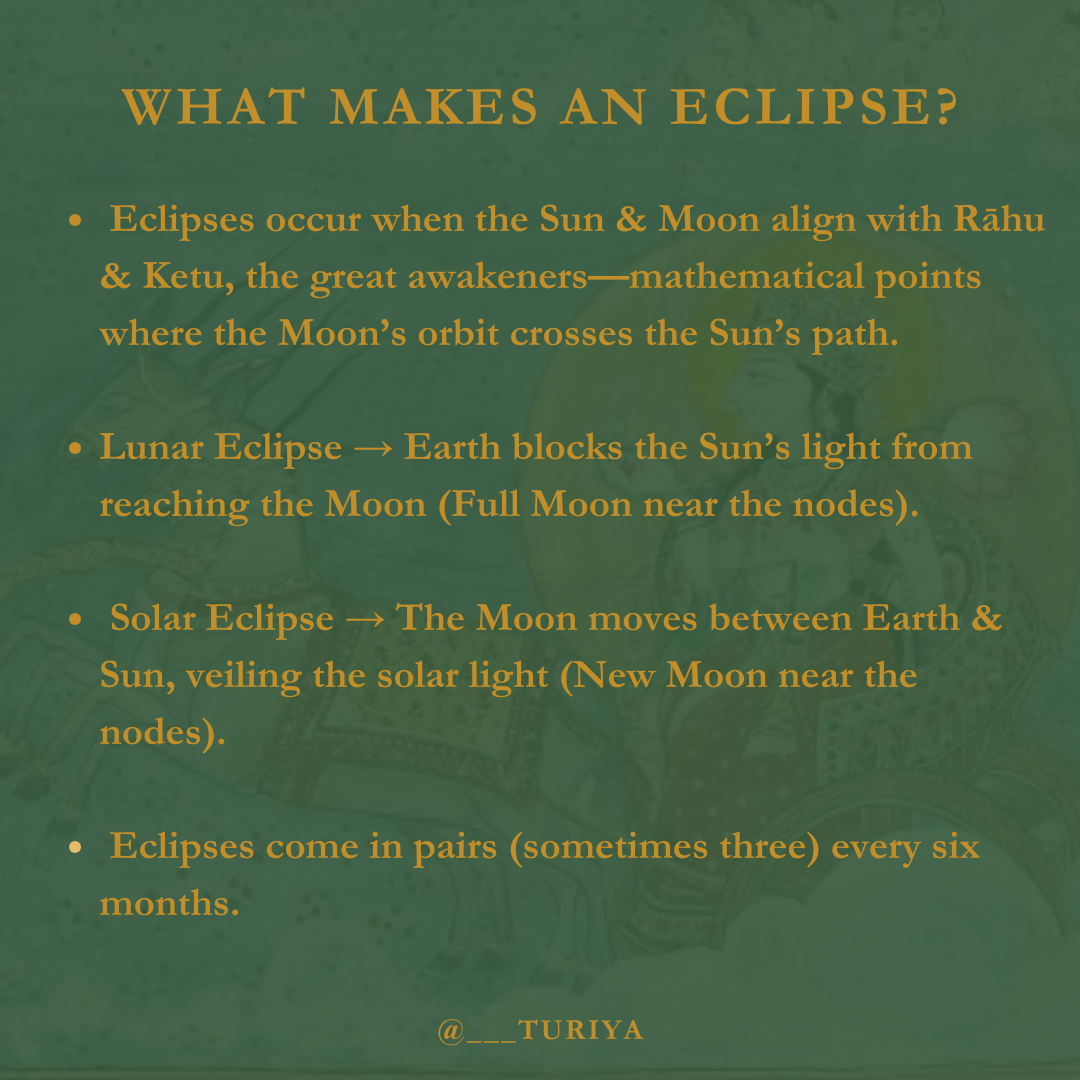
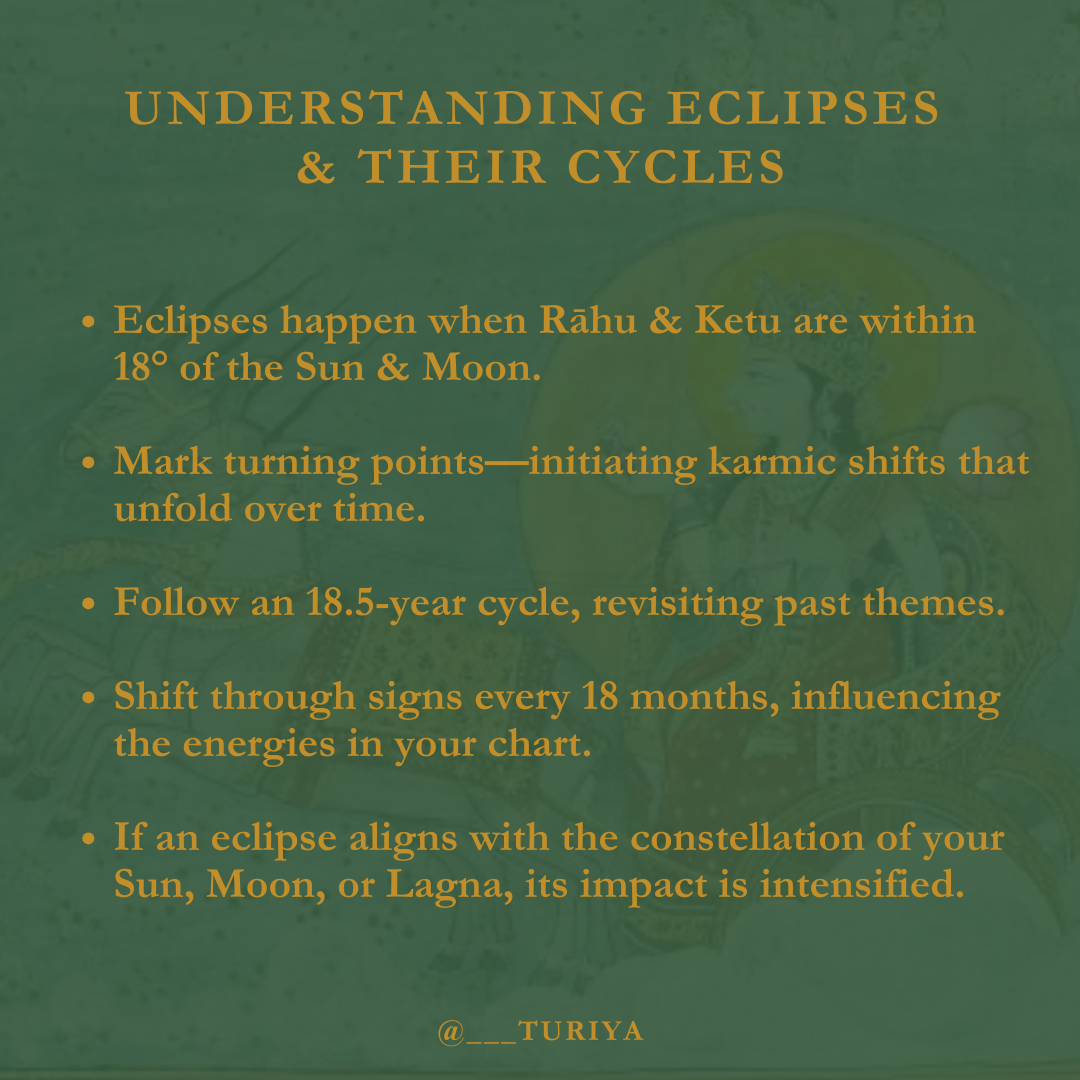
The points where the Sun and Moon intersect the ecliptic plane, positioned exactly 180 degrees apart, are known as the lunar nodes — Rāhu and Ketu in Jyotiṣa. These shadowy grahas, often called the great awakeners, govern eclipses and symbolize the eternal dance between light and darkness. They confront us with what has been concealed, disrupt stagnant patterns, and offer the opportunity to awaken to deeper truths along our journey.

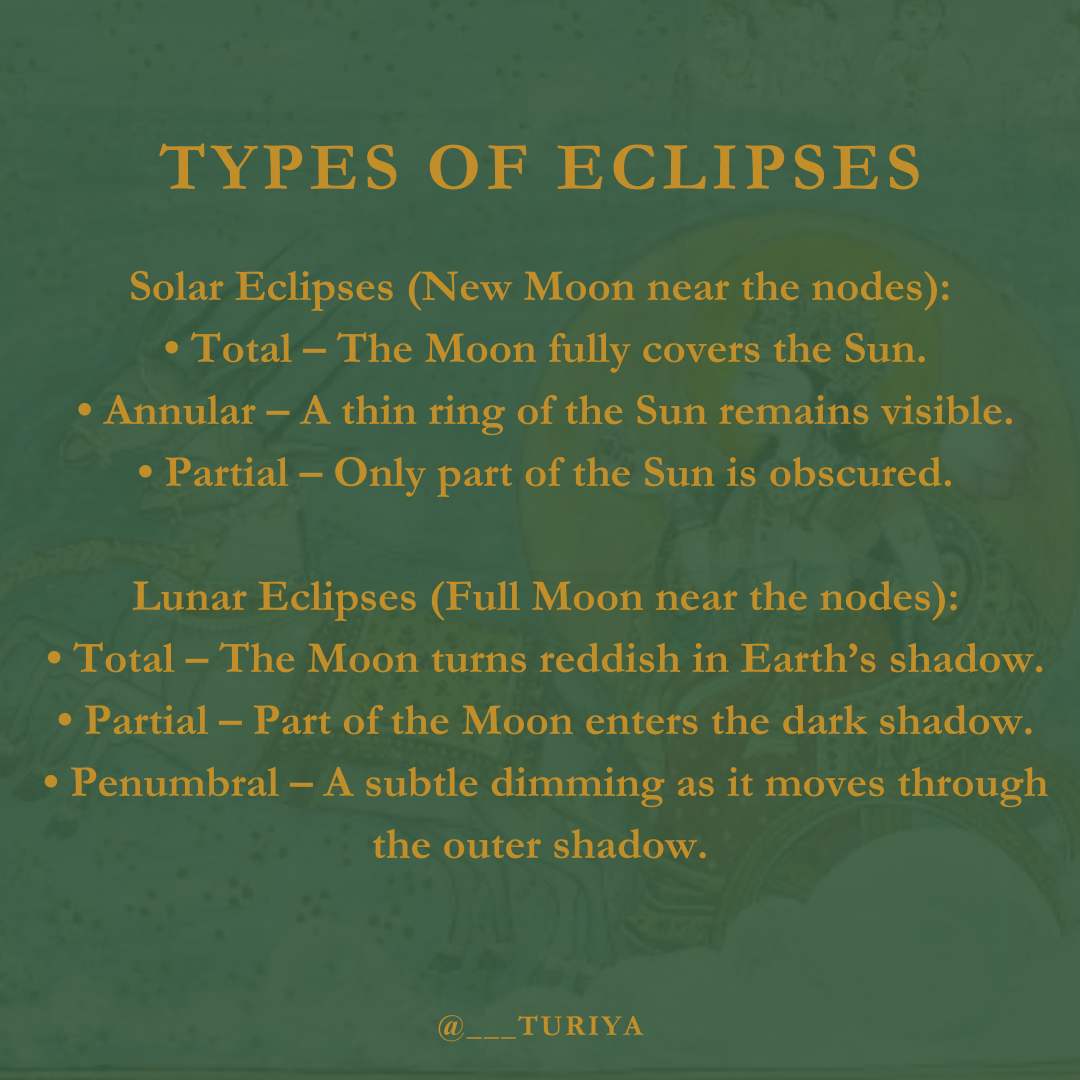
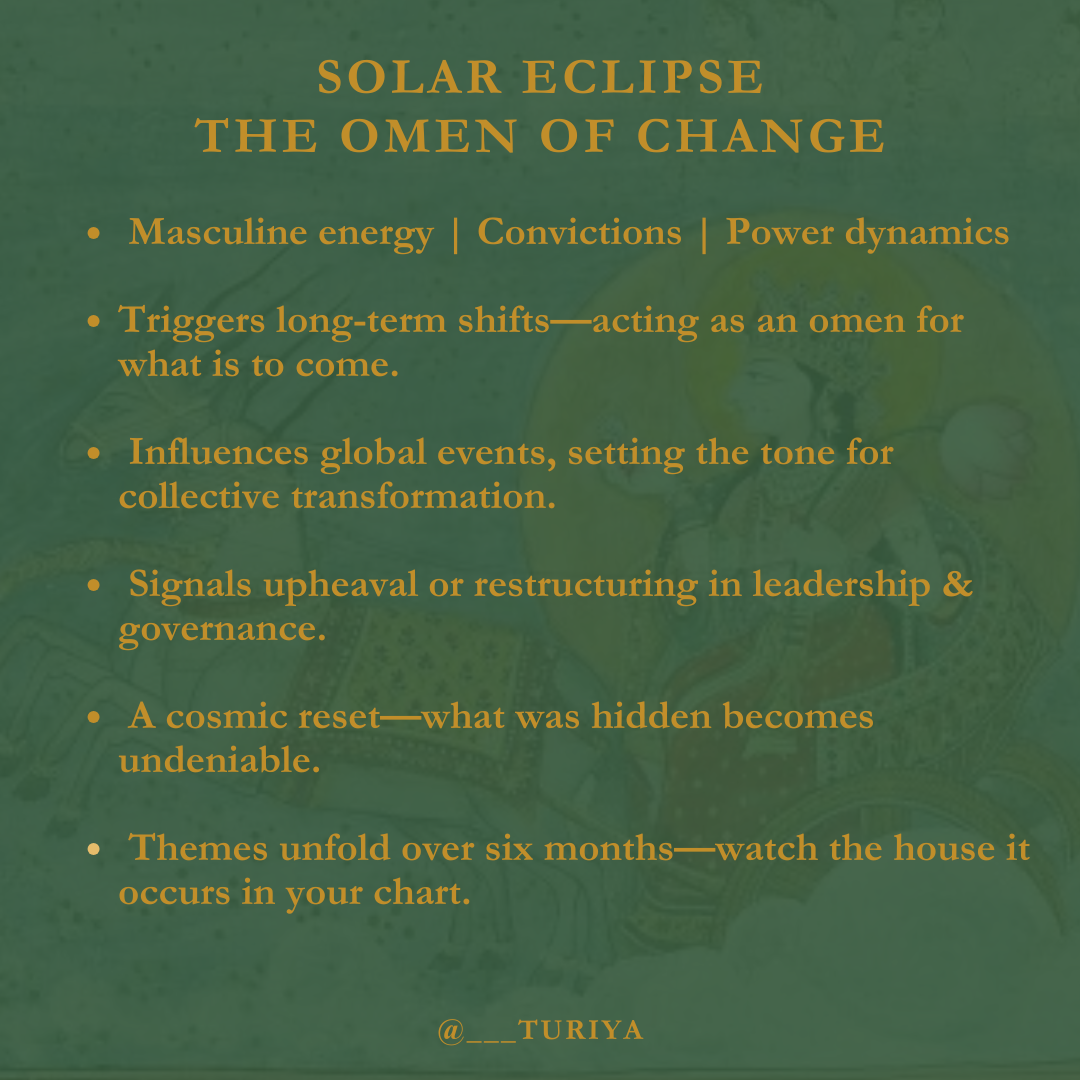
Solar eclipses expose that which has been hidden from view and set the tone as an omen of the energies for the next six months. A spiritual culmination unfolds, signaling transformative endings and the potential for new beginnings — inviting introspection, healing, and the initiation of new creative endeavors. This cycle urges us to refine our inner compass, untangle and release an old karmic pattern.

What is revealed now invites you to reassess and consciously redesign the physical architecture of your life with greater awareness. Accelerated spiritual growth becomes possible when we allow ourselves time to introspect. Some pattern has been attempting to surface for completion and healing. Create space to meet it with steadiness.

During eclipse windows, for most, it is traditionally advised to postpone major auspicious undertakings such as marriage or business ventures. However, it is an ideal time for sādhanā.

Eclipses stir duality to initiate purification — a necessary process through which self-knowledge is deepened and stabilized. Any turbulence you feel is part of this alchemy.

During this eclipse window, keep life simple. Stay grounded. Rest. Reflect on what is being revealed and what needs untangling.

The ancients taught that any practice undertaken during an eclipse bears fruit a thousandfold. In this sacred window, they consumed less — physically and mentally — to keep their channels clear. With the Sun and Moon — our sources of prāṇa — obscured, this becomes a potent time for:

  • Mantra chanting

  • Meditation & breathwork

  • Prayer & fasting

  • Turning inward, rather than outward

It is also recommended to bathe before and after the eclipse to cleanse both body and mind, allowing for a smoother energetic transition.

Trust that this cycle serves as an initiation, sowing the seeds of transformation that will blossom in divine timing, guiding you into the next phase of your journey.

Pay close attention if you have major planets — your Sun, Moon, or Lagna — in Aśleṣā (Sidereal Cancer). This cycle may bring sudden change, an unanticipated turning point, or the revelation of something deeper within. Also take note if you are currently running a dāśā or antar dāśā of Ketu, Sun, Moon, or Mercury.

All My Relations, Tulsi

ॐ तत्पुरुषाय विद्महे
महादेवाय धीमहि
तन्नो रुद्रः प्रचोदयात् ॥

Om Tatpuruṣāya Vidmahe
Mahādevāya Dhīmahi
Tanno Rudraḥ Prachodayāt ॥

New Moon: New Moon Aśleṣā (Cancer)
August 12th, 00:36am PST | 23:06 PM IST 

Eclipse Timing: August 12/13th
8:34am - 12:57pm PST | 12/13th 21:04 - 1:27AM IST

With the path of totality extending from northern Russia through Greenland and Iceland to northern Spain and northeastern Portugal.

"In order to establish order, disorder has to be shaken; and for shaking to remain under control, we who are at the basis, at the level of Para, have to be Para – that is, unreachable by the surface turmoil. In that integrated state, the fast moving chaos and change will pass away in a steady manner.

So, we have to be very steady. We have to be very careful not to get upset by little or big things. If we lose our basis, our dignity, the phase transition will take much longer.

Don't give importance to things which may upset us. This is a very precious time for the world. Everything depends on how our awareness is; just don't let it be shaken. Our awareness is the basis of all these transformations. More than ever before, time demands we remain completely ourselves. It is a very tender, delicate time for us - we should not become angry, indifferent, or sad; we should just be like an ocean. The evolutionary power is waking up.

We shake it, then leave it; then after some time shake it again. Each time a new level of purity, awakening, is added.”

~ Maharishi Mahesh Yogi
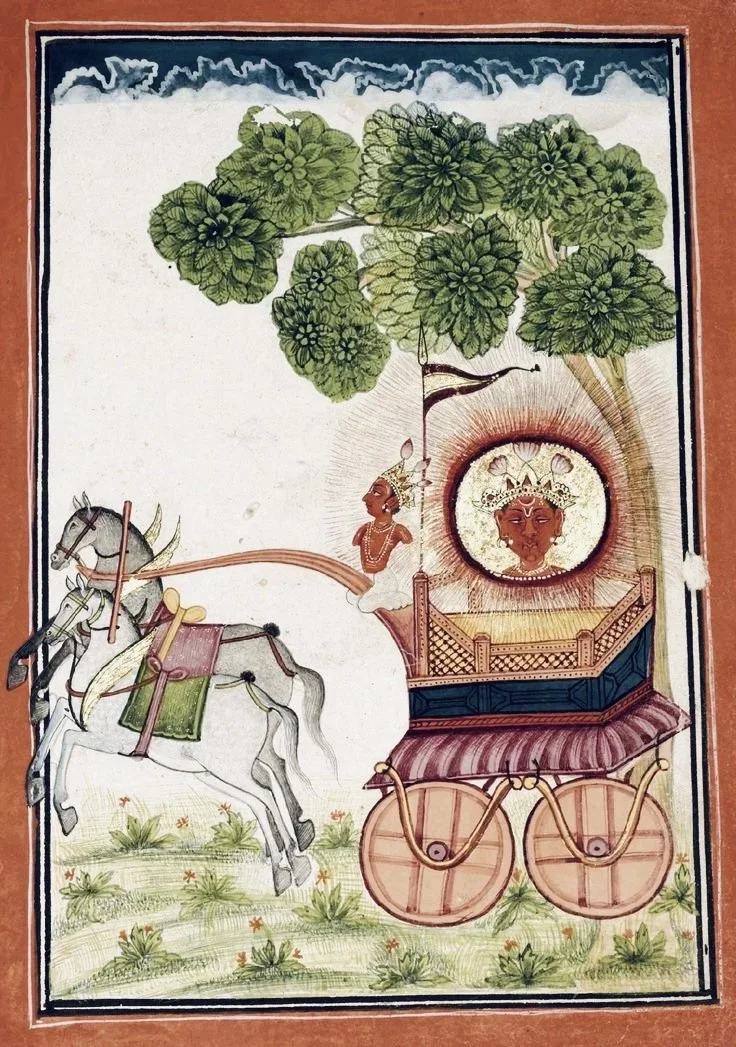
Mercury Retrogrades in Punarvasu: The Star of Renewal

MERCURY RETROGRADE

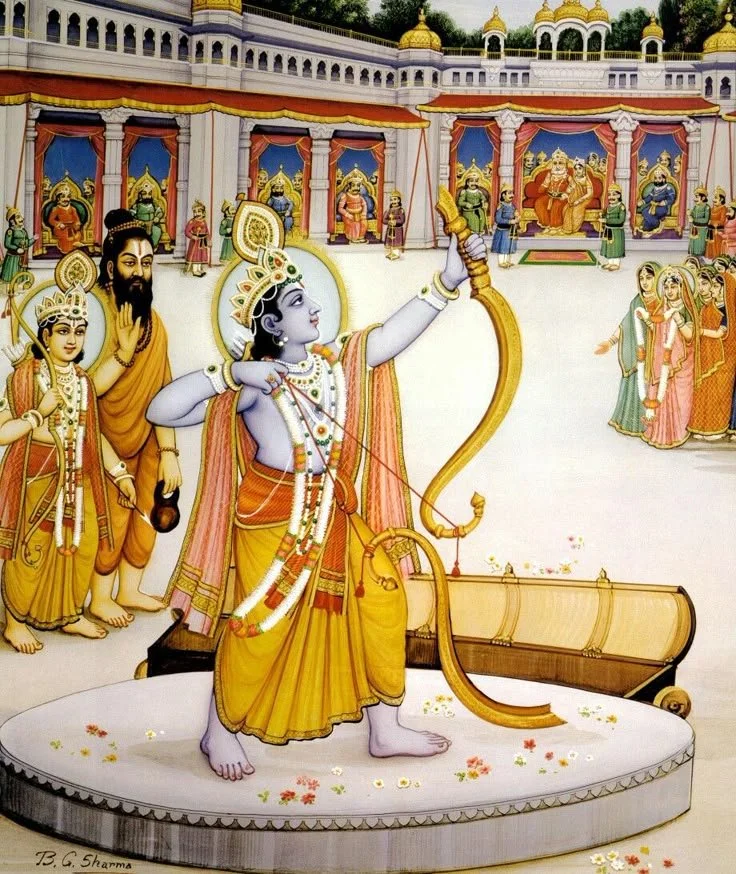
Artwork: B.G. Sharma

06.29–07.23

Budha Graha (Mercury) stations retrograde (Vakri) in the Vedic lunar mansion of Punarvasu पुनर्वसु (sidereal Cancer), the Star of Renewal, initiating a passage of reflection, reimagination, and restoration. 

In Jyotiṣa, when a graha stations retrograde, its apparent backward motion signals a turning inward, an intensification of its essential nature.

Fourth among the Navagrahas, Budha is the graha of intellect, viveka (discernment), speech, skill, storytelling, research, negotiation, and balance. Born of Chandra, he asks a single question: Who am I? Through questioning, discernment, and interpretation, Budha seeks to distinguish what is essential from what is incidental, neutralizing what no longer serves and restoring equilibrium.

Symbolized by a quiver of arrows, Punarvasu carries the śakti of Vasutva Prāpaṇa, the power to regain, restore, and recover what has been lost. Governed by Jupiter and presided over by Aditi, the boundless mother of the Ādityas, it represents the replenishment of life force after expenditure, the rebuilding that follows disruption, and the return of light after a storm.

Punarvasu is often associated with abundance, though not merely in a material sense. It is a reservoir of energy, vitality, wisdom, merit, and support. In this sense, Punarvasu functions much like a spiritual storehouse. When our reserves are strong, we possess the resources required to weather adversity, sustain effort, and respond wisely to life's challenges. When depleted, even small obstacles can feel overwhelming.

The exile and eventual return of Lord Rāma, who was born under Punarvasu Nakṣatra, beautifully reflects this principle. Though separated from his kingdom, Rāma never lost his dharma by staying upright in character. Through perseverance, virtue, and right action, what had been lost was ultimately restored. Punarvasu reminds us that setbacks are not always endings. Often they are preparations for renewal.

As the significator of the mind's interpretive faculty, Mercury retrograde invites us to pause, reconsider, revise, and realign. What has been overlooked? What requires correction? What deserves a second look?

Mercury's retrograde through this nakṣatra invites a reconsideration of how we expend and replenish our energy. Where is your attention being invested? What strengthens your reserves of vitality, clarity, faith, and purpose? What continually drains them?

Just as Viṣṇu descends age after age to restore balance, this retrograde calls us inward through svādhyāya, returning to the center of our own wheel. Some karmas are seeking completion. Some stories are ready to be rewritten. Some patterns have reached their natural conclusion.

Move slowly. Reconsider before reacting. Restore before expanding. The light is returning, and Punarvasu reminds us that renewal is not found by pushing forward. It is found by returning to what is essential.

ॐ ब्रां ब्रीं ब्रौं सः बुधाय नमः

June 29th: Mercury Retrogrades in Punarvasu (Cancer)

July 7th: Mercury retro re-enters Gemini

July 23/24: Mercury Stations direct in Punarvasu (Gemini)

August 5th: Mercury re-enters Cancer

Full Moon in Āśleṣā: The Embracing Star

Full Moon in Āśleṣā

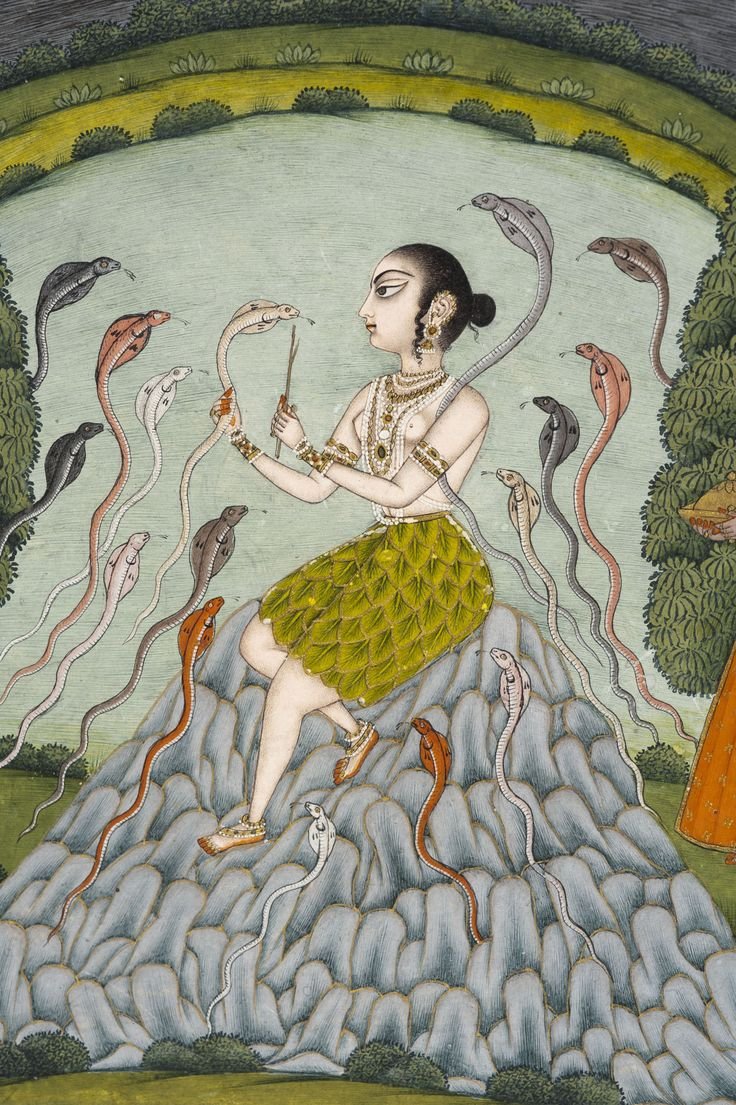
Artowrk: Rita Dixit Indian Miniatures Asavari Ragini: A Painted Melody Murshidabad, Bengal, India c. 1780

The Full Moon (Pūrṇimā) of Māgha (Jan/Feb) rises in the Vedic lunar mansion of Āśleṣā (आश्लेषा). Situated from 16°40′–30° of Kāraka Rāśi (Cancer), the embracing and entwining star appears as a coiling ring of stars in the constellation Hydra. It marks an alchemical threshold where viṣa (poison) becomes amṛta (nectar), drawing awareness toward the subtle work of inner transformation.

Āśleṣā, one of Ketu’s birth stars and the nīca point of Maṅgala (Mars), initiates the gaṇḍānta juncture — the karmic knot between water and fire, Mokṣa and Dharma. Its Devatās are the Nāgās (Sarpas), guardian serpent beings of primordial wisdom. Its animal yoni is the male cat — a nocturnal guardian of thresholds, moving in silence between worlds, master of stillness, instinct, and unseen passage.

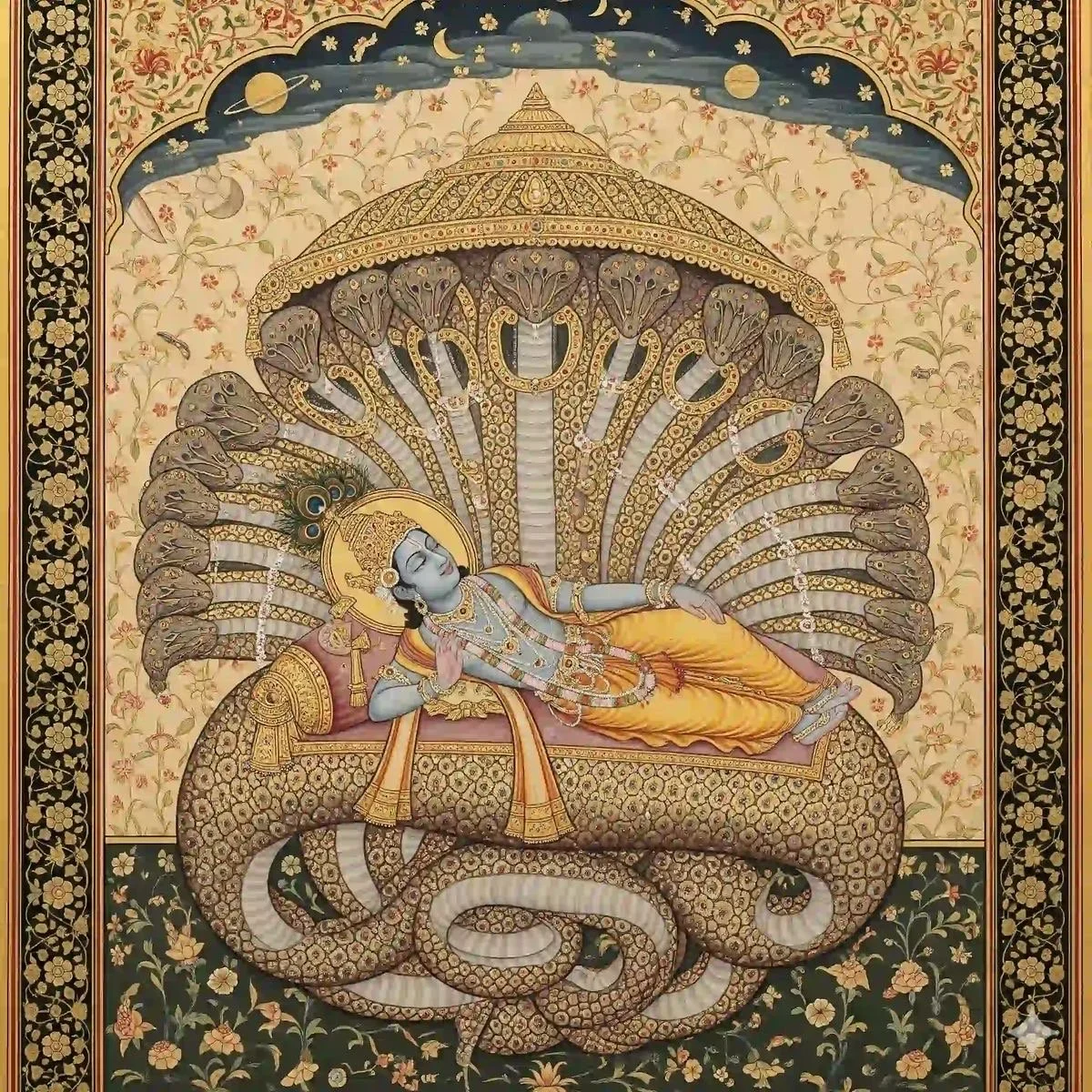
Artowrk: Pinterest

Āśleṣā holds the energy of Viṣāśleṣaṇa Śakti — the power to inflict poison, to penetrate and bind at a subtle level — revealing how venom, when rightly handled, becomes medicine, mirroring the inner path where shadow is transmuted into healing. Just as the coiled energy at the base of the spine yearns to merge with its beloved in the crown, Āśleṣā stirs the curiosity to delve deeper and unite with one's desired outcome, weaving disparate elements into coherence and granting true inner authority through the patient art of alchemy.

Āśleṣā is linked with Ādi Śeṣa and Sage Patañjali, pointing to the serpent power of consciousness that binds and releases. Its medicine lies in yoga, mantra, and disciplined inner awareness — the same forces that can entangle the mind become, when refined, the means of profound purification and healing of citta, speech, and body.

What old skin is ready to be shed?

Lalitā Jayantī

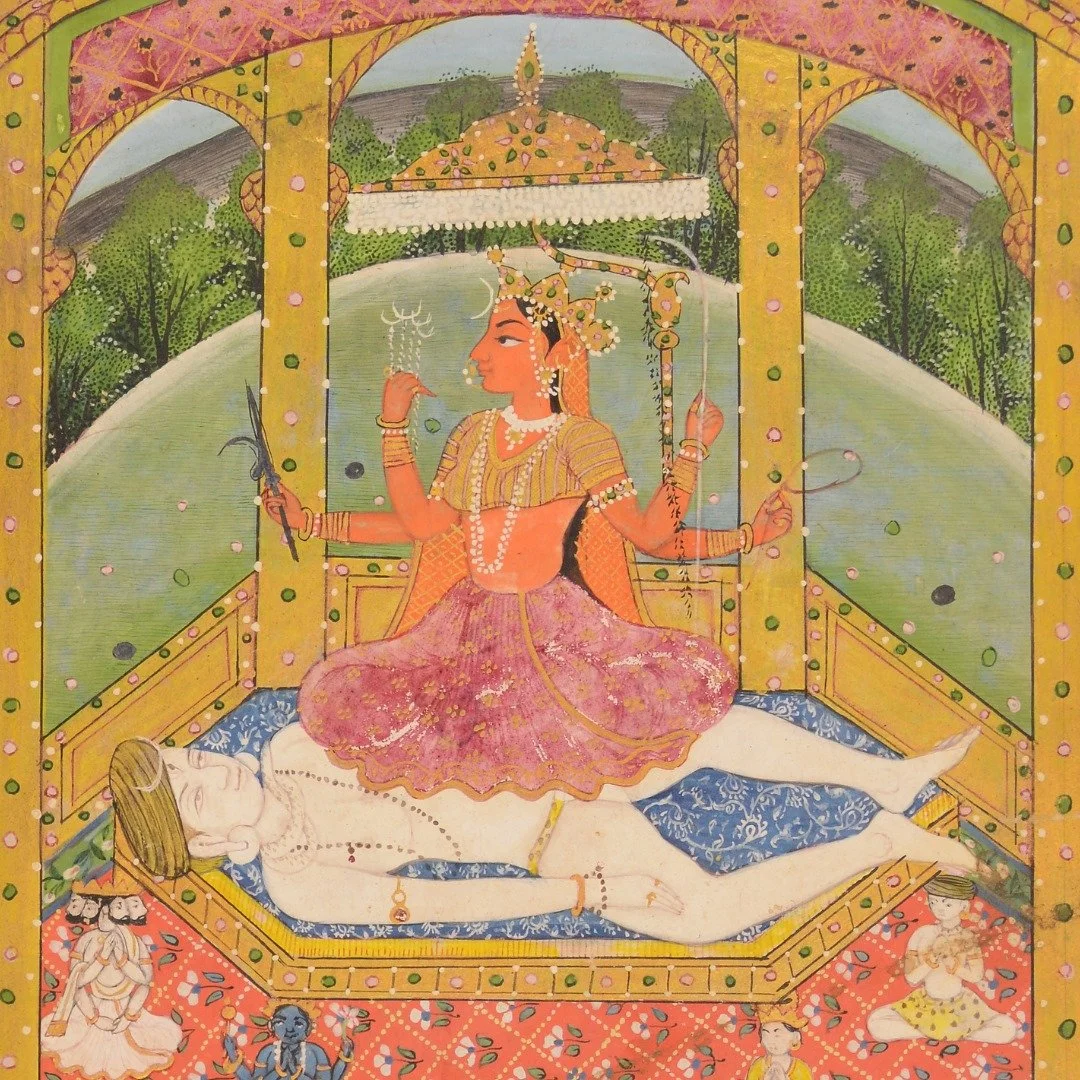
Artwork: Mahāvidyā Tripura Sundarī National Museum, New Delhi 

Lalitā Jayantī commemorates the appearance of the Goddess in her supreme form as Mahāvidyā Tripura Sundarī, the third of the Daśa Mahāvidyās — “Beauty of the Three Cities,” harmonizing the three worlds and the three states of consciousness — who embodies supreme beauty, clarity, and the power of refined discernment. 

This observance honors her as Lalitā (the playful one), Śoḍaśī (ever-perfect youth), Kāmakṣī (she whose gaze bestows grace), and Rājarājeśvarī (the Supreme Empress, sovereign of sovereigns), the radiant fullness of consciousness abiding in effortless grace and wisdom.

All my Relations, Tulsi

Full Moon Timing: 02.01.26 14:09 PST | 02.02.26 3:39 AM IST 

The degree to which a person can grow is directly proportional to the amount of truth he can accept about himself without running away.” 

― Leland Val Van De Wall


Mars in Cancer

Mars in Cancer

April 3rd – June 7th

Artwork: Pinterest

Mars (Maṅgal graha), having retrograded through the Vedic Lunar Mansion of Puṣyā (sidereal Cancer) since December, now retraces its steps, inviting us to revisit the energies and intentions seeded in the closing months of last year. 

This period offers a fresh perspective, with the benefit of hindsight and deeper self-awareness, offering an opportunity to engage those themes more consciously, integrate lessons, recalibrate our intentions, and move forward with greater clarity and purpose.

Maṅgal is allegedly born from the sweat of Lord Śiva during profound tapas (bhūmiputra - born from the earth)—is intimately linked with the Mahāvidyā Bagalāmukhi, the goddess of speech and protection, and is the carrier of Agni Tattva, the fiery principle.

As Deha Kāraka, Maṅgal is the indicator of the body, the heart, and the immune system, as he is the defense system within our bodies. He is the carrier of Agni (fire) tattva, the significator of one-pointed focus (dhāraṇā), the lord of logic, power, preservation, and violence. He represents protection, particularly the protection of the innocent. 

Within Puṣyā nakṣatra, the energy of invocation is potent—awakening our capacity to channel creative and spiritual force, nourishing both worldly and transcendent pursuits. The goat, the animal totem of this nakṣatra, reminds us that what we consume—physically, emotionally, and energetically—must eventually be integrated and digested. This period may compel us to confront the truths of what we have been "taking in," and to discern what truly sustains us.

On May 12th, Mars enters Āśleṣā at the gaṇḍānta, the mystical threshold between water and fire. Ruled by the Nāgas, this nakṣatra weaves together desire and transformation, calling us to patiently untangle karmic knots and refine our art of transmutation. Āśleṣā, the Clinging Star, stirs our curiosity and unites disparate elements, echoing the coiled energy at the base of the spine yearning to merge with its source.

Artowrk: Pinterest

Mars’ extended sojourn in Cancer—a sign of water, emotion, and moksha—invites us to steward our energy with care. The friction between Mars’ fiery drive and Cancer’s watery depths may present as frustration, inertia, or simmering anger. Here, the wisdom of the body becomes paramount: movement, sweat, and mindful exertion (whether through swimming, yoga, martial arts, or sauna) offer pathways to release pent-up energy constructively, fortifying both body and spirit.

As Āyurveda teaches, unchecked anger heats the blood and clouds the mind, swiftly diminishing our intelligence. The challenge and gift of this transit is to transmute reactive heat into the steady warmth of presence and purpose.

Whether you choose to pause here or wish to journey deeper, know that the story of Maṅgala in Cancer continues to unfold—each day offering new opportunities for reflection, resilience, and renewal.

For those who feel called to explore these themes further, join us for our monthly Vidya and Chai gathering on, April 20/21, where we will delve into the ongoing dance of Mars in Cancer and its impact on our inner and outer worlds.

Email me at tulsibagnoli@gmail.com to RSVP

All my Relations

ॐ ह्रीं बगलामुखी देव्यै नमः