Eclipse Season: A Field Guide

Eclipse Season

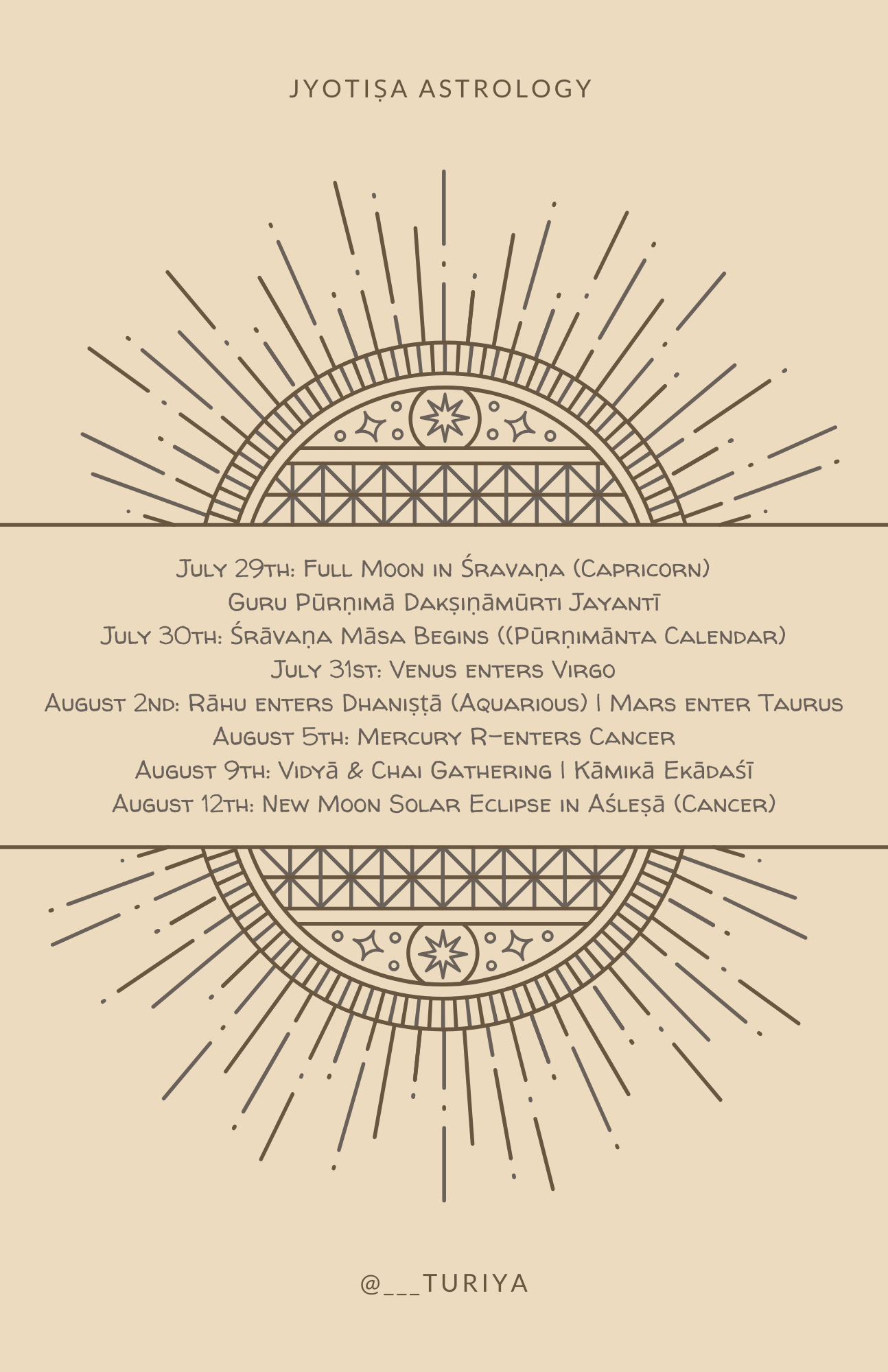
August 12th & 27/28th

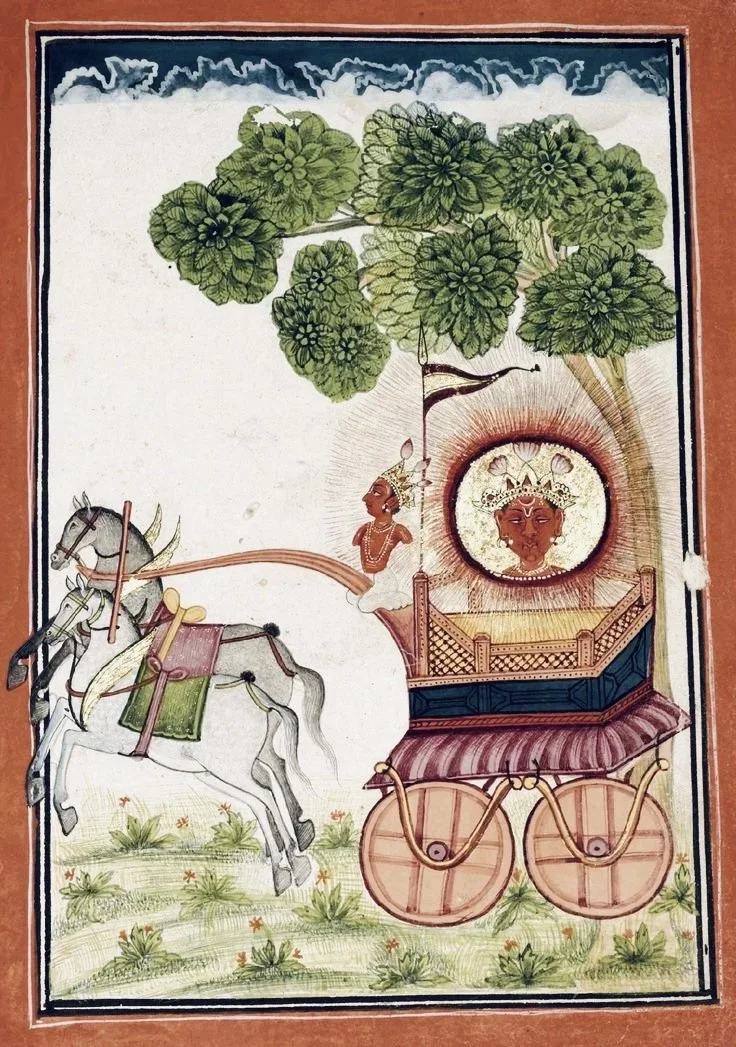
Eclipse season commences on August 12th with the new moon in the Vedic lunar mansion of Aśleṣā (Cancer), the Embracing and Entwining Star. Expect deep alchemical transformation and the surfacing of what has long been hidden.

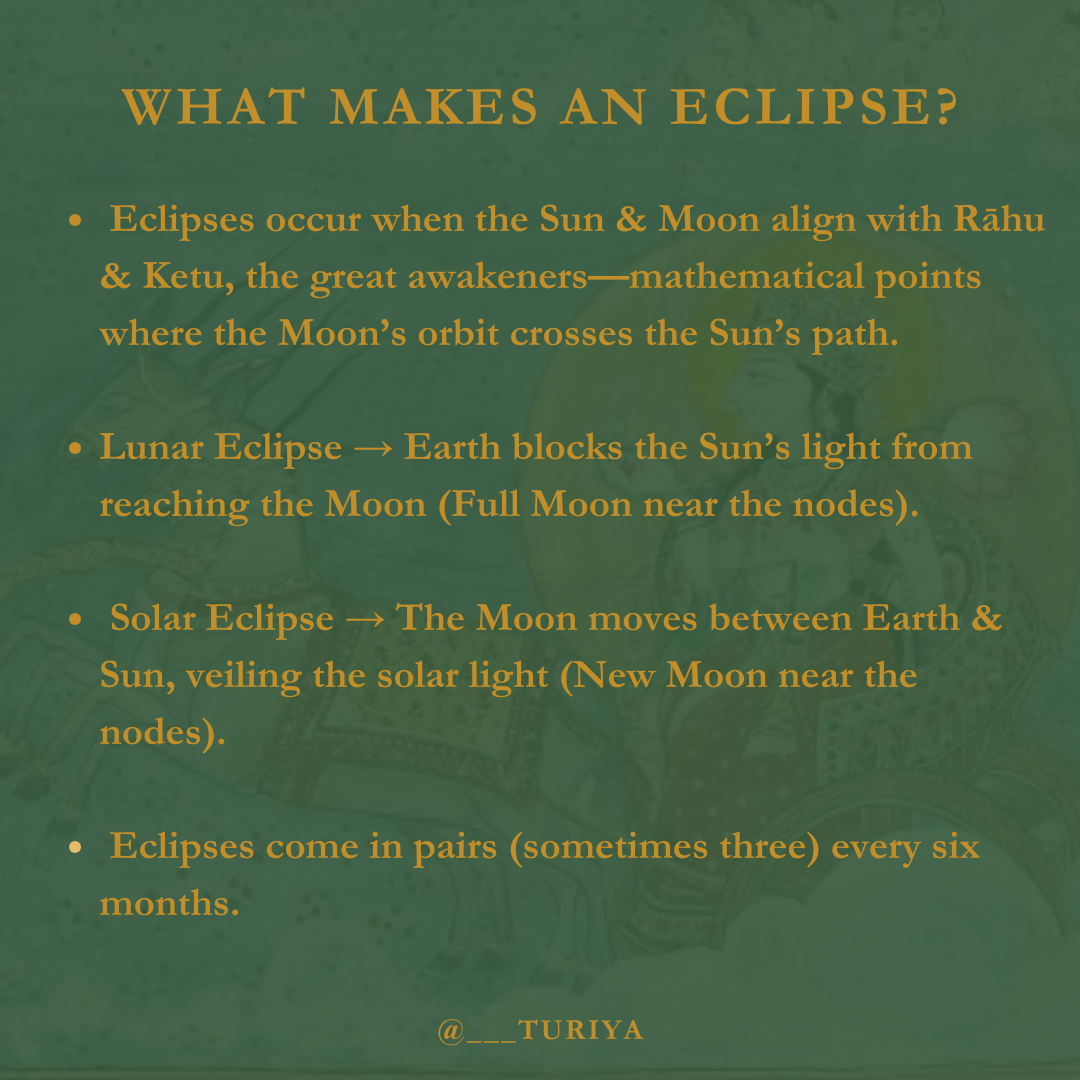
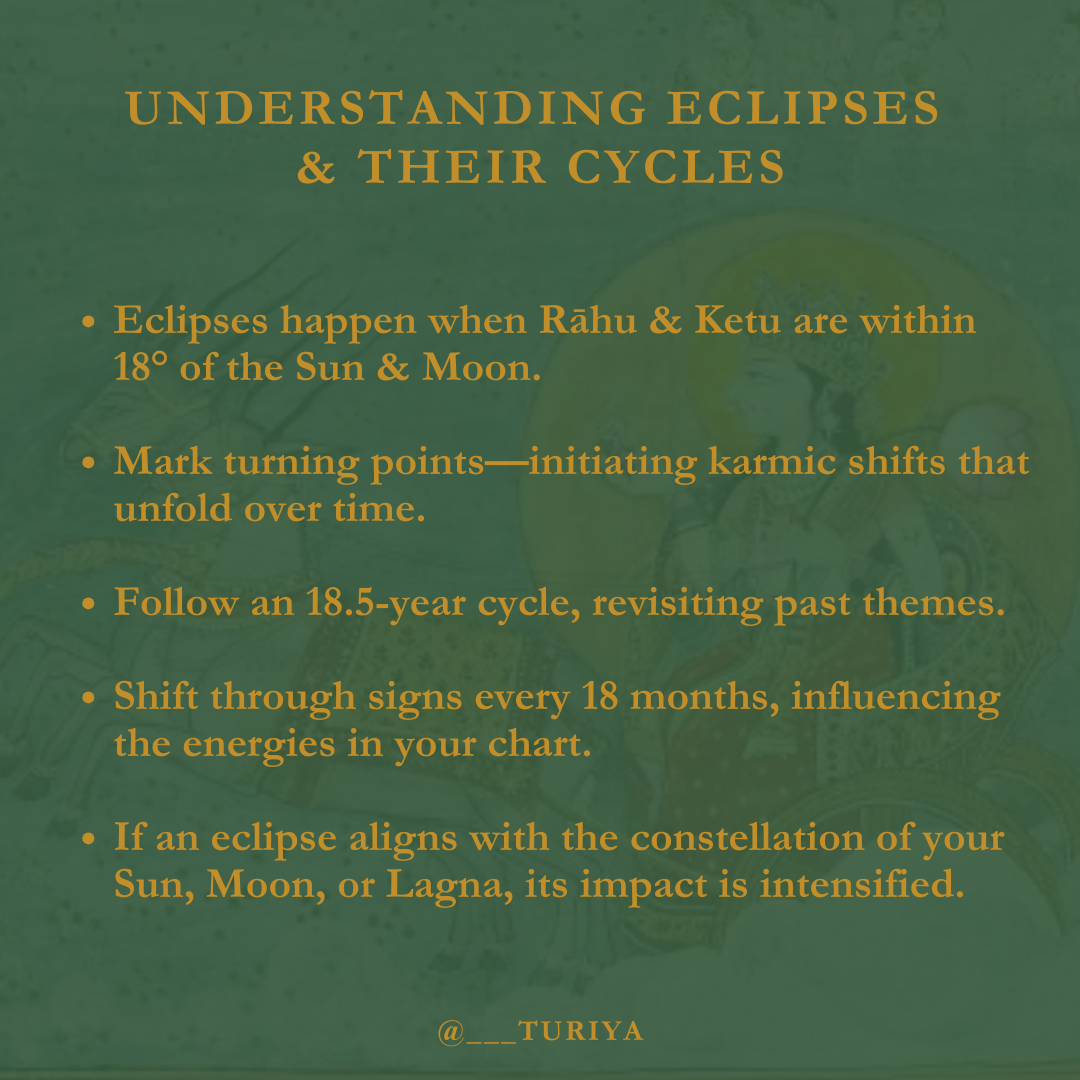
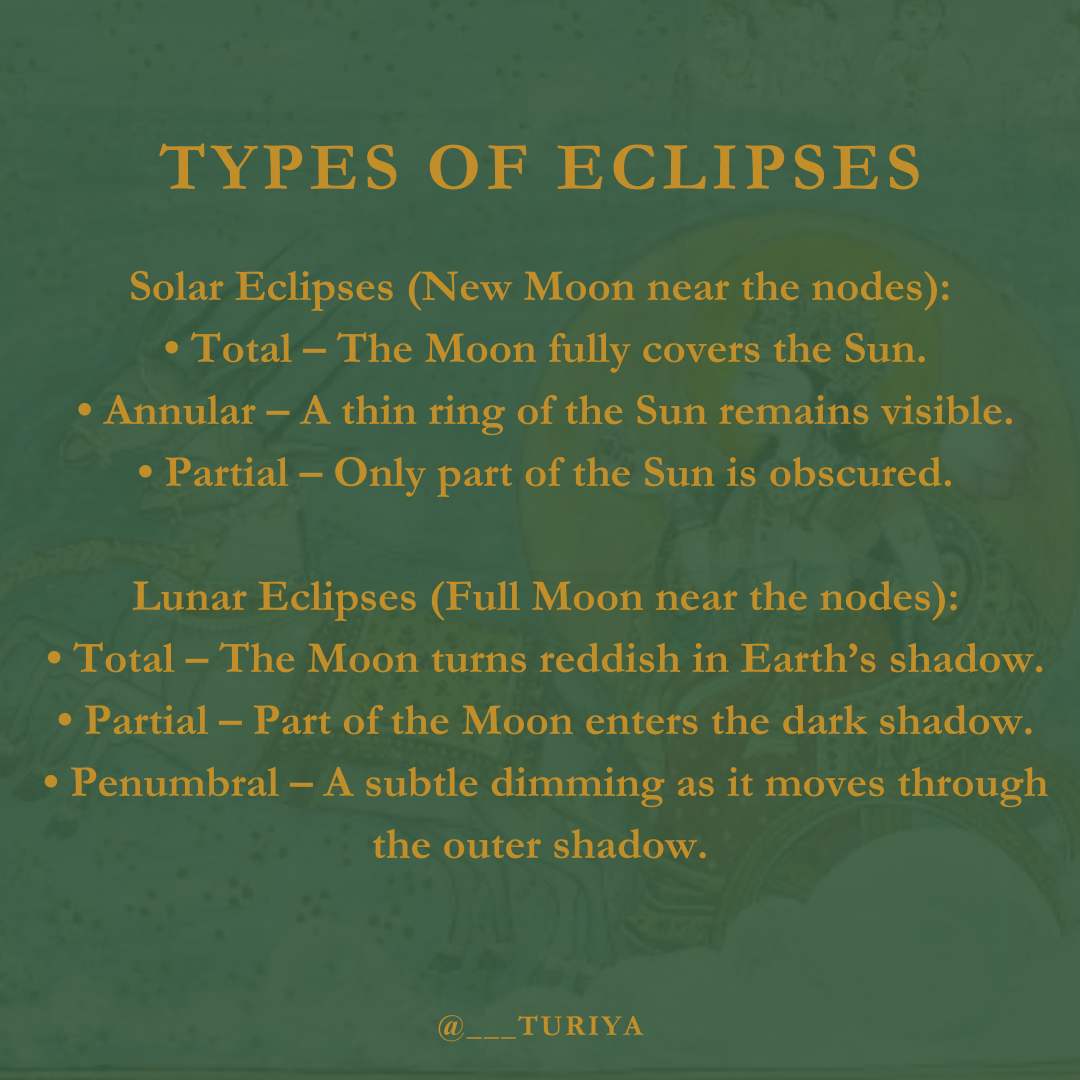
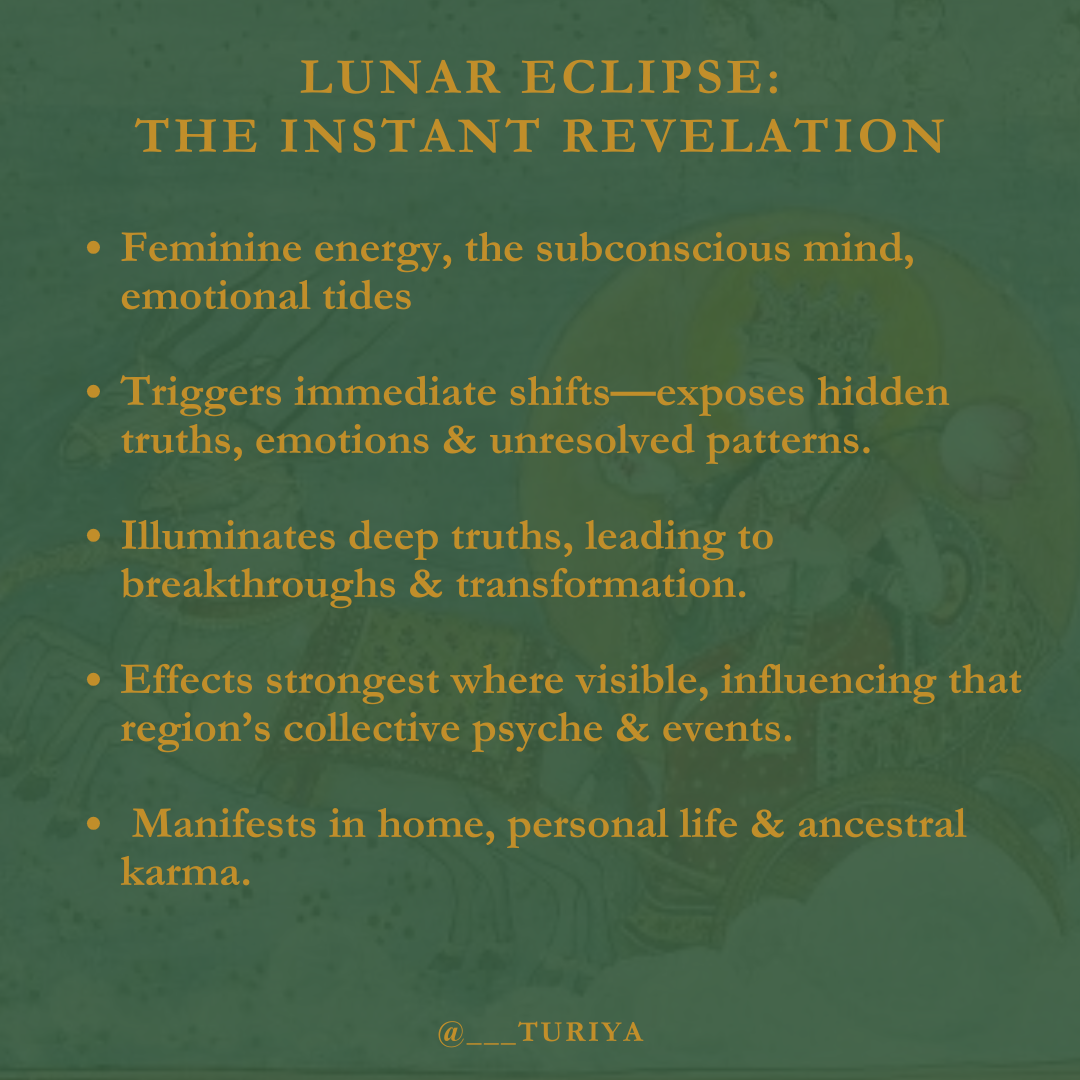
The points where the Sun and Moon intersect the ecliptic plane, positioned exactly 180 degrees apart, are known as the lunar nodes — Rāhu and Ketu in Jyotiṣa. These shadowy grahas, often called the great awakeners, govern eclipses and symbolize the eternal dance between light and darkness. They confront us with what has been concealed, disrupt stagnant patterns, and offer the opportunity to awaken to deeper truths along our journey.

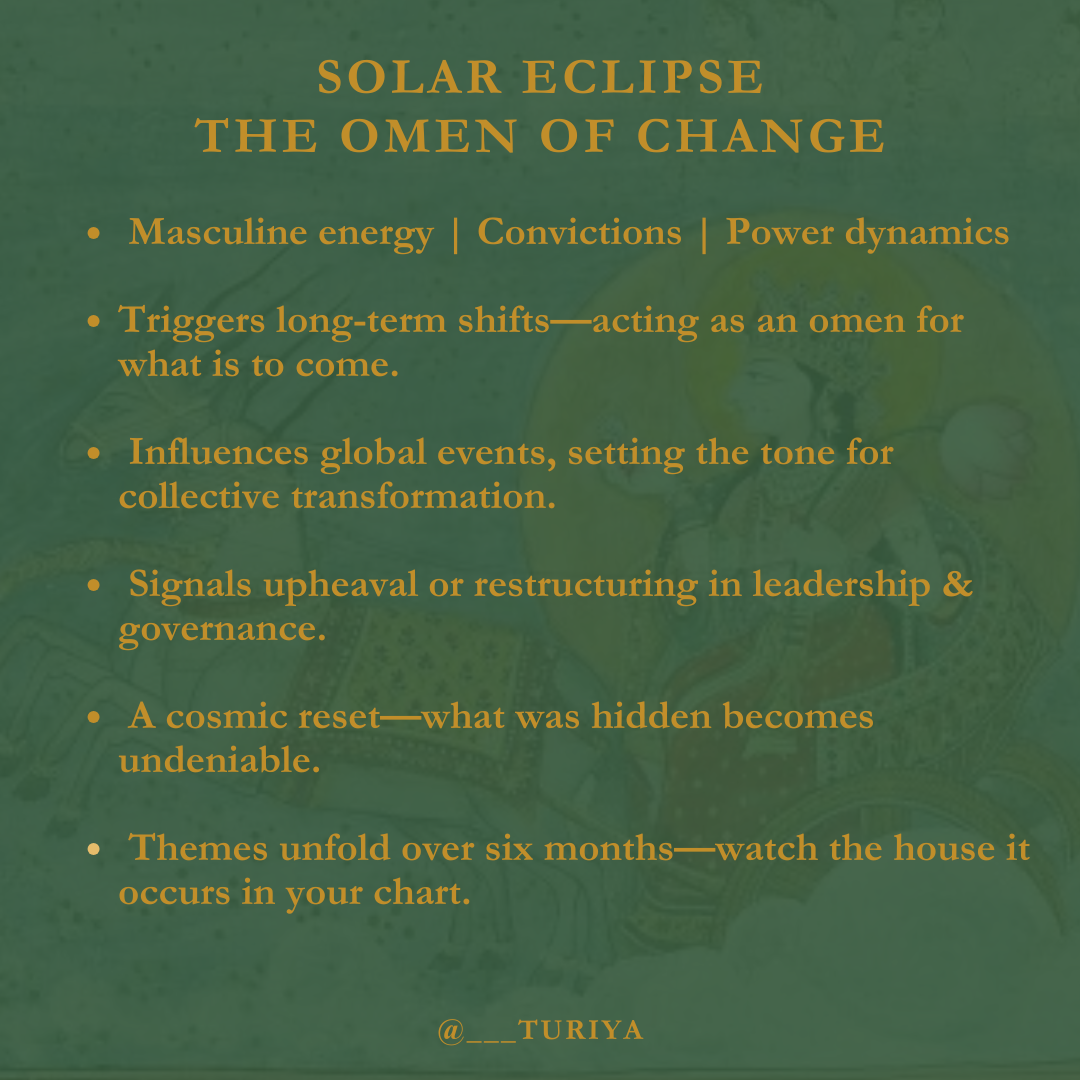
Solar eclipses expose that which has been hidden from view and set the tone as an omen of the energies for the next six months. A spiritual culmination unfolds, signaling transformative endings and the potential for new beginnings — inviting introspection, healing, and the initiation of new creative endeavors. This cycle urges us to refine our inner compass, untangle and release an old karmic pattern.

What is revealed now invites you to reassess and consciously redesign the physical architecture of your life with greater awareness. Accelerated spiritual growth becomes possible when we allow ourselves time to introspect. Some pattern has been attempting to surface for completion and healing. Create space to meet it with steadiness.

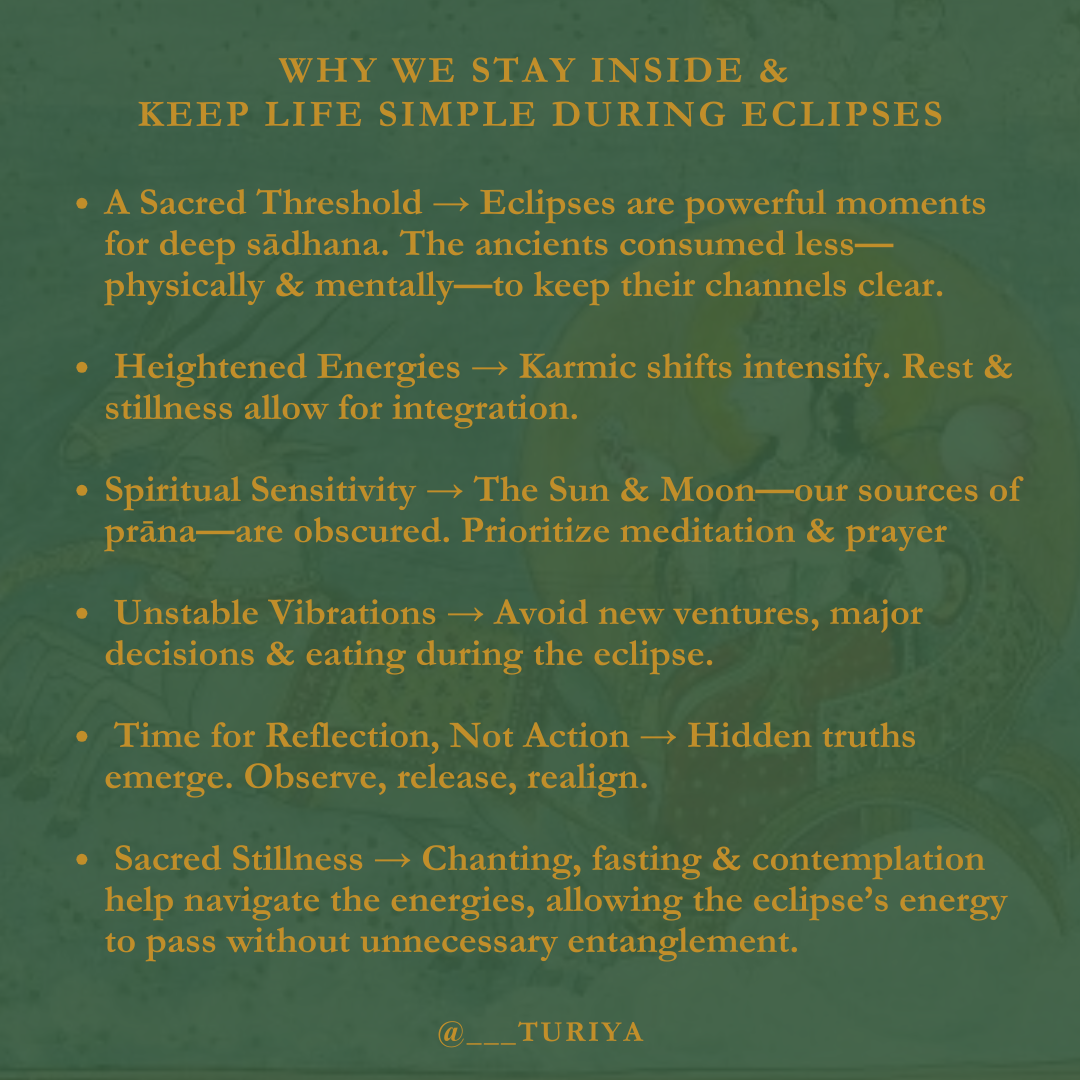
During eclipse windows, for most, it is traditionally advised to postpone major auspicious undertakings such as marriage or business ventures. However, it is an ideal time for sādhanā.

Eclipses stir duality to initiate purification — a necessary process through which self-knowledge is deepened and stabilized. Any turbulence you feel is part of this alchemy.

During this eclipse window, keep life simple. Stay grounded. Rest. Reflect on what is being revealed and what needs untangling.

The ancients taught that any practice undertaken during an eclipse bears fruit a thousandfold. In this sacred window, they consumed less — physically and mentally — to keep their channels clear. With the Sun and Moon — our sources of prāṇa — obscured, this becomes a potent time for:

  • Mantra chanting

  • Meditation & breathwork

  • Prayer & fasting

  • Turning inward, rather than outward

It is also recommended to bathe before and after the eclipse to cleanse both body and mind, allowing for a smoother energetic transition.

Trust that this cycle serves as an initiation, sowing the seeds of transformation that will blossom in divine timing, guiding you into the next phase of your journey.

Pay close attention if you have major planets — your Sun, Moon, or Lagna — in Aśleṣā (Sidereal Cancer). This cycle may bring sudden change, an unanticipated turning point, or the revelation of something deeper within. Also take note if you are currently running a dāśā or antar dāśā of Ketu, Sun, Moon, or Mercury.

All My Relations, Tulsi

ॐ तत्पुरुषाय विद्महे
महादेवाय धीमहि
तन्नो रुद्रः प्रचोदयात् ॥

Om Tatpuruṣāya Vidmahe
Mahādevāya Dhīmahi
Tanno Rudraḥ Prachodayāt ॥

New Moon: New Moon Aśleṣā (Cancer)
August 12th, 00:36am PST | 23:06 PM IST 

Eclipse Timing: August 12/13th
8:34am - 12:57pm PST | 12/13th 21:04 - 1:27AM IST

With the path of totality extending from northern Russia through Greenland and Iceland to northern Spain and northeastern Portugal.

"In order to establish order, disorder has to be shaken; and for shaking to remain under control, we who are at the basis, at the level of Para, have to be Para – that is, unreachable by the surface turmoil. In that integrated state, the fast moving chaos and change will pass away in a steady manner.

So, we have to be very steady. We have to be very careful not to get upset by little or big things. If we lose our basis, our dignity, the phase transition will take much longer.

Don't give importance to things which may upset us. This is a very precious time for the world. Everything depends on how our awareness is; just don't let it be shaken. Our awareness is the basis of all these transformations. More than ever before, time demands we remain completely ourselves. It is a very tender, delicate time for us - we should not become angry, indifferent, or sad; we should just be like an ocean. The evolutionary power is waking up.

We shake it, then leave it; then after some time shake it again. Each time a new level of purity, awakening, is added.”

~ Maharishi Mahesh Yogi
Rāhu enters Dhaniṣṭhā: The Star of Symphony

Rāhu ENTERS Dhaniṣṭhā

Artwork by: Kailesh Raj

August 2nd

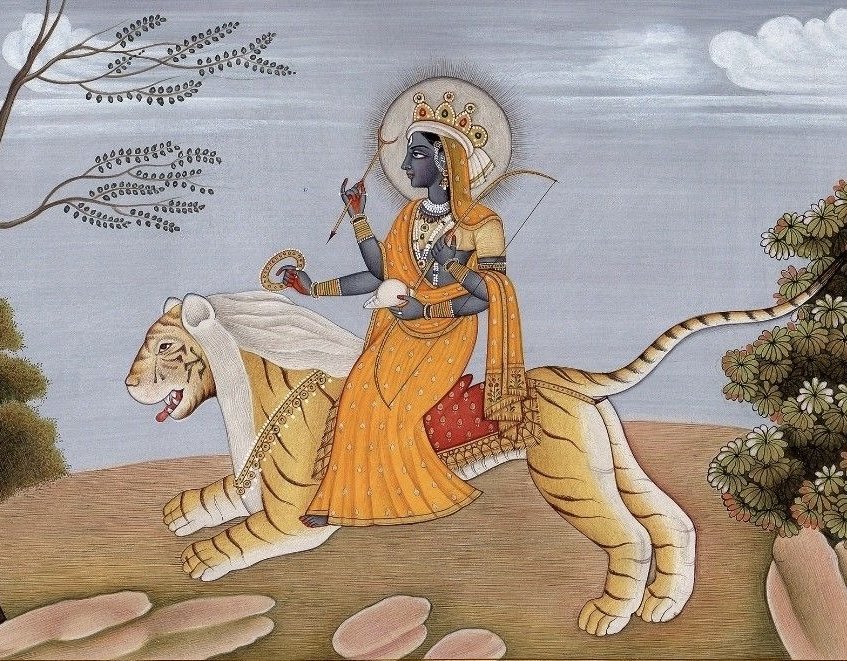
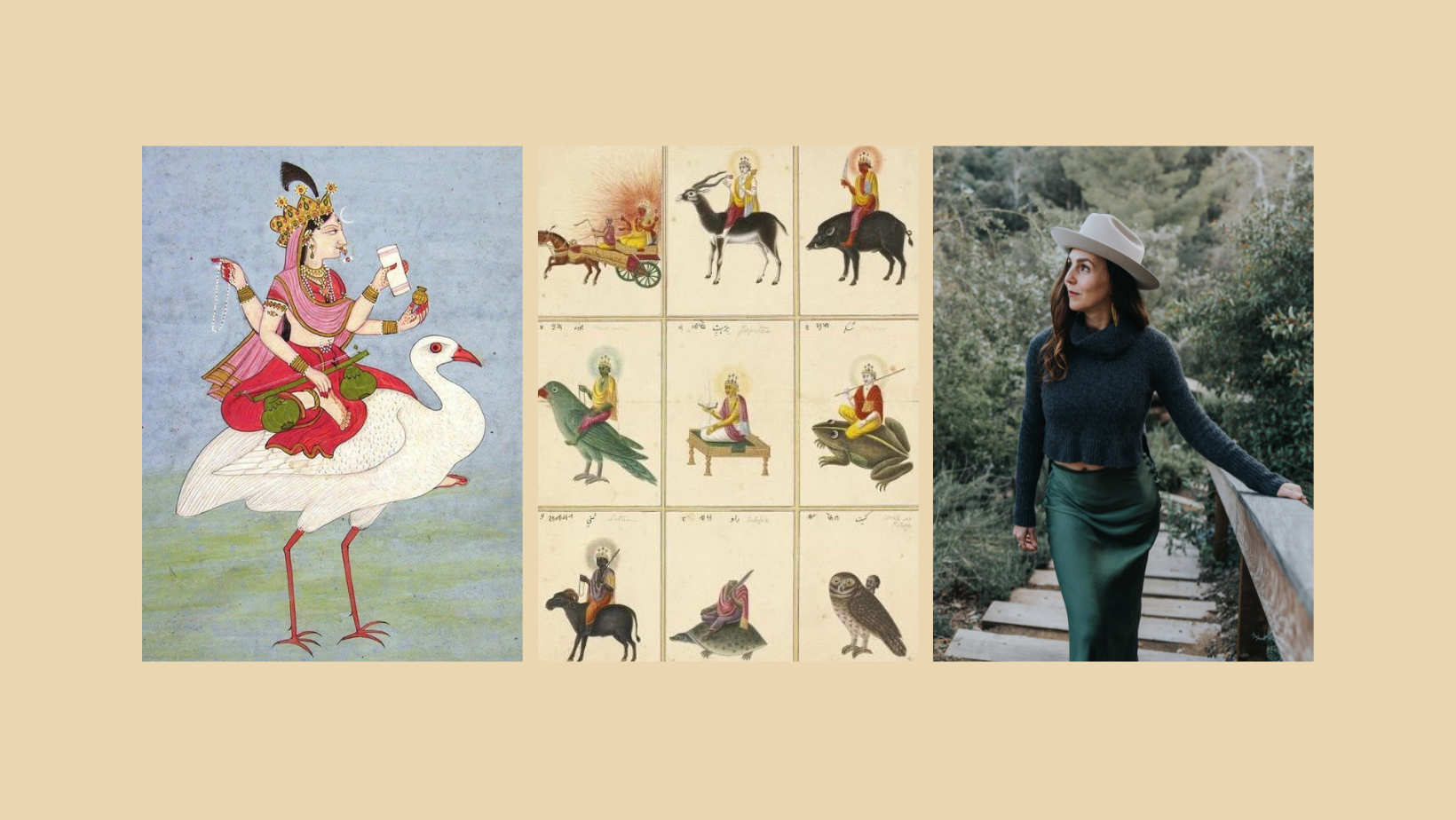
The shadowy graha Rāhu, depicted as mounted on a lion, bluish-black and smoke in color, residing in the forest, eclipser of the luminaries, karaka (significator) of justice, courage, and the mission, often associated with rebellion, the foreigner, and protector of Earth, entered the Vedic Lunar mansion of Dhaniṣṭhā (sidereal Aquarius), the Star of Symphony, on August 2nd.

This same constellation held our last Solar Eclipse, on February 17th, setting the omen and theme for the six-month cycle now drawing to a close: a season of disciplined ambition and the maturation of long-term goals.

Dhaniṣṭhā, zenith of Maṅgala, is traced across the night sky by four luminous stars in Delphinus, arranged in a perfect rhombus, Śiva's ḍamaru poised beneath the canopy of stars.

As the drum of Mahākāla, keeper of time, its beat measures the birth and dissolution of worlds. In the ancient telling, when its cadence shifts, the old order falls away and a new one is born. We are no longer standing at the threshold; we are dancing to a new drummer.

Dhaniṣṭhā lands between Capricorn and Aquarius, both rāśis of Śani. Ruled by the Aṣṭa Vasus, elemental deities of abundance (Vasu meaning "wealth" or "brightness"), it carries Kṣepayitrī Śakti, the power to bestow fame and prosperity. Activated by Maṅgala, it contains his uccha point and, in certain traditions, is remembered as the birth star of both Guru and Budha, born of the churning and friction within Dhaniṣṭhā, which endowed these grahas with its karakas and mastery.

Like the drum itself — hollow, receptive, precisely tuned, neither too tight nor too loose, this affluent asterism teaches that the pulse flows through what is emptied.
When we become a conduit for Source, when we become as a hollow bone, the rhythms of the universe move through us more effortlessly.

As the drum shifts hands and the cadence changes, step into receptivity. Trust in the presence of the Unknown and attune your awareness to the shifting pulse. Act when the rhythm calls.

Rāhu in Dhaniṣṭhā asks us to distinguish between ambition that arises from hunger and ambition that arises from purpose. One exhausts itself chasing recognition. The other becomes an instrument through which something greater is accomplished.

This is only the beginning. On Saturday at our monthly Vidyā & Chai we'll explore Rāhu's passage through Dhaniṣṭhā, the approaching eclipse season, and why this shift marks the opening movement of a much larger karmic cycle.

My course on the Glory of the Nine Grahas begins in a couple weeks.

If you've been curious about how I approach Jyotiṣa, this is a beautiful opportunity to experience the depth of the tradition and the spirit in which I teach.

ॐ रां राहवे नमः

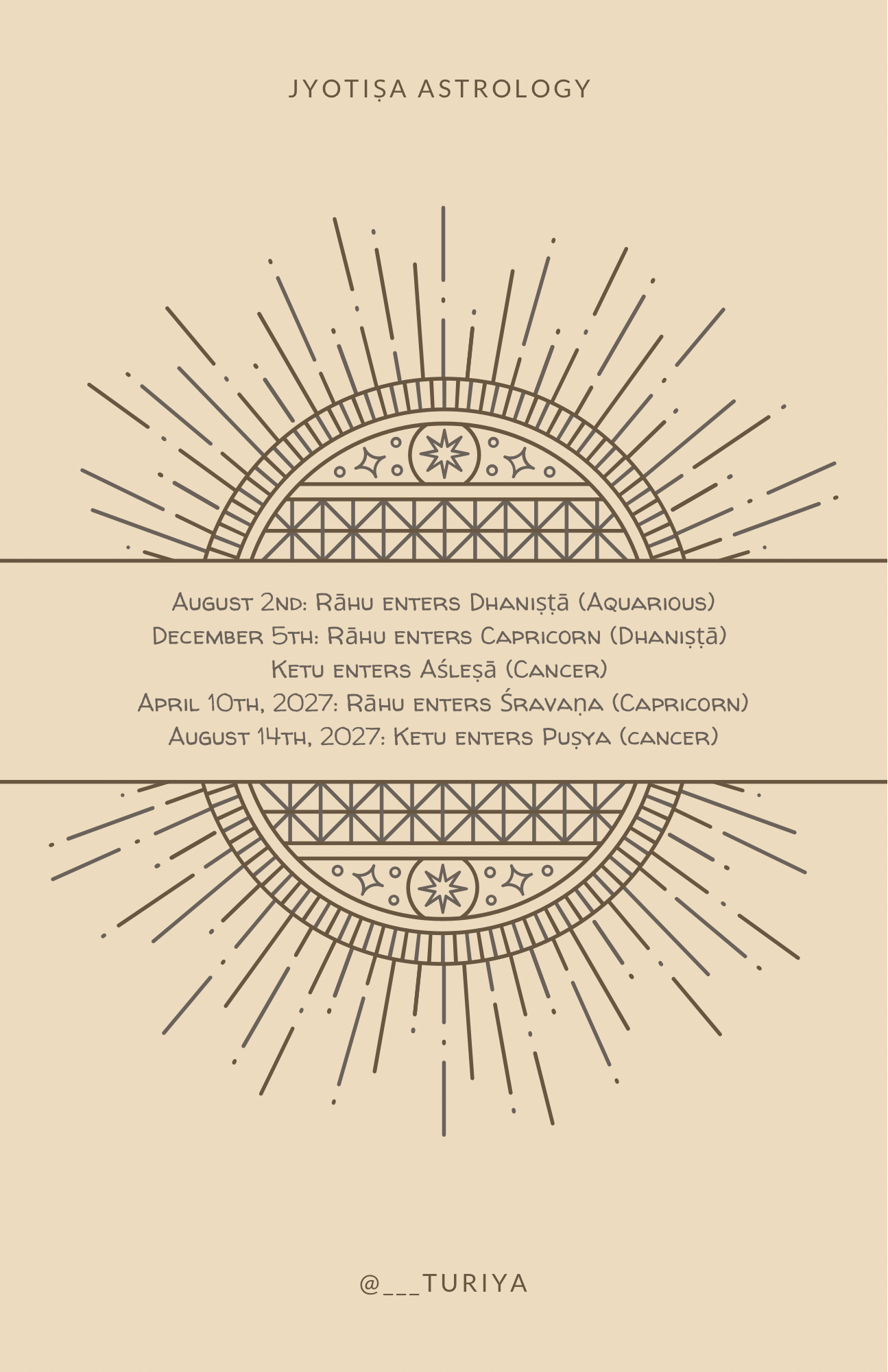
August 2nd: Rāhu enters Dhaniṣṭā (Aquarious)

December 5th: Rāhu enters Capricorn (Dhaniṣṭā) | Ketu enters Aśleṣā (Cancer) 

April 10th, 2027: Rāhu enters Śravaṇa (Capricorn)

August 14th, 2027: Ketu enters Puṣya (cancer)


VIDYĀ & CHAI 🦢 | 08.08

We'll begin with a 20-minute silent meditation (all practices welcome), followed by storytelling that reflects on the energies of the New Moon Solar Eclipse in the constellation of Aśleṣā (Cancer).

We will also open the floor for community sharing and questions. All are welcome.

Saturday, August 8th
7:30 AM PDT | 10:30 AM EDT | 6:30 PM Madrid (Spain) | 8:00 PM IST | 10:30 PM Bali

RSVP to: turiya.vidya@gmail.com


NAVAGRAHA KATHĀ: Glory of the Nine Planets

5-Week Immersion | 2.5 hours each

The Grahas are living intelligences. Through the lens of Viṣṇu's Avatāras, animal yonis, and the vidyā preserved in Itihāsa, Purāṇa, and Yoga Śāstra, we are invited into a deeper relationship with the Grahas, revealing the underlying architecture of our embodied reality.

August 20 – September 17, 2026
6:30–9:00 a.m. Pacific Time (PT) | 3:30–6:00 p.m. Spain (CEST) | 7:00–9:30 p.m. India (IST)

Live via Zoom. Classes will be recorded. Limited enrollment.

Email turiya.vidya@gmail.com to receive registration details.

Full Moon Guru Pūrṇimā in Śravaṇa: The Listening Star

GURU PŪRṆIMĀ IN ŚRAVAṆA

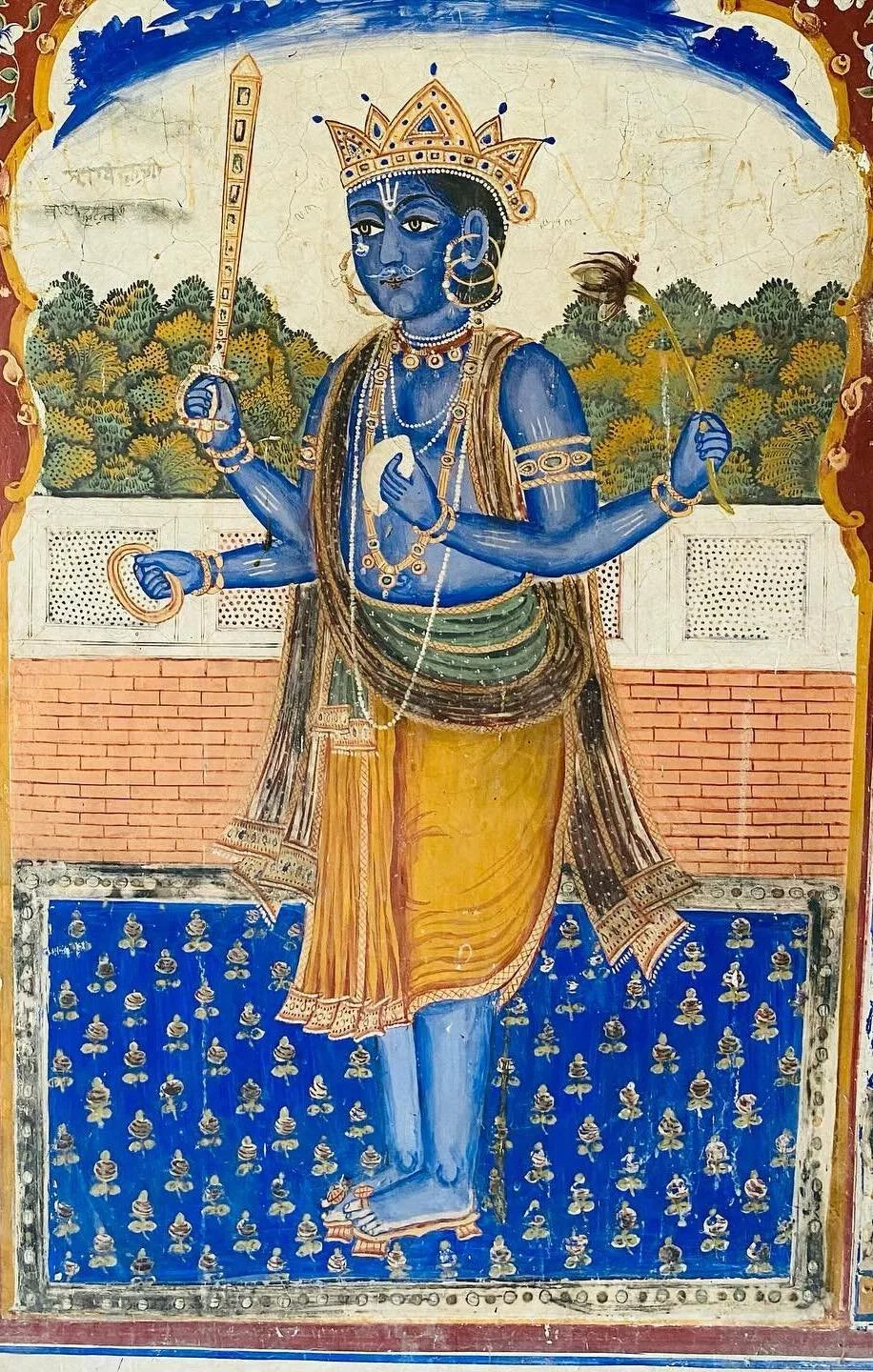
Artwork: Lord Viṣṇu. Located within the samadhi of Sardar Bahadur Lal Singh in Amritsar, India. 1890

07.29
On the Full Moon of Āṣāḍha, we venerate Guru Pūrṇimā, also known as Vyāsa Pūrṇimā. This year the Moon rises in the Vedic lunar mansion of Śravaṇa (Capricorn), The Star of Listening.

Commemorating the appearance of Bhagavān Vedavyāsa, the Maharṣi who compiled the Vedas, composed the Mahābhārata, and preserved the timeless wisdom of the Vedic tradition for humanity. It is a sacred day to honor the Guru Paramparā, the unbroken lineage of teachers through whom this knowledge has been faithfully transmitted across the ages.

Śravaṇa is symbolized by an ear and a row of three uneven footprints, recalling Viṣṇu's Vāmana avatāra measuring the three worlds. It is associated with communication of all kinds, connectivity, learning, language, ancient knowledge, oral traditions, and music. This asterism is ruled by Lord Viṣṇu, who maintains Brahmā's dream and comes to restore balance whenever dharma declines and adharma rises. The name comes from śruti, that which is heard, the sacred sound preserved not through writing but through the ear, teacher to student, across generations.

Guru Pūrṇimā is said to be the brightest full moon of the year, while the Moon in Śravaṇa marks the zenith of lunar energy and sits in the heart of Capricorn, the final earth sign. The ancient Ṛṣis saw its three guiding stars, known today as Altair, Alshain, and Tarazed, as the footsteps of Viṣṇu measuring the heavens.

Before King Bali, Viṣṇu asked for only three steps of land, then spanned the heavens, the earth, and Bali himself, restoring the devas to their rightful place. The demons displaced were never external, they were distraction, excess, and desire that had veiled what mattered most. Śravaṇa asks the same of us now: release what has taken the seat of your highest priorities, and let dharma return to its rightful place within.

This listening is not only of the ears but of the heart, attuned to the inner voice, intuition, and the words that are never spoken aloud. Śravaṇa carries the śakti Saṃhanana, the power to unite what has scattered into wholeness, awakening our capacity for connection and the emotional duty we hold toward others, offered without expectation of return.

This same Full Moon is also Dakṣiṇāmūrti Jayantī, honoring Śiva in his form as the silent guru, seated beneath the banyan tree, teaching the four sage sons of Brahmā through stillness rather than speech. His wisdom passed not through words but through darśana, the direct transmission of presence, the highest teaching offered in complete silence. Dakṣiṇāmūrti reminds us that the deepest knowledge is never spoken, it is received.

The Guru is not merely an individual, but the living embodiment of Divine Knowledge. In honoring the Guru, we honor the unbroken Guru Paramparā through which the timeless wisdom of the Vedas has flowed from Bhagavān Vedavyāsa through the ages, dispelling the darkness of ignorance and illuminating the Self that has always been present.

गुरुर्ब्रह्मा गुरुर्विष्णुः गुरुर्देवो महेश्वरः।
गुरुः साक्षात् परं ब्रह्म तस्मै श्री गुरवे नमः॥

Saturn Retrogrades in Revatī: The Wealthy Star

SATURN RETROGRADE IN REVATĪ

July 26th - December 10th

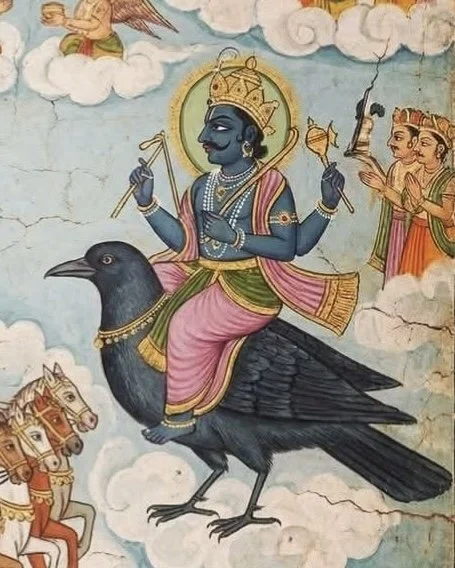
Śani, the venerable son of Sūrya Dev and his shadowy consort Chāyā, is often depicted as a dark figure seated upon a crow. He is the planet of restraint and duty, measured and deliberate, the giver of responsibility and longevity (Āyuṣkāraka).

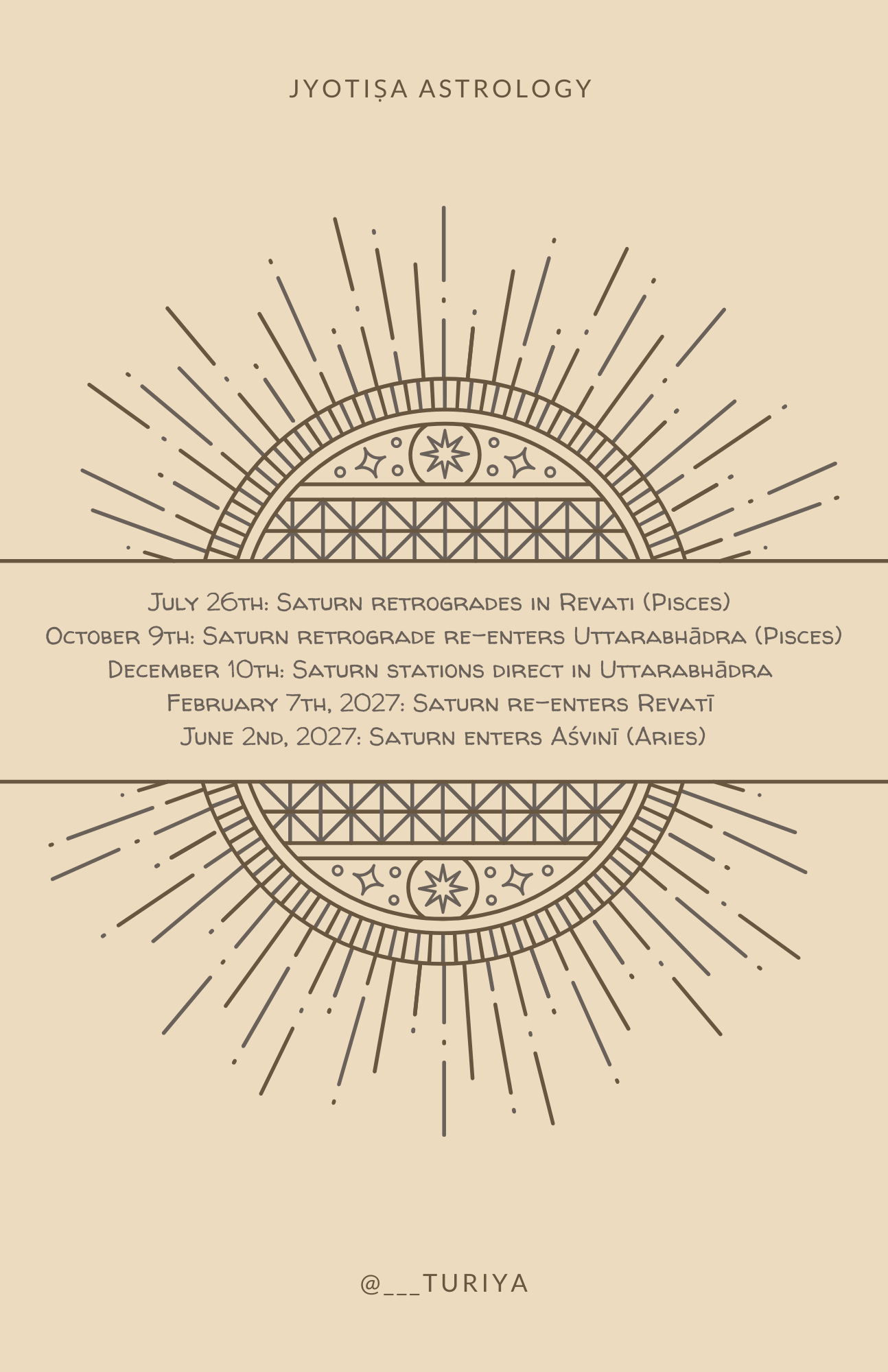
From July 26th to December 10th, Saturn turns retrograde (vakrī) in the Vedic lunar mansion Revatī (Pisces), the Wealthy Star, his own janma-nakṣatra. Revatī is the final nakṣatra, the last waters of the zodiac, a transit that deepens the call toward completion, discernment, and the releasing of what no longer belongs to the path ahead.

Retrograde planets are said to increase in power, drawing their influence inward, where lasting transformation begins, a strength classical astrology calls Ceṣṭā Bala. Śani's return to his birth star beckons a season of karmic refinement, reassessment, and renewal.

Revatī is governed by Pūṣan, divine nourisher and protector of all who wander, carrying the śakti Kṣīradyāpana, the power to nourish and sustain until fulfillment. Before new life can be sustained, what has run its course must first be completed. This retrograde asks us to revisit unfinished responsibilities, close long-standing chapters, and cultivate only what has the strength to endure.

This retrograde also arrives within Chaturmāsya, the four months when Lord Viṣṇu is said to rest, and the pairing is fitting: two great forces of the sky now ask for stillness rather than motion. Use this season to finish what's unfinished and deepen your practice, not to launch what's new.

Revatī is the threshold between worlds, the final breath before one cycle gives way to the next. It governs endings, departures, and the passage from one state of being into another. Old matters seek resolution; hidden truths surface. Saturn asks that every ending be met with maturity and discernment.

Counted among the Ādityas, his very name comes from puṣ, to nourish, so his role as nourisher is not just poetic, it's etymological. Pūṣan also guards the crossroads, the meeting point of paths, fitting for Revatī's own threshold between worlds. In the Ṛg Veda he is invoked to find what is lost, stray cattle, wealth, the way home, which is why hidden truths surface and old matters seek resolution under his watch.

Pūṣan never abandons the traveler. He protects those on uncertain roads and leads both the living and the departed toward their destined arrival. This is Revatī's quiet promise: the waters may be unfamiliar, but sincere effort is never without destination. Trust the slow unfolding, nourish what is worthy of enduring, and let Saturn carry you toward the chapter waiting to begin.

ॐ शनि शनैश्चराय नमः। 

Transit Dates:

July 26th: Saturn retrogrades in Revati (Pisces) 

October 9th: Saturn retrograde re-enters Uttarabhādra (Pisces)

December 10th: Saturn stations direct in Uttarabhādra 

February 7th, 2027: Saturn re-enters Revatī 

June 2nd, 2027: Saturn enters Aśvinī (Aries)