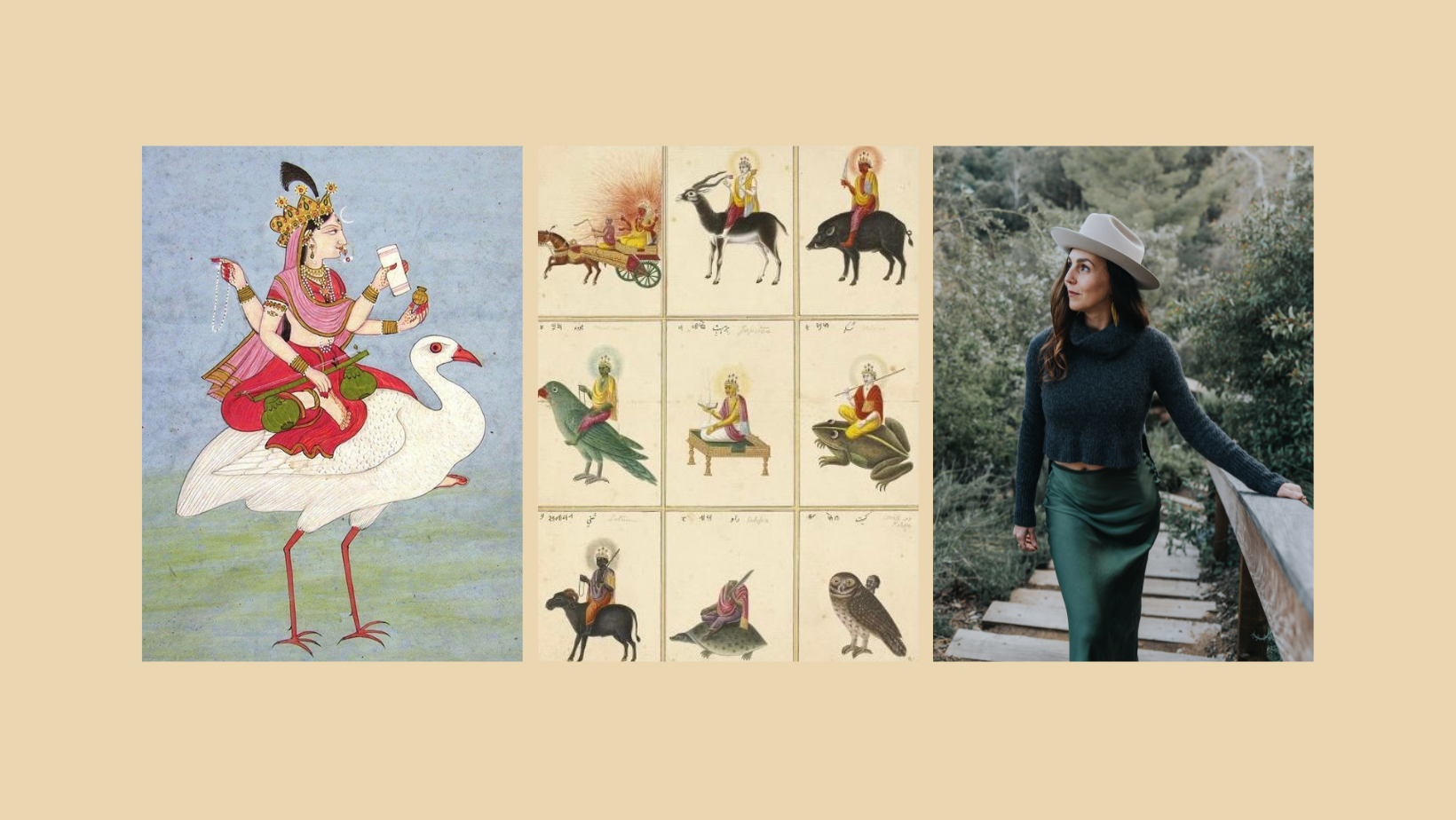
Rāhu / Ketu Transit – Aquarius / Leo

Navigating Aquarius and Leo: Rāhu and Ketu's New 18-Month Cycle

Artwork: Ayush Kejriwal

May 19, 2025 – December 5, 2026

Shadow Forces at the Threshold

In the subtle architecture of destiny, not all thresholds are lit by stars—some are cast in shadow. Rāhu and Ketu, the lunar nodes, are such thresholds: unseen forces that awaken, dismantle, and initiate. They do not emit light, yet their influence reshapes the sky within.

The jyotiṣa narrative shifts as the nodes complete their backward journey from the Pisces–Virgo axis into Aquarius–Leo. This new cycle, initiated on May 19 (true node shift on May 29), will reverberate through the end of 2026.

Sovereignty and Service

This is the axis of sovereignty and service—Leo illuminates the light of the self, while Aquarius holds the vision for the collective. One radiates from the heart; the other disperses through the field. The invitation is not to choose between them, but to consecrate their union.

Mechanics of the Nodes

Unlike the visible grahas, Rāhu and Ketu are chāyā-grahas—shadow planets formed by the intersection of the Sun and Moon’s paths along the ecliptic. Ever retrograde and 180 degrees apart, they govern eclipses and set the karmic tone of each 18-month cycle, shaping the undercurrent of the six-month intervals between eclipses.

Known as the great awakeners, they mark the dance between light and shadow—disrupting patterns, awakening deeper truths, and exerting particular influence when transiting one’s Lagna or Moon Nakṣatra (constellation).

Echoes of the Past: 2005–2007

Artowrk: Pinterest

Let us return to the last time Rāhu and Ketu moved through the Kumbha–Siṃha axis: 2005 to 2007. It was a period shaped by the tension between personal sovereignty and collective belonging—between the need to stand apart, and the yearning to find one’s place within a greater whole. 

Rāhu in Kumbha stirred the impulse to question systems and seek new forms, while Ketu in Siṃha quietly loosened the grip of self-importance, revealing where identity had been entangled with status or validation. As one of the co-rulers of Kumbha, alongside Śani, Rāhu moves through this sign with a certain authority—its drive to rupture, innovate, and unbind finds natural expression here. For many, it was a time of inward reorientation—of discerning what it truly means to offer oneself without needing to be seen.

Timing Matters: Mean and True Node Gap

In that cycle, the difference between the mean and true node transitions was pronounced. The mean node entered Kumbha in November 2005, while the true node did not follow until March 2006—resulting in a gap of nearly four months.

This delay was due to greater oscillation in the Moon’s nodal path at the time, which caused the true node to temporarily move direct or hover near the sign boundary. In contrast, the 2025 transit is far more aligned: the mean node enters Kumbha on May 9, 2025, and the true node follows just ten days later on May 19. The shorter gap reflects minimal oscillation in the nodal path during this period, resulting in a more immediate and unified shift.

This convergence in 2025 holds deeper significance for Jyotiṣa interpretation:

While the true node reflects the Moon’s exact astronomical path, including its erratic oscillations, the mean node offers a steady, symbolically coherent trajectory through the zodiac. During periods of minimal oscillation—such as the 2025 transit—the closeness between mean and true nodes lends further support to the mean node’s use in timing and interpretation. Many Jyotiṣa practitioners favor the mean node for its predictive consistency and alignment with the symbolic essence of Rāhu and Ketu as karmic forces that operate beyond the visible realm.

In traditional South Indian lineages, the mean node remains the standard—a practice that reflects its longstanding alignment with the metaphysical dimension of Jyotisa rather than only astronomical precision.

Clean Threshold, Swift Delivery

Most discussions of Rāhu and Ketu focus on their symbolism, yet their movement itself tells us something. In 2005–2006, the true node lagged nearly four months behind the mean, creating a prolonged liminal space. The karmic axis had shifted—yet hadn’t. This delay, subtle as it was, mirrored a period of energetic diffusion: slower integration, ambiguous thresholds, and karmic delivery that unfolded in layers.

In contrast, the 2025 shift occurs with near exactness. The true and mean nodes enter Kumbha–Siṃha just ten days apart. When the nodes move with precision, karma tends to deliver without pause. There is less wavering at the threshold, and the cycle begins cleanly. Have you been noticing a quickening? A sense that movement has already begun—subtle shifts, sudden truths, old patterns unraveling without ceremony. The timing may be astronomical, but the delivery is already in motion.

First full eclipse season in the Aquarius / Leo Axis:

  • Sept 7th: Total Lunar Eclipse 13:09pm CT (full moon) Pūrva Bhādrapadā

  • Sept 21st: Partial Lunar Eclipse 14:55 CT (new moon) UttaraphalgunĪ

Mythic Origins

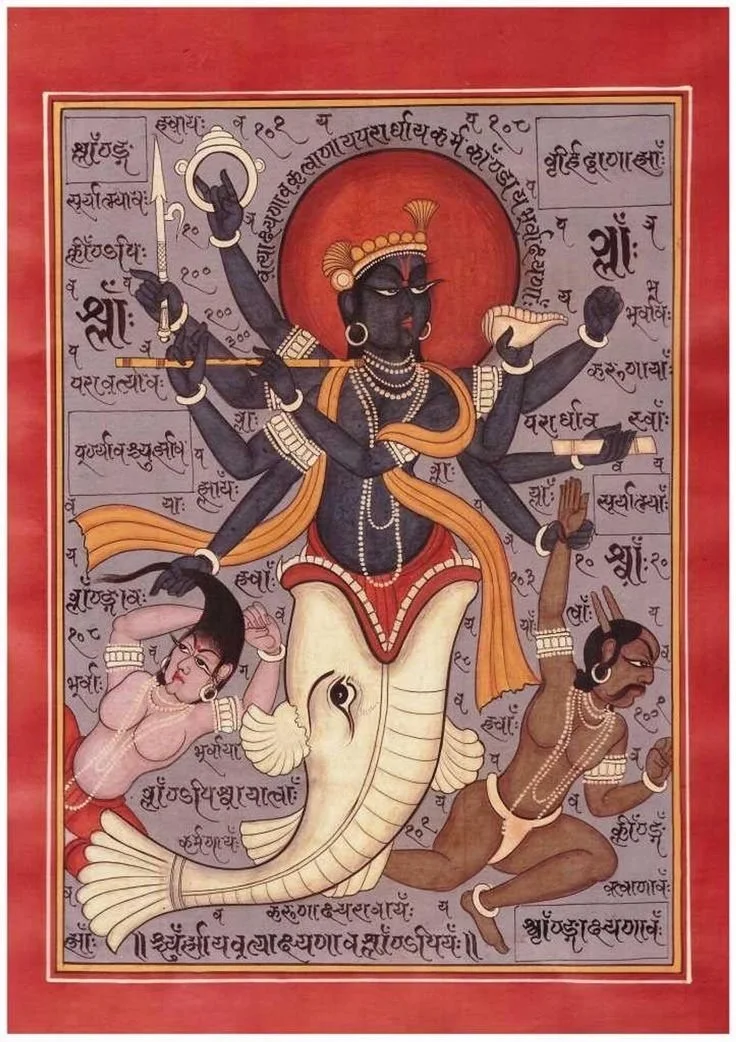
According to ancient Vedic mythology, Rāhu and Ketu were born during the churning of the cosmic ocean (Samudra Manthana). The devas, with Viṣṇu’s help, plotted to keep the nectar of immortality (amṛtṭa) for themselves. In response, the asura Svarbhānu disguised himself as a deva and slipped into their ranks. Just as he drank the nectar, the Sun and Moon exposed him. Viṣṇu beheaded him with his Sudarsana Chakra.

The drop of nectar had already passed his throat, making him immortal. His severed head became known as Rāhu, the immortal head; his body became Ketu, the headless body. Feeling betrayed by the luminaries, the nodes are said to chase and devour them again and again—causing eclipses (grahaṇa) that continue to fascinate and unsettle us to this day.

The Hero’s Journey: Varāha and Matsya

To understand Rāhu graha a little more, we can look to the narrative of the hero’s journey and to the life of Varāha Avatār, the third incarnation of Lord Viṣṇu, the wild boar. Varāha Dev story narrates how Viṣṇu came to rescue Bhūdevī (Earth) and restore her to her rightful place in the universe.

Rāhu is the karaka for justice, courage, truth, self-sacrifice, renovation, risking one’s life for a cause, going against the established order, the foreigner, and the protector of the Earth. As the immortal head, Rāhu is the head of everything. With his tusks, Varāha is said to have the ability to dig up any impurities in the heart.

Ketu Graha is reflected in the veiled presence of ŚrĪ Matsya, the first avatāra of Viṣṇu—the fish who guides the sage Manu through the great deluge (pralaya). When he first appears to King Satyavrata, pleading for protection from the larger creatures of the sea, it signals a dissolution already underway. As creation gets out of hand, Matsya carries forward only a small volume of the Earth’s population—preserving what must endure, while the rest is surrendered.

Ketu is the karaka of mokṣa and the genetic code—what sets one apart, like the royal class. He is the writer, the one behind the scenes, the backdrop. Karaka of the ṛṣis, omens, sūkṣma indriyas (subtle senses), extremity, religious fanatics, blind faith, mystery, secrets, coding, and reduction. He is the reducer, the one that clears the field, cuts the thread, and clears out your closet. Mahākāya—he expands something only to get it out of the way. Like Matsya, he does not engage in violence.

Upcoming Transits

Rāhu (Mean Node)

  • Currently in: Pūrvabhādrapadā (Aquarius)

  • Entering Shatabhiṣak: November 22, 2025

  • Entering Dhaniṣṭhā: June 30, 2026
    Even though Rāhu has entered Kumbha (Aquarius rāśi) on May 19, 2025, it's still transiting within the earlier Pūrvabhādrapadā Nakṣatra, which spans the end of Mīna and the beginning of Kumbha. This is why, despite the rāśi shift, the Nakṣatra hasn't changed yet.

    Rāhu in Pūrvabhādrapadā intensifies the fire of transformation. Known for its scorching, untamed energy (pari), this star initiates deep internal alchemy through tapas—discipline, vision, and inner combustion. It is a place of conscious rebirth. Under Rāhu’s influence, the latent fire of Pūrvabhādrapadā becomes insatiable, requiring full devotion to one’s goals and the courage to burn through illusion. What is not aligned will not survive the heat.
Artwork: Pinterest

Ketu (Mean Node)

  • Currently in: Uttaraphalgunī (Leo)

  • Entering Pūrvaphalgunī: July 6, 2025

  • Entering Maghā: April 20, 2026

Ketu in Uttaraphalgunī draws attention to the unseen threads within relationships, contracts, and sacred service. This is the star of patronage—where prosperity flows through bonds rooted in integrity, hospitality, and selfless offering. With Ketu here, the outer structures may dissolve, but the deeper intent behind partnership is revealed. 

Artwork: Pinterest

It's a time to refine the purity of our commitments, honor agreements, and serve from the heart without attachment to recognition or reward. True wealth arises through inner alignment and grace-bearing acts.

May this cycle of shadows illuminate what is essential. May what is ready to dissolve be released with grace. And may the unseen forces guide you inward—toward your own becoming.

All My Relations, Tulsi

ॐ रां राहवे नमः । ॐ कें केतवे नमः
Rahu into Pūrvabhādrapadā: The Scorching Star

Rahu in Pūrvabhādrapadā

Artwork: Pinterest

March 16 — November 23rd

The chāyā (shadowy) graha Rāhu, depicted as mounted on a lion, bluish-black and smoke in color, residing in the forest, the renovator and eclipser of the luminaries, enters the Vedic Lunar Mansion of Pūrva Bhādrapadā पूर्वभाद्रपदा (Pisces), the Scorching Star, on March 16th.

To understand Rāhu graha a little more, we can look to the narrative of the hero’s journey and to the life of Varāha Avatār, the third incarnation of the daśāvatār of Lord Viṣṇu (the preserver and protector), the wild boar. Varāha Dev is one of the four full Paramātmās whose story narrates how Lord Viṣṇu came to rescue Bhūdevī (Pṛthvī), Earth, and restore her to her rightful place in the universe.

Rāhu is the karaka (significator) for justice, courage, truth, self-sacrifice, renovation, risking one’s life for a cause, going against the established order, the foreigner, and the protector of the Earth. With his tusks, Varāha is said to have the ability to dig up any impurities in the heart.

Pūrva Bhādrapadā is symbolized by metamorphosis, rebirth, tapas (penance), perseverance, and the undifferentiated fire energy that has the capacity to raise our consciousness. This constellation, being one of the birth stars of Mercury, represents the chaos and turmoil of fragmentation that births the wisdom of neutrality.

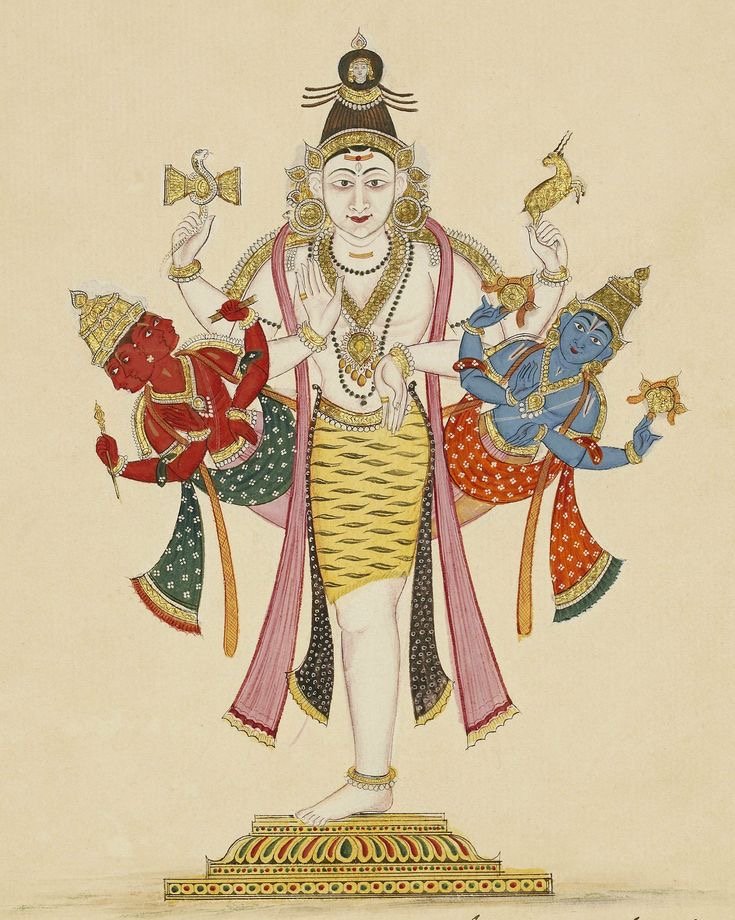
The Burning Pair’s deity (Aja Ekapāda) stands on one leg and has two heads—split yet able to see in both directions. Pūrva Bhādrapadā seeks to bridge heaven and earth, possessing the power to elevate and sacrifice (Yajamana Udyamana Śakti)

Pūrvabhādrapadā initiates an alchemical process where discipline and renunciation refine raw potential into awakened wisdom. This nakṣatra does not merely demand confrontation with duality; it invites us into a dance of integration, where material ambition and spiritual transcendence find their rightful place. 

How we manage vast reservoirs of life force energy becomes the defining arc of this cycle, shaping our capacity to channel intensity into focused intention. Yet, the cultivation of inner contentment amidst this dynamic flux is equally vital.

This sacrifice channels energy that can produce and draw down spiritual blessings. Through tapasya (austerity), this energy rises to melt and dissolve the veils obscuring the hidden moon within our minds, showering us with grace.

As Rāhu enters Pūrvabhādrapadā, symbolized by a funeral pyre, we stand at the precipice of transformation, where the purifying fire of Rūdra (fierce form of Śiva) dissolves illusion. While Rāhu’s presence here may manifest through sudden and unpredictable karma-phala (fruits of action), it ultimately compels a dismantling of rigid ideologies, allowing limitation to be transmuted into higher understanding.

Artwork: Pinterst

This is a cycle of intensity, yet not one of inevitable destabilization. The presence of Rāhu here is the ascetic who must temper his fire, the revolutionary who must refine his vision. Discernment (Viveka) becomes paramount, guiding us to differentiate between the higher call of dharma and the consuming hunger for dominion—whether material, intellectual, or ideological.

Rāhu amplifies an insatiable drive for knowledge, power, and ultimate truth, compelling us to navigate the razor’s edge of profound revelation and self-mastery. Those attuned to this energy may find themselves positioned at the forefront of social reform, philosophical inquiry, or disciplined spiritual practice.

The challenge—and the opportunity—is to ensure that transformation does not become an all-consuming blaze, but rather a luminous beacon. When tempered with humility, this fire does not devour but illuminates, revealing the path to higher realization and authentic awakening.

Those running a Dasha or sub-period of Jupiter or Rāhu, or with natal planets in Pūrva Bhādrapadā, will feel this transit's transformative energy even more profoundly.

This cycle will be defined by the goals you set for yourself and what you are willing to give away.

In the planetary protection mantras, we invoke Rāhu to protect our tongue.

For those navigating the depths of this transit, I offer one-on-one Vedic Astrology readings—guiding you through its unfolding with clarity and support. You can book here:

ॐ राम राहवे नमः | ॐ वराहाय नमः

All My Relations

Mercury Retrograde in Uttara Bhādrapadā

Mercury Retrograde

March 15th - April 7th

Artwork: Unknown

Budha Graha (Mercury) stations retrograde on March 15th in the Vedic lunar mansion of Uttara Bhādrapadā उत्तरभद्रपदा (sidereal Pisces), the Warrior Star—punctuating a passage of deep reflection, reimagination, and renewal.

Budha (Mercury), fourth among the navagrahas (nine planets), the embodiment of rajo-guṇa (the mode of passion) and pṛthvī tattva (earth element), is revered as the radiant son of Chandra (the Moon), known for his golden eyes and tireless energy. He is also connected to Mahāvidyā Tripura Sundarī, who embodies supreme beauty, clarity, and the power of refined discernment.

Mercury bestows discernment and is the karaka (significator) of intellect, skill, talent, eloquent speech, the nervous system, storytelling, the student, negotiation, and neutrality. Just as Viṣṇu takes birth age after age to reestablish dharma and restore balance, mercury retrograde invites us to return to the center of our wheel

This powerful asterism resides at the heart of the last water sign, in a mokṣa bhāva (house of liberation), ruled by ākāśa tattva (ether element) and Ahirbudhnya (Serpent of the Deep). As the seat of Mahā Lakṣmī, this nakṣatra is deeply connected to the fertility of both earth and sky, dreamtime, the excavation of the unconscious, and the harmonization of universal mind. Here, we are beckoned to uncover hidden wisdom through humility, experience, and self-sacrifice—a śakti that is both transformative and karmic.

With Budha in Uttara Bhādrapadā conjunct Śukra (Venus) and Rāhu, rajo-guṇa is amplified, along with a heightened sense of protection. What is it that you are seeking to protect? A position you have claimed or wish to claim? A sense of personal justice? Or perhaps, your connection to source?

Mahāvidyā Śrī Lalitā Tripurā Sundarī | Kapoor Galleries Inc. wrote: Mandi, style of Sajnu, circa 1810

This transit embodies the dual current of existence, urging us to reconcile the spiritual and material realms. As Mercury retraces its path through the deep waters of Uttara Bhādrapadā, we encounter the mystical serpent—a force that strips away illusion, purges material toxins, and refines perception. This is a time when logic softens into intuition, and clarity arises not through analysis, but through surrender.

It is a period of intellectual purification, where communication is tested and refined—not for speed, but for depth. Unresolved matters from the past—especially those placed on the back burner—may resurface, seeking resolution through contemplation rather than reaction. Through introspection and surrender, the trials of this transit can lead not to confusion, but to spiritual illumination and ultimate liberation.

We are stepping powerfully into a new timeline—go inward to catch the memo of this time. Some karmas are requesting completion, release, and unraveling. How can you return to the center of your wheel and step into greater balance and neutrality?

Pay close attention if you have major planets—your Sūrya (Sun), Chandra (Moon), or Lagna (rising sign)—in Uttara Bhādrapadā, as this cycle may bring a lasting effect, especially with the New Moon Solar Eclipse occurring in this constellation on March 29th. Also, take note if you are currently running a daśā (major planetary period) or antara-daśā (sub-period) of Śani (Saturn).

For a more detailed look at what this means for you personally, I offer one-on-one consultations, which you can book directly at Jyotish Consultations

All My Relations

ॐ श्री मात्रे नमः | ॐ ब्रां ब्रीं ब्रौं सः बुधाय नमः

Venus Retrograde in Uttara Bhādrapadā: The Warrior Star

Venus Retrograde in Uttara Bhādrapadā

Artwork: Pinterest | Edit by @turiyacollection

March 1st - April 11th

Today, Venus retrogrades (vakrī वक्री) in the Vedic lunar mansion of Uttara Bhādrapadā (sidereal Pisces) उत्तरभद्रपदा, the Warrior Star. This mystical asterism is connected to the fertility of both earth and sky, the realm of dreamtime, and the excavation of the unconscious. It harmonizes universal mind, beckoning us to uncover hidden wisdom through humility, experience, and self-sacrifice—an energy that is transformative and karmic.

Śukra Graha, the revered planet of devotion, divine love, justice, restoration, relationships, and virility, is one of the three Jñāna Kārakas (significators of knowledge) and the Kāraka of union (yoga) and transportation.

In this retrograde through Uttara Bhādrapadā, Venus invites us to reflect on our emotional patterns and relationships, urging us to examine whether they align with our highest self. It is a time to reassess, reimagine, and review our connection to love, provisions, creativity, and self-worth.

The retrograde cycle offers us a sacred pause, encouraging us to consider how we might balance our lives by harmonizing the internal and external worlds. As Śukra transits this deeply transformative space, it becomes a moment to ask: Are the connections we are nurturing authentic, or are we simply repeating old patterns from the past?

Guru Śukrācārya, the holder of Sanjīvinī Vidyā, possessed the sacred wisdom to revive the dead. This knowledge aligns with the synodic cycle of Venus, which spans 584 days. Venus follows a rhythm of life, death, and rebirth: it is visible on the eastern horizon at sunrise for 263 days (symbolizing birth), disappears for 50 days (symbolizing death), and reappears as the evening star on the western horizon for another 263 days (resurrection/regeneration), only to disappear again for 8 days before the cycle repeats.

As Venus prepares to relinquish its reign as the evening star, we enter a rite of passage, confronting and healing old shadows and wounds. This transition, known as the inferior conjunction, occurs when Venus passes between the Earth and the Sun, disappearing from view for approximately 8 days. It then reemerges as the morning star, marking a symbolic rebirth.

Venus will be last visible as the evening star on March 19th. After this, it will disappear until March 23rd, when it enters its inferior conjunction and remains invisible for 8 days. The planet will then reappear as the morning star on March 26th. This pivotal transition mirrors the process of death and rebirth, offering us an invitation to reflect on our own cycles of transformation.

Venus follows a distinct rhythm, retrograding every eighteen months as part of an eight-year cycle. Reflecting on the lessons of the last Venus retrograde in 2017, we are invited to revisit themes from that time, particularly concerning relationships, creative projects, and emotional healing. Much like its celestial dance in 2017, this retrograde prompts us to assess whether our relational dynamics and emotional patterns have truly evolved since then.

On February 27th, Mercury entered Pisces, where it is debilitated—a position that can present as confusion, miscommunication, and difficulty maintaining clarity of thought. Adding complexity, Mercury will conjunct Venus retrograde on March 2nd, amplifying the need for introspection in matters of love, communication, and creativity. This alignment calls us to look inward, particularly regarding past relationships and unspoken thoughts that need to be aired or healed.

On March 15th, Mercury will also turn retrograde, amplifying the energies of reflection, review, and rethinking—especially around how we express ourselves emotionally and intellectually. This upcoming Mercury retrograde cycle, lasting until April 4th, will further invite us to slow down, reevaluate communication, and revisit unresolved issues from the past. A more detailed blog post on this will follow soon.

Artwork; Pinterest

Śukrācārya, as the Guru of the Āsuras, was known for his protection of his people. He is also associated with Paraśurāma, the sixth incarnation of Lord Viṣṇu. Paraśurāma's story is among the most violent of the incarnations, as he wielded an axe against the Kṣatriyas (warrior/political class) to rebuild a better society.

Pay close attention to where you draw lines between "your people" and others—and what you are willing to do to obtain and maintain your position or seat. Notice the actions that arise from a sense of injustice, particularly if fueled by vengeance or a desire for retribution.

Śukra's narrative is often linked to blindness or arrogance, reflecting a misalignment between one’s self-perception and the views of others. This can manifest as seeing oneself as either superior or inferior, diverging from reality.

Śukra Graha is the enjoyer—the one who delights in all sensory experiences: music, good company, fine food, mantra, and meditation. Venus imparts wisdom through experience, calling for complete absorption. He is the Samādhi maker, invoking unity with the divine at his highest octave.

This is beautifully exemplified in the story of MahāLakṣmī, who resides in Viṣṇu’s heart, as well as in the lives of saints born with Śukra in Pisces in their charts—embodiments of supreme devotion and the boundless grace of divine love.

As we navigate the deep waters of this transit, the energies associated with Śukra’s karakas will be amplified, requiring thoughtful self-reflection and a container for introspection. Pay close attention if you have major planets, your moon, or your Lagna (rising sign) in Pisces, or if you are currently running a cycle of Venus or Saturn.

This Venus retrograde in Uttara Bhādrapadā invites us to explore the depths of our relationships and creative pursuits, unraveling karmic patterns and allowing us to emerge transformed. Use this time wisely, for it is through wisdom, experience, and self-reflection that we can find clarity and renewal.


All My Relations | ॐ शुं शुक्राय नमः

Brene brown // “Vulnerability is not winning or losing; it's having the courage to show up and be seen when we have no control over the outcome. Vulnerability is not weakness; it's our greatest measure of courage. A lot of cheap seats in the arena are filled with people who never venture onto the floor.”

Venus Retrograde Key Dates and Transitions

  • January 28th: Venus enters Pisces

  • February 1st: Venus enters Uttarabhadrapada (Pisces)

  • March 1/2: Venus Retrogrades in Uttarabhadrapada (Pisces)

  • April 12/13: Venus Stations Direct in Purvabharapada (Pisces)

  • May 31st: Venus enters Aries


These dates mark the transition of Venus from an evening star to a morning star.

  • Last visible as an evening star: March 19, 2025

  • Inferior conjunction (invisible): March 23, 2025

  • First visible as a morning star: March 26, 2025