New Moon Solar Eclipse in Uttaraphalgunī: The Star Of Patronage

SOLAR ECLIPSE

Edit by @___turiya

SOLAR ECLIPSE सूर्य ग्रहण 

Eclipse season culminates with the new moon (amāvásyā) and a partial solar eclipse (Sūrya Grahaṇam) in the Vedic Lunar mansion of Uttaraphalgunī उत्तरफल्गुनी (Virgo), the star of Patronage.

This new moon is also known as Sarvapitṛ Amāvāsyā which concludes Pitṛ Pakṣa (fortnight of the ancestors), also called Mahalaya Amāvāsyā, when oblations can be offered to all ancestors (sarva-pitṛ), especially for those who may have been forgotten or for whom individual śrāddha has not been performed.

Solar eclipses are omens for the energies to come. Track what has been trying to make itself known to you in the past few weeks. They expose what is hidden and set the tone for the next six months. A spiritual culmination unfolds, signaling transformative endings and the potential for new beginnings.

Right now, we’re in a time outside of time, where things aren’t what they seem. 

The eclipse portal has delivered confrontation with the unknown as promised and continues to bring old patterns to the surface for transmutation. Don’t touch what’s coming up.

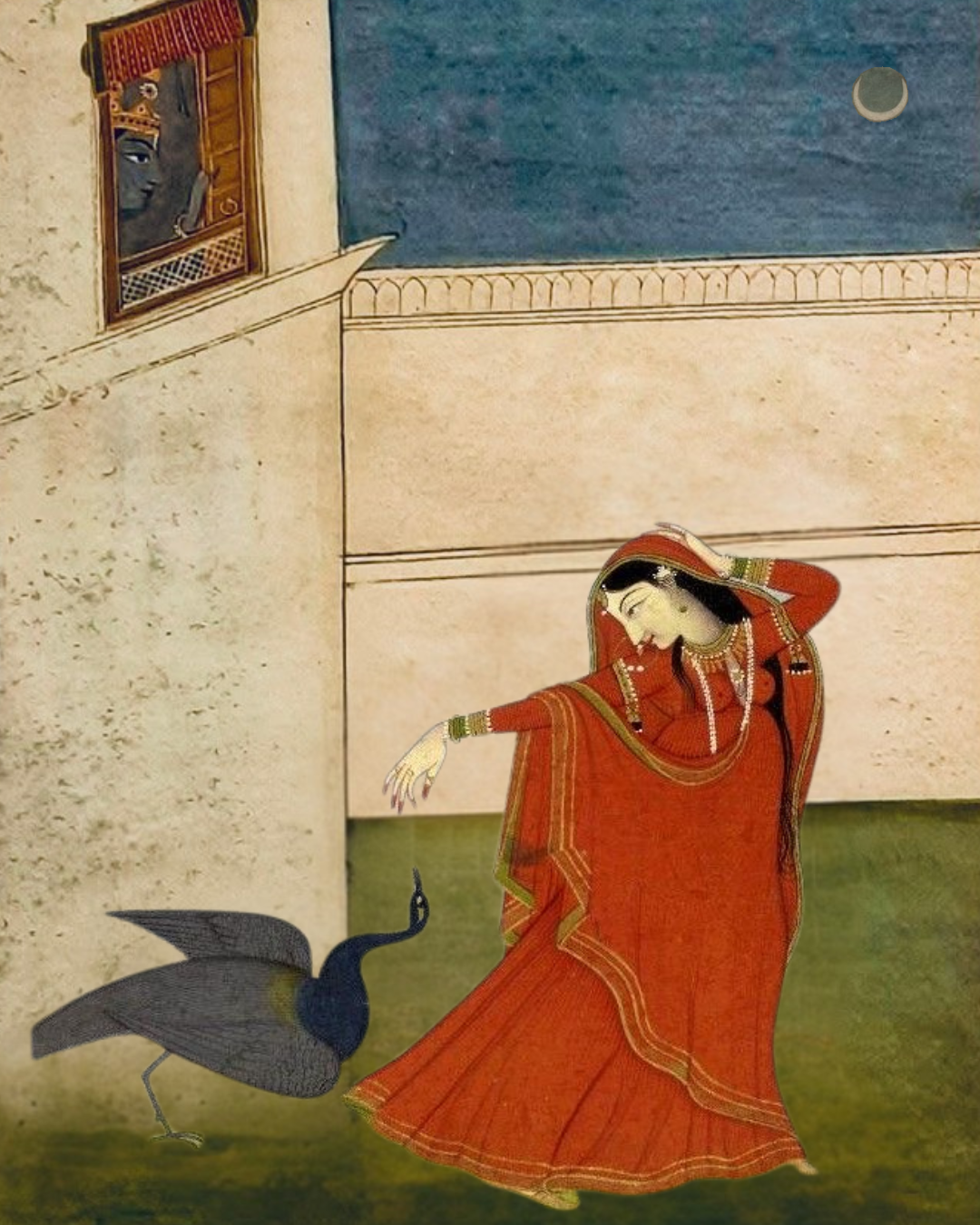
Uttaraphalgunī calls us to build authentic connections through acts of service, generosity, and mutual support. As the patron of contracts and agreements, this asterism, steeped in the qualities of hospitality and protection, encourages us to honor our commitments and nurture relationships that foster both personal and collective growth.

Holding the energy and śakti of prosperity and the accumulation of wealth through partnership, this is a powerful window for collaboration that ignites a fresh perspective and creative growth. 

With the responsibility of breathing life into new architecture, we become most in need of balance. The fine tuning point between self and other — anchoring into and committing fully to self sovereignty, while practicing the grace of presence and participation within this co-created dream.

You can only change and work on yourself. No matter how deeply you feel the need to hold on or piece together something that is unraveling, you may not be able to. Allow yourself to be surprised. This is an opportunity for profound growth—don’t bypass it simply because it’s uncomfortable. Observe what is unfolding and step powerfully into taking responsibility for your own spiritual evolution.

Accelerated spiritual growth awaits if we allow introspection. Some pattern has been attempting to reveal itself for completion and healing. What would it take for you to stop resisting that which you don’t prefer? Welcome it all—the beauty, the terror, the rapture, and the turbulence. Be with it and let it go. It may not be comfortable or easy, but it will undoubtedly be worth it.
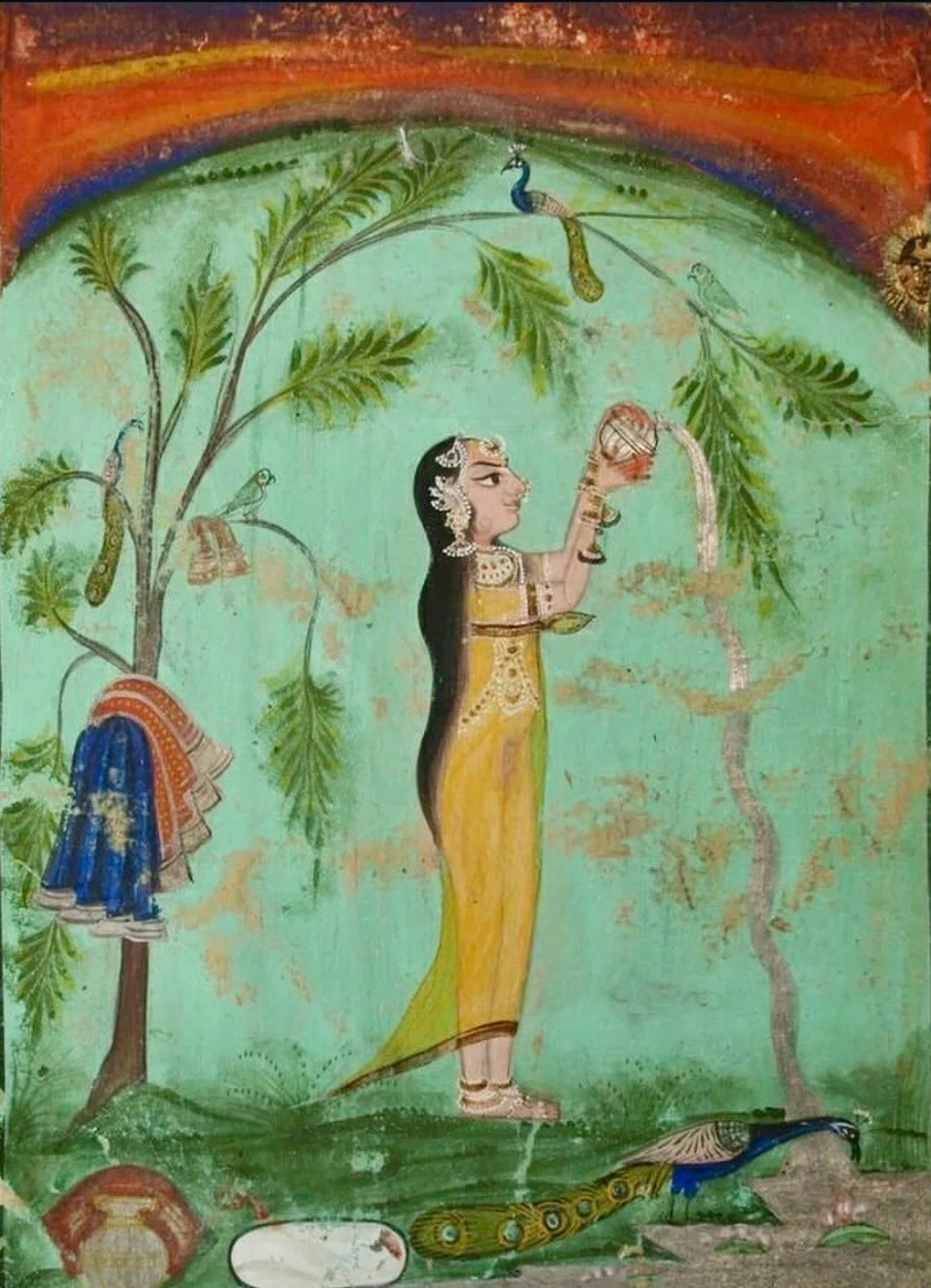
Eclipses stir duality to initiate purification, a necessary process through which self-knowledge is deepened and stabilized. The turbulence you may feel is part of the alchemy drawing you deeper into your own psyche.

Know there is light at the end of the tunnel—keep going. Do yourself a favor and create space to delve deeper into what you may have been resisting. Release what you desire and realign with what is in right relationship and highest alignment.

In this phase of heightened impulsivity, keep life simple, stay grounded, and rest. Reflect on what’s being revealed and what needs untangling. Expect the unexpected.

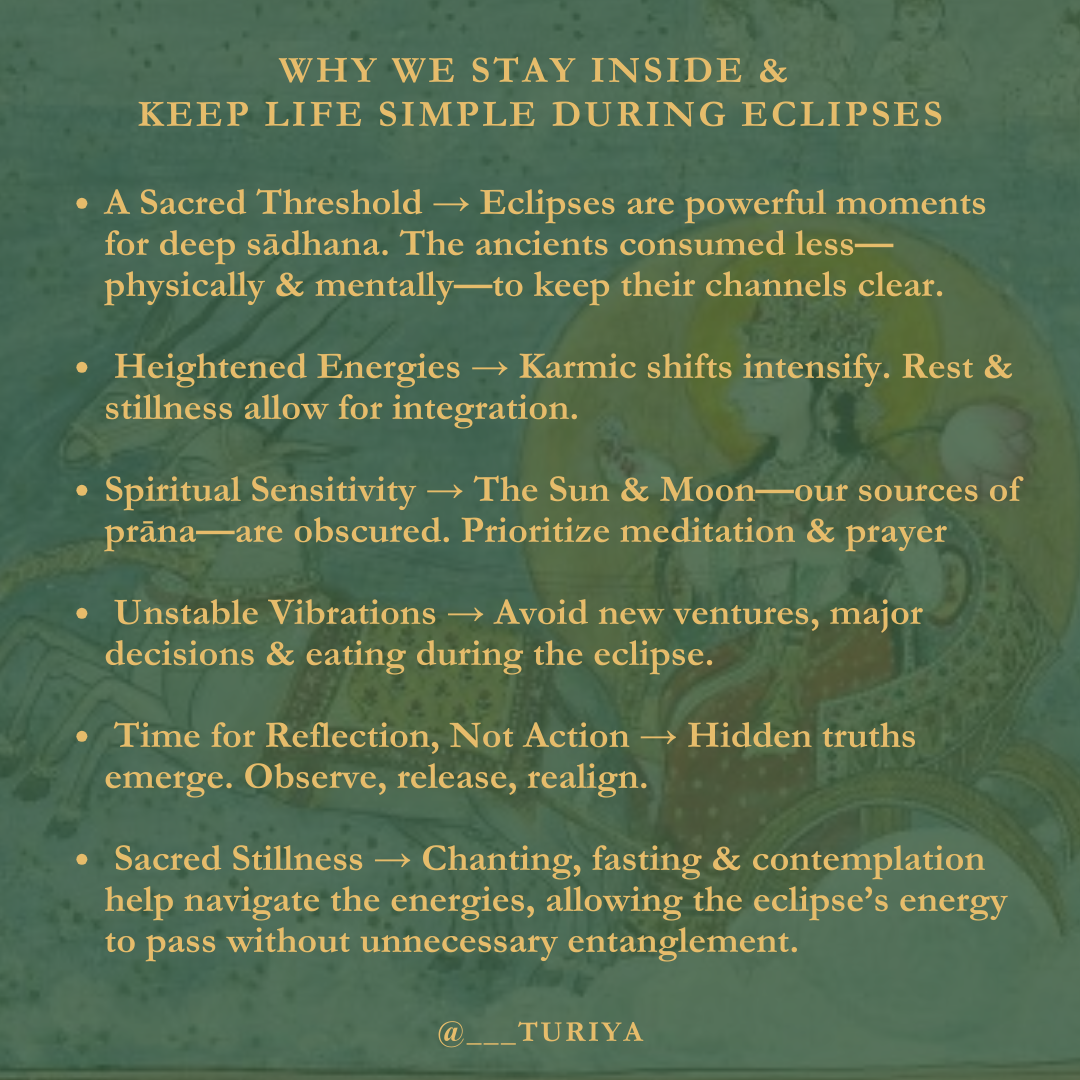
The ancients taught that any practice undertaken during an eclipse bears fruit a thousandfold. In this sacred window, they consumed less—physically and mentally—to keep their channels clear. With the Sun and Moon—our sources of prāṇa—obscured, this becomes a potent time for:

  • Mantra chanting

  • Meditation & breathwork

  • Prayer & fasting

  • Turning inward, rather than outward


It is also recommended to bathe before and after the eclipse to cleanse both body and mind, allowing for a smoother energetic transition.

Trust that this cycle serves as an initiation, sowing the seeds of transformation that will blossom in divine timing, guiding you into the next phase of your journey. Take your time to process things and allow the story to continue unfolding.


Those in a dasha or sub-period of Saturn, or with natal planets (Sun, Moon, Rising) in Uttaraphalgunī, will experience this transit’s transformative energy even more profoundly….

All My Relations 🦚

We will be diving deeper together in our monthly Vidyā & Chai: Group meditation and Sacred Storytelling

September, 22nd 1:30pm pst 🦢☽☼
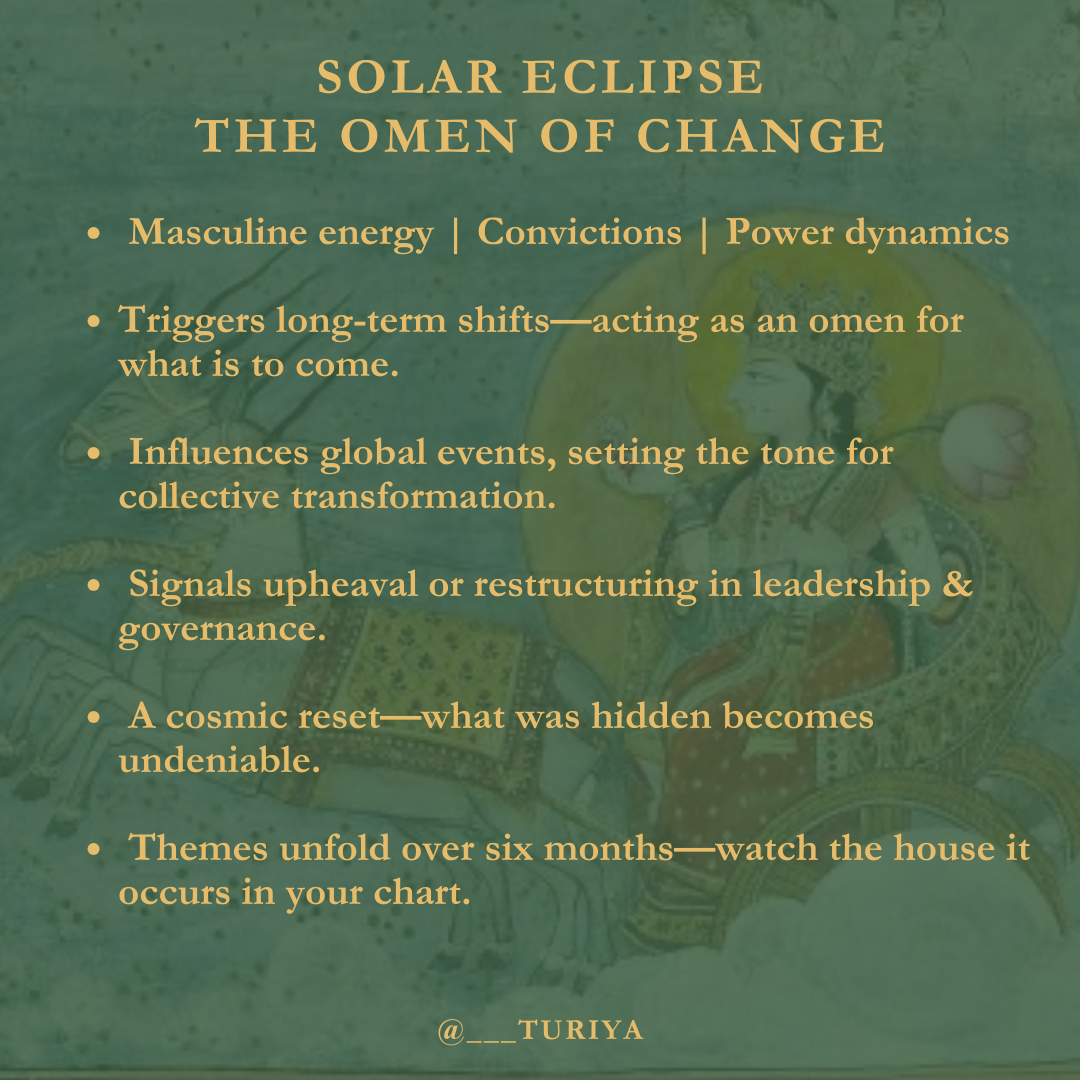

Partial Solar Eclipse: New Moon in Uttaraphalgunī (Virgo)

Sept 21st 2025 12:54 PM PST | Sept 22nd 1:24 am IST


Eclipse Timing:

Sept 21st 10:29 am PST - Sept 21st 14:53 pm PST

Sept 21st 22:59 pm IST - Sept 22nd 3:23 am IST


Lunar Eclipse in Pūrvabhādrapadā: The Scorching Star

FULL MOON LUNAR ECLIPSE

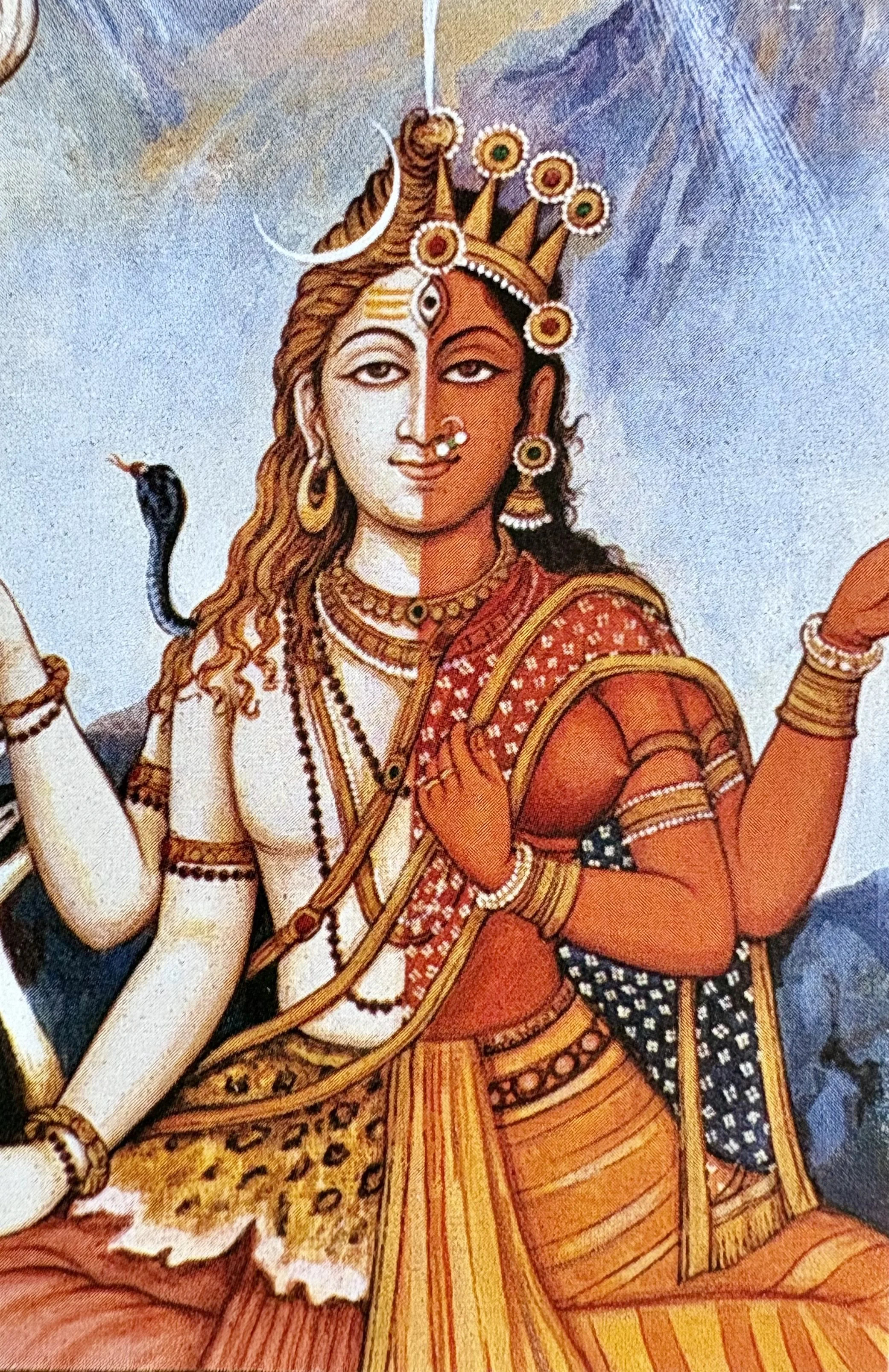
Artwork: Mandala Publishing

Sept 7th, 11:08 AM PST | 23:38 IST

As the Earth passes between the Sun and Moon, a shadow is cast on the lunar surface, commencing eclipse season with a total lunar eclipse पूर्णचन्द्रग्रहणम् (Pūrṇa-candra-grahaṇam) in the Vedic Lunar mansion of Pūrvabhādrapadā पूर्वभाद्रपदा (Aquarius), the Scorching Star. This cycle urges us to refine our inner compass, untangle and release an old karmic pattern.

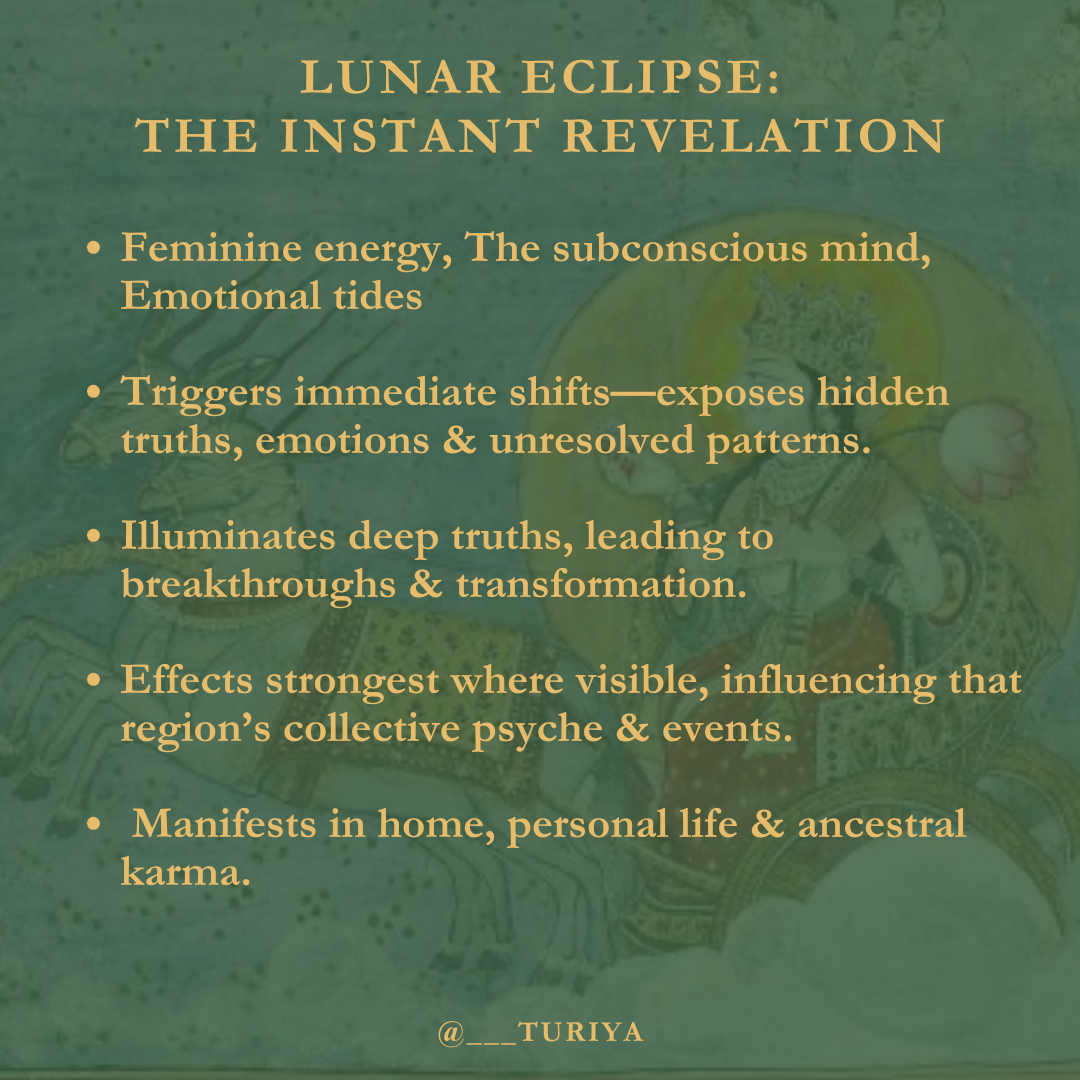
Lunar eclipses are thresholds, thinning the veil between seen and unseen. That which is ready to be healed surfaces now. This dynamic cycle is ripe for accelerated spiritual growth — missing pieces can be reassessed for course correction and redesigning of the physical architecture of your life.

We are stepping into a realm beyond time, where things may not be as they appear. Lunar eclipses serve as triggers, offering sudden exposure to hidden truths, intensifying emotions and—perhaps—beckoning an instant revelation.

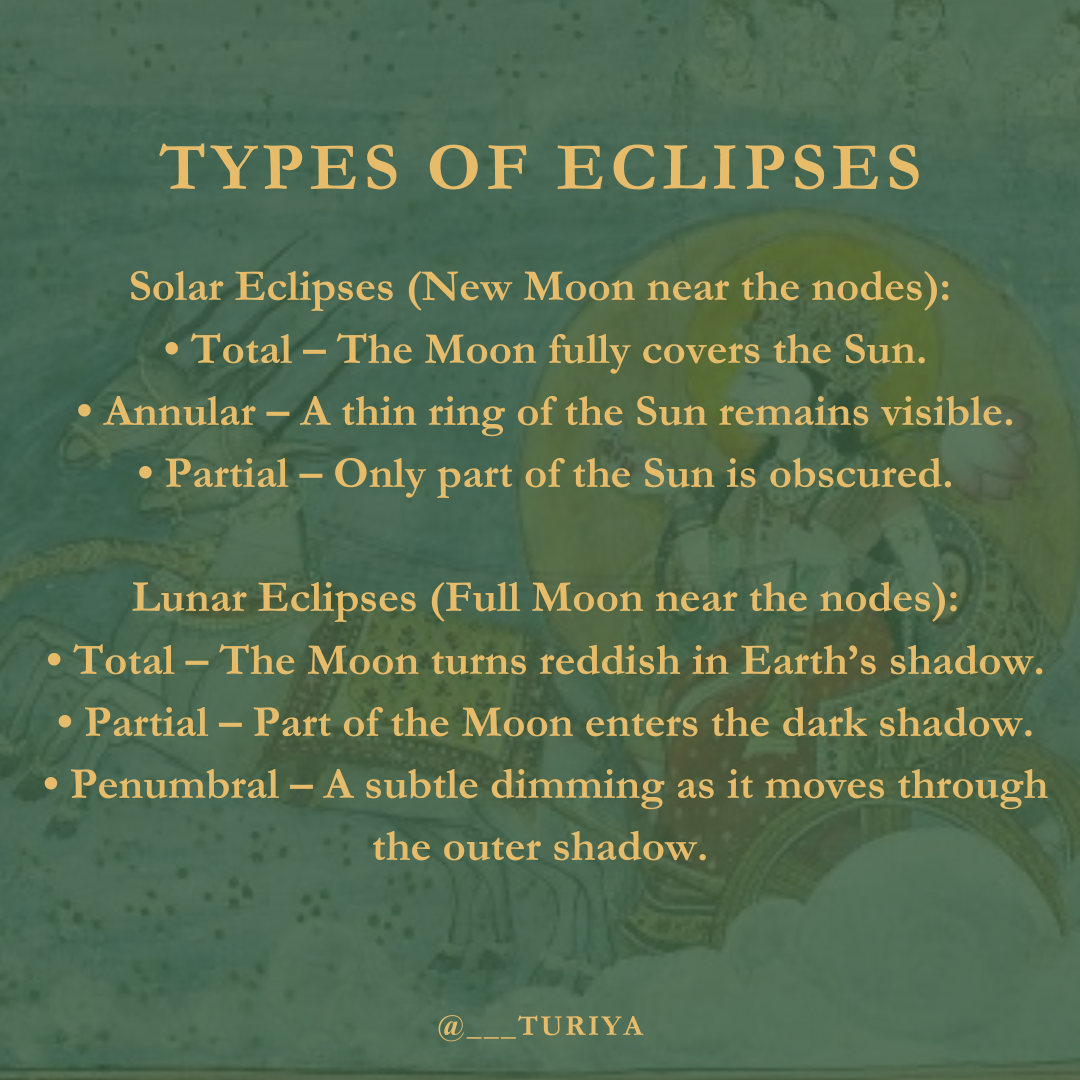
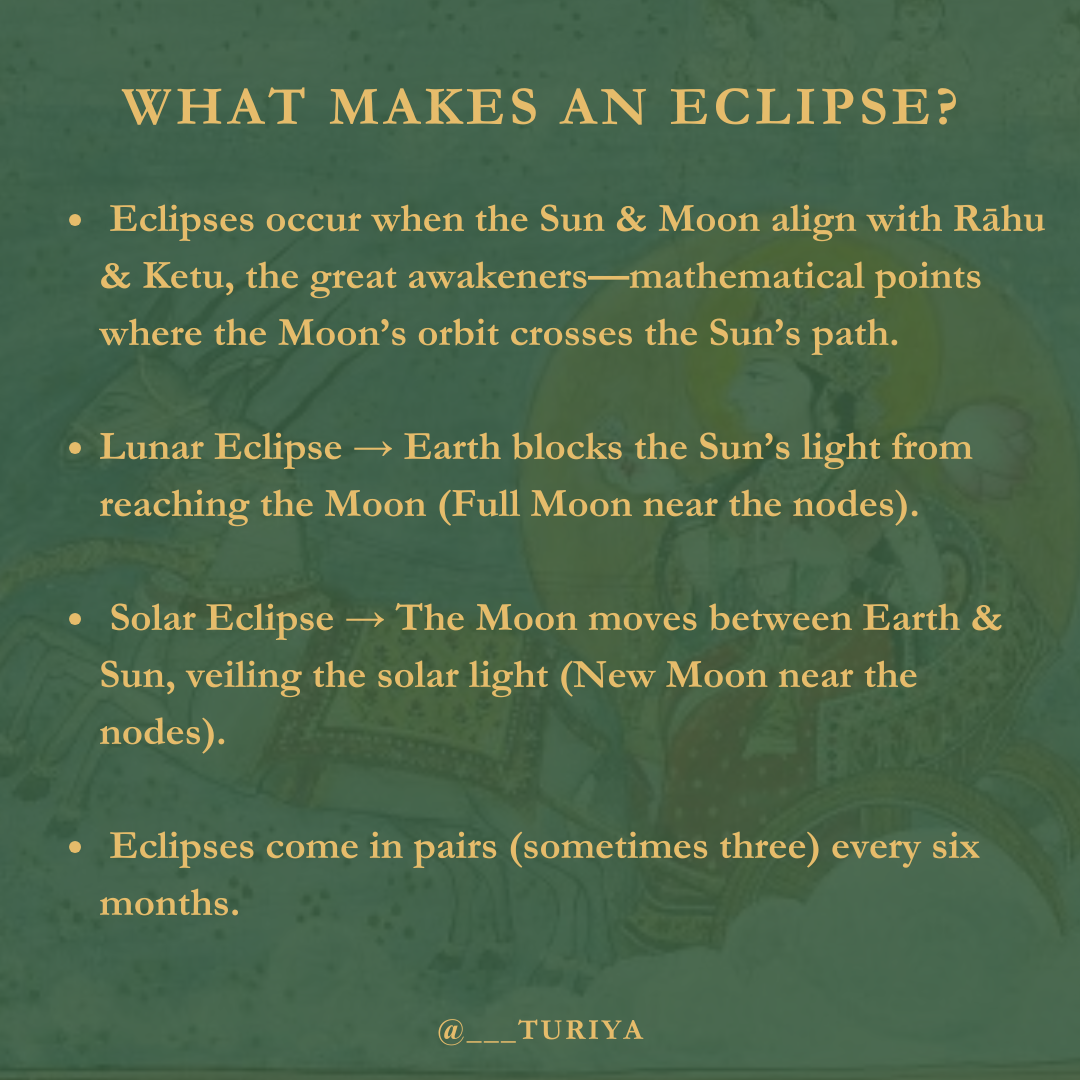
The points where the Sun and Moon intersect the ecliptic plane, positioned exactly 180 degrees apart, are known as the lunar nodes, or Rāhu and Ketu in Vedic Astrology. These shadowy grahas, often called the "great awakeners," govern the eclipses and symbolize the eternal dance between light and darkness, offering us the opportunity to confront our shadows, disrupt old patterns, and awaken to deeper truths along our journey.

Heightened emotions, hidden energies, and truths, long concealed come to light. With the moon eclipsed, you may find yourself at a turning point—on the verge of a decision, exhausted, or facing uncertainty. This portal holds to shift you into a new timeline.

A breakthrough is possible now. An old pattern may resurface—don’t touch what is coming up—hold space and let it go. Pūrvabhādrapadā is symbolized by metamorphosis, rebirth, perseverance, and the undifferentiated fire energy that has the capacity to raise our consciousness. This constellation, being one of the birth stars of Mercury, represents the chaos and turmoil of fragmentation that births the wisdom of neutrality.

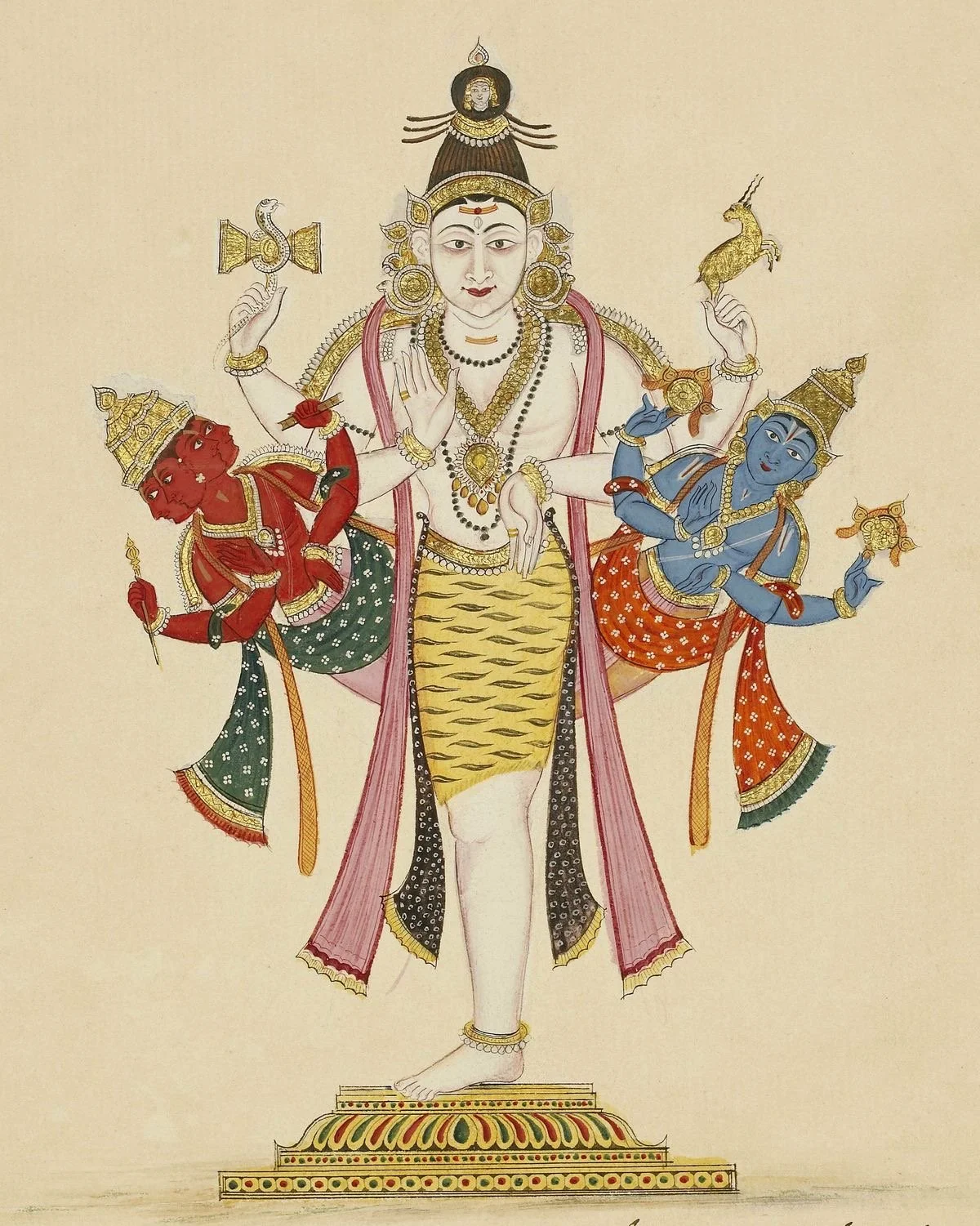
Pinterest: Aja Ekapāda

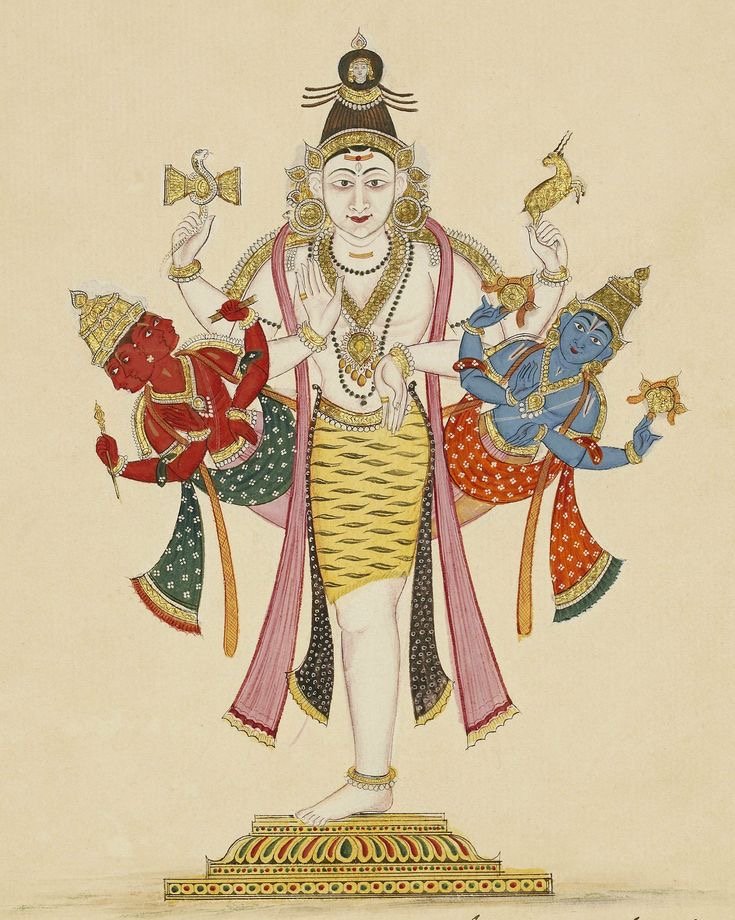
The Burning Pair’s deity (Aja Ekapāda) stands on one leg and has two heads—split yet able to see in both directions, seeking to bridge heaven and earth, possessing the power to elevate through sacrifice—the Yajamāna Udyamana Śakti, the force that uplifts the evolutionary fire.

An alchemical process initiates here, as discipline and renunciation refine raw potential into awakened wisdom. This nakṣatra does not merely demand confrontation with duality; it invites us into a dance of integration, where material ambition and spiritual transcendence find their rightful place.

How we steward vast reservoirs of life force energy defines this cycle—shaping our capacity to channel intensity into focused intention, while cultivating inner contentment amidst dynamic flux.

Symbolized by a funeral pyre, we find ourselves standing at the precipice of transformation, where the purifying fire of Rūdra dissolves illusion. While Rāhu’s presence here may manifest through sudden and unpredictable karma-phala, it ultimately compels a dismantling of rigid ideologies, allowing limitation to be transmuted into higher understanding.

With the responsibility of breathing life into new architecture, we become most in need of balance. The fine tuning point between self and other—anchoring into and committing fully to self sovereignty and taking full responsibility for yourself, while practicing the grace of presence and participation within this co-created dream. Choosing wisely in the direction of what is truly beneficial.

Pay close attention if you have major planets — your Sun, Moon, or Lagna (rising sign) — in Pūrvabhādrapadā, as this cycle could bring sudden change, bring forward something you didn’t plan for, or reveal something deeper about yourself. Also, take note if you are currently running a dāśā (cycle) or antar dāśā (sub-cycle) of Rāhu, Ketu, Sun, Moon, or Jupiter.

One of my teachers has also recommended listening to or chanting Śrī Lalitā Sahasranāma Stotram during the eclipse hours. I personally enjoy this rendition on Spotify and the one on Maharishi Veda app— (which also includes other beautiful and traditional vedic rāga and chants).

This is a threshold for deep personal sādhana. The ancients regarded eclipses as sacred—consuming less, fasting, and turning inward to keep their channels clear. Fasting, meditation, and japa are recommended to optimize this shift, and it is ideal to postpone major decisions and commitments during this period.

What familiar holding patterns are you ready to transcend?

All My Relations

Tulsi

September 7th also begins Pitru Pakṣa, the sacred fortnight dedicated to honoring our ancestors. This two-week period culminates with the new moon on September 21st/22nd, known as Sarvapitṛ Amāvasyā or Mahālaya Amāvasyā. Traditionally, offerings (tarpana, śrāddha) are made to nourish ancestral lineages, invoking blessings and clearing karmic debts.

Full Moon: Pūrvabhādrapadā (Aquarius)
Sept 7th, 11:08 AM PST | 23:38 IST

Eclipse Timing
PST: Sept 7, 8:28 AM – 1:55 PM
IST: Sept 7, 8:58 PM – Sept 8, 2:25 AM

Next: New Moon Solar Eclipse — Sept 21/22

“Write all that worries you on a piece of parchment;
 Offer it to God 

Even from the distance
 of a millennium I can lean the flame 

in my heart
 Into your life
 And turn
 All that frightens you
 Into holy Incense Ash." 

~Hafiz


Rāhu / Ketu Transit – Aquarius / Leo

Navigating Aquarius and Leo: Rāhu and Ketu's New 18-Month Cycle

Artwork: Ayush Kejriwal

May 19, 2025 – December 5, 2026

Shadow Forces at the Threshold

In the subtle architecture of destiny, not all thresholds are lit by stars—some are cast in shadow. Rāhu and Ketu, the lunar nodes, are such thresholds: unseen forces that awaken, dismantle, and initiate. They do not emit light, yet their influence reshapes the sky within.

The jyotiṣa narrative shifts as the nodes complete their backward journey from the Pisces–Virgo axis into Aquarius–Leo. This new cycle, initiated on May 19 (true node shift on May 29), will reverberate through the end of 2026.

Sovereignty and Service

This is the axis of sovereignty and service—Leo illuminates the light of the self, while Aquarius holds the vision for the collective. One radiates from the heart; the other disperses through the field. The invitation is not to choose between them, but to consecrate their union.

Mechanics of the Nodes

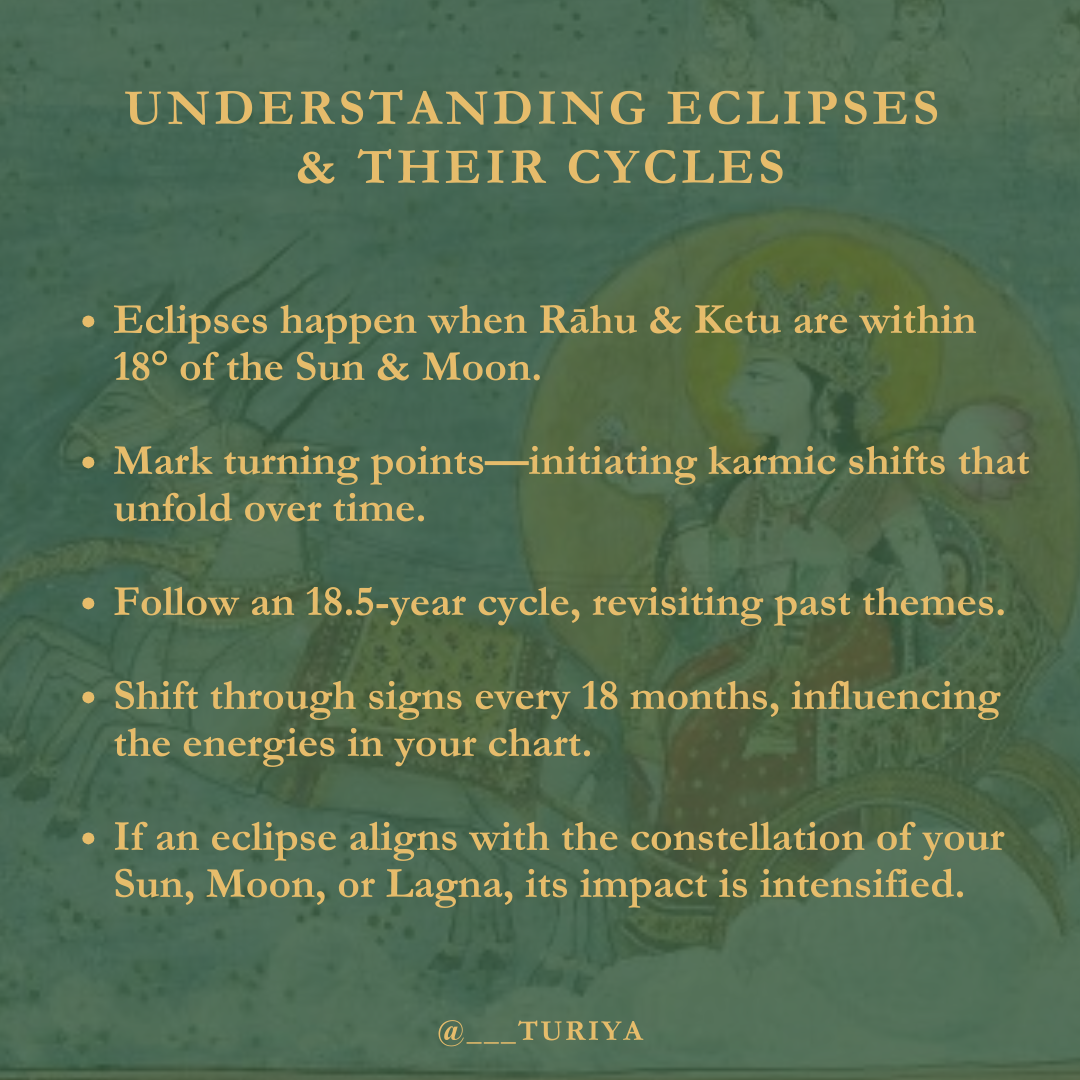
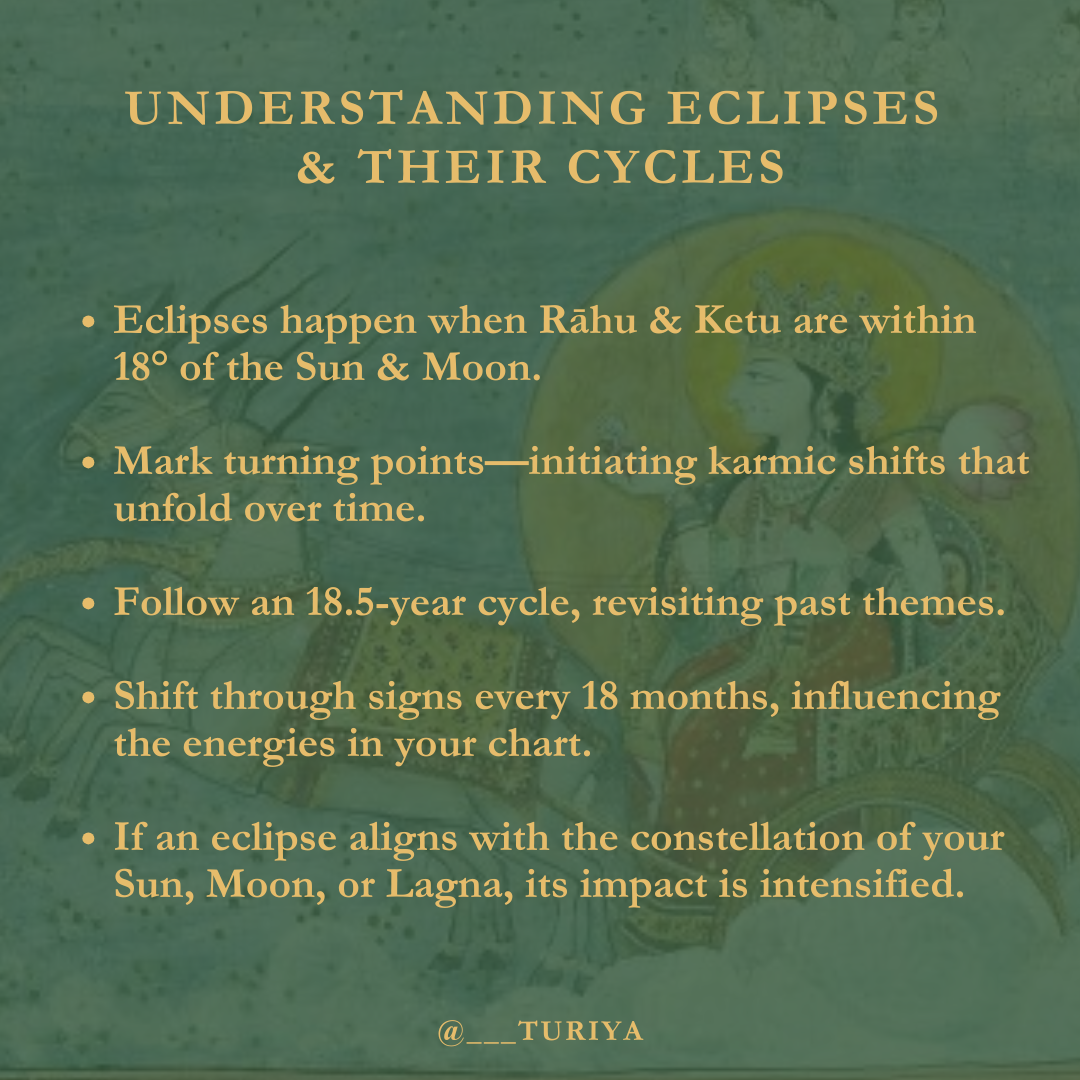
Unlike the visible grahas, Rāhu and Ketu are chāyā-grahas—shadow planets formed by the intersection of the Sun and Moon’s paths along the ecliptic. Ever retrograde and 180 degrees apart, they govern eclipses and set the karmic tone of each 18-month cycle, shaping the undercurrent of the six-month intervals between eclipses.

Known as the great awakeners, they mark the dance between light and shadow—disrupting patterns, awakening deeper truths, and exerting particular influence when transiting one’s Lagna or Moon Nakṣatra (constellation).

Echoes of the Past: 2005–2007

Artowrk: Pinterest

Let us return to the last time Rāhu and Ketu moved through the Kumbha–Siṃha axis: 2005 to 2007. It was a period shaped by the tension between personal sovereignty and collective belonging—between the need to stand apart, and the yearning to find one’s place within a greater whole. 

Rāhu in Kumbha stirred the impulse to question systems and seek new forms, while Ketu in Siṃha quietly loosened the grip of self-importance, revealing where identity had been entangled with status or validation. As one of the co-rulers of Kumbha, alongside Śani, Rāhu moves through this sign with a certain authority—its drive to rupture, innovate, and unbind finds natural expression here. For many, it was a time of inward reorientation—of discerning what it truly means to offer oneself without needing to be seen.

Timing Matters: Mean and True Node Gap

In that cycle, the difference between the mean and true node transitions was pronounced. The mean node entered Kumbha in November 2005, while the true node did not follow until March 2006—resulting in a gap of nearly four months.

This delay was due to greater oscillation in the Moon’s nodal path at the time, which caused the true node to temporarily move direct or hover near the sign boundary. In contrast, the 2025 transit is far more aligned: the mean node enters Kumbha on May 9, 2025, and the true node follows just ten days later on May 19. The shorter gap reflects minimal oscillation in the nodal path during this period, resulting in a more immediate and unified shift.

This convergence in 2025 holds deeper significance for Jyotiṣa interpretation:

While the true node reflects the Moon’s exact astronomical path, including its erratic oscillations, the mean node offers a steady, symbolically coherent trajectory through the zodiac. During periods of minimal oscillation—such as the 2025 transit—the closeness between mean and true nodes lends further support to the mean node’s use in timing and interpretation. Many Jyotiṣa practitioners favor the mean node for its predictive consistency and alignment with the symbolic essence of Rāhu and Ketu as karmic forces that operate beyond the visible realm.

In traditional South Indian lineages, the mean node remains the standard—a practice that reflects its longstanding alignment with the metaphysical dimension of Jyotisa rather than only astronomical precision.

Clean Threshold, Swift Delivery

Most discussions of Rāhu and Ketu focus on their symbolism, yet their movement itself tells us something. In 2005–2006, the true node lagged nearly four months behind the mean, creating a prolonged liminal space. The karmic axis had shifted—yet hadn’t. This delay, subtle as it was, mirrored a period of energetic diffusion: slower integration, ambiguous thresholds, and karmic delivery that unfolded in layers.

In contrast, the 2025 shift occurs with near exactness. The true and mean nodes enter Kumbha–Siṃha just ten days apart. When the nodes move with precision, karma tends to deliver without pause. There is less wavering at the threshold, and the cycle begins cleanly. Have you been noticing a quickening? A sense that movement has already begun—subtle shifts, sudden truths, old patterns unraveling without ceremony. The timing may be astronomical, but the delivery is already in motion.

First full eclipse season in the Aquarius / Leo Axis:

  • Sept 7th: Total Lunar Eclipse 13:09pm CT (full moon) Pūrva Bhādrapadā

  • Sept 21st: Partial Lunar Eclipse 14:55 CT (new moon) UttaraphalgunĪ

Mythic Origins

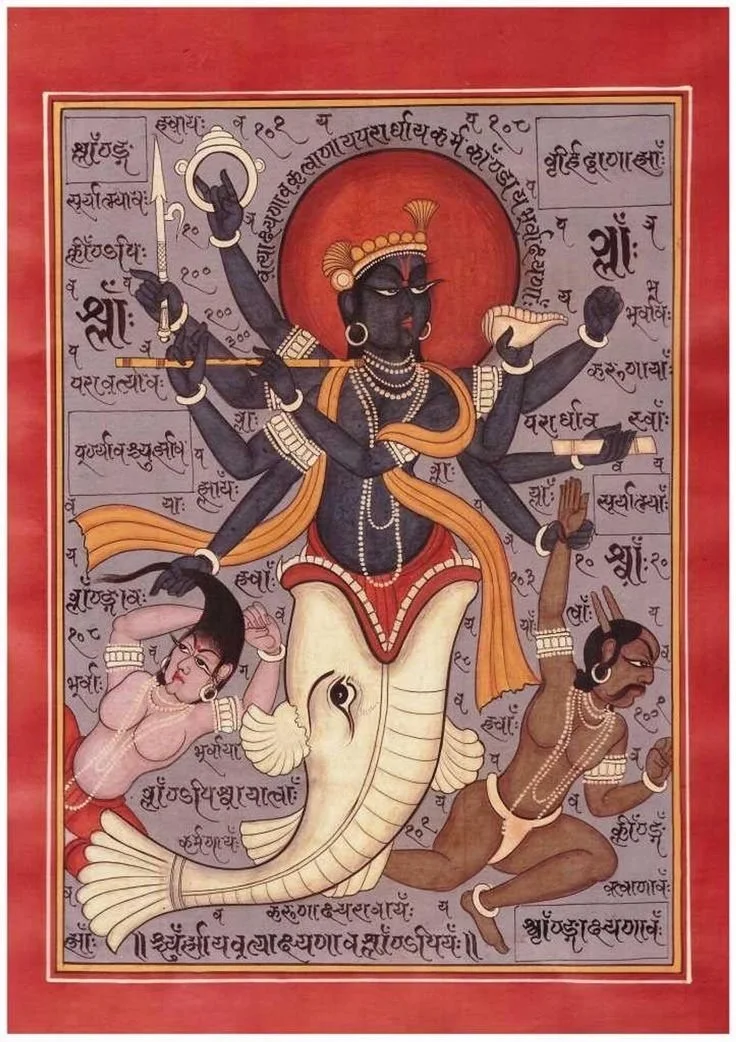
According to ancient Vedic mythology, Rāhu and Ketu were born during the churning of the cosmic ocean (Samudra Manthana). The devas, with Viṣṇu’s help, plotted to keep the nectar of immortality (amṛtṭa) for themselves. In response, the asura Svarbhānu disguised himself as a deva and slipped into their ranks. Just as he drank the nectar, the Sun and Moon exposed him. Viṣṇu beheaded him with his Sudarsana Chakra.

The drop of nectar had already passed his throat, making him immortal. His severed head became known as Rāhu, the immortal head; his body became Ketu, the headless body. Feeling betrayed by the luminaries, the nodes are said to chase and devour them again and again—causing eclipses (grahaṇa) that continue to fascinate and unsettle us to this day.

The Hero’s Journey: Varāha and Matsya

To understand Rāhu graha a little more, we can look to the narrative of the hero’s journey and to the life of Varāha Avatār, the third incarnation of Lord Viṣṇu, the wild boar. Varāha Dev story narrates how Viṣṇu came to rescue Bhūdevī (Earth) and restore her to her rightful place in the universe.

Rāhu is the karaka for justice, courage, truth, self-sacrifice, renovation, risking one’s life for a cause, going against the established order, the foreigner, and the protector of the Earth. As the immortal head, Rāhu is the head of everything. With his tusks, Varāha is said to have the ability to dig up any impurities in the heart.

Ketu Graha is reflected in the veiled presence of ŚrĪ Matsya, the first avatāra of Viṣṇu—the fish who guides the sage Manu through the great deluge (pralaya). When he first appears to King Satyavrata, pleading for protection from the larger creatures of the sea, it signals a dissolution already underway. As creation gets out of hand, Matsya carries forward only a small volume of the Earth’s population—preserving what must endure, while the rest is surrendered.

Ketu is the karaka of mokṣa and the genetic code—what sets one apart, like the royal class. He is the writer, the one behind the scenes, the backdrop. Karaka of the ṛṣis, omens, sūkṣma indriyas (subtle senses), extremity, religious fanatics, blind faith, mystery, secrets, coding, and reduction. He is the reducer, the one that clears the field, cuts the thread, and clears out your closet. Mahākāya—he expands something only to get it out of the way. Like Matsya, he does not engage in violence.

Upcoming Transits

Rāhu (Mean Node)

  • Currently in: Pūrvabhādrapadā (Aquarius)

  • Entering Shatabhiṣak: November 22, 2025

  • Entering Dhaniṣṭhā: June 30, 2026
    Even though Rāhu has entered Kumbha (Aquarius rāśi) on May 19, 2025, it's still transiting within the earlier Pūrvabhādrapadā Nakṣatra, which spans the end of Mīna and the beginning of Kumbha. This is why, despite the rāśi shift, the Nakṣatra hasn't changed yet.

    Rāhu in Pūrvabhādrapadā intensifies the fire of transformation. Known for its scorching, untamed energy (pari), this star initiates deep internal alchemy through tapas—discipline, vision, and inner combustion. It is a place of conscious rebirth. Under Rāhu’s influence, the latent fire of Pūrvabhādrapadā becomes insatiable, requiring full devotion to one’s goals and the courage to burn through illusion. What is not aligned will not survive the heat.

Artwork: Pinterest

Ketu (Mean Node)

  • Currently in: Uttaraphalgunī (Leo)

  • Entering Pūrvaphalgunī: July 6, 2025

  • Entering Maghā: April 20, 2026

Ketu in Uttaraphalgunī draws attention to the unseen threads within relationships, contracts, and sacred service. This is the star of patronage—where prosperity flows through bonds rooted in integrity, hospitality, and selfless offering. With Ketu here, the outer structures may dissolve, but the deeper intent behind partnership is revealed. 

Artwork: Pinterest

It's a time to refine the purity of our commitments, honor agreements, and serve from the heart without attachment to recognition or reward. True wealth arises through inner alignment and grace-bearing acts.

May this cycle of shadows illuminate what is essential. May what is ready to dissolve be released with grace. And may the unseen forces guide you inward—toward your own becoming.

All My Relations, Tulsi

ॐ रां राहवे नमः । ॐ कें केतवे नमः

Rahu into Pūrvabhādrapadā: The Scorching Star

Rahu in Pūrvabhādrapadā

Artwork: Pinterest

March 16 — November 23rd

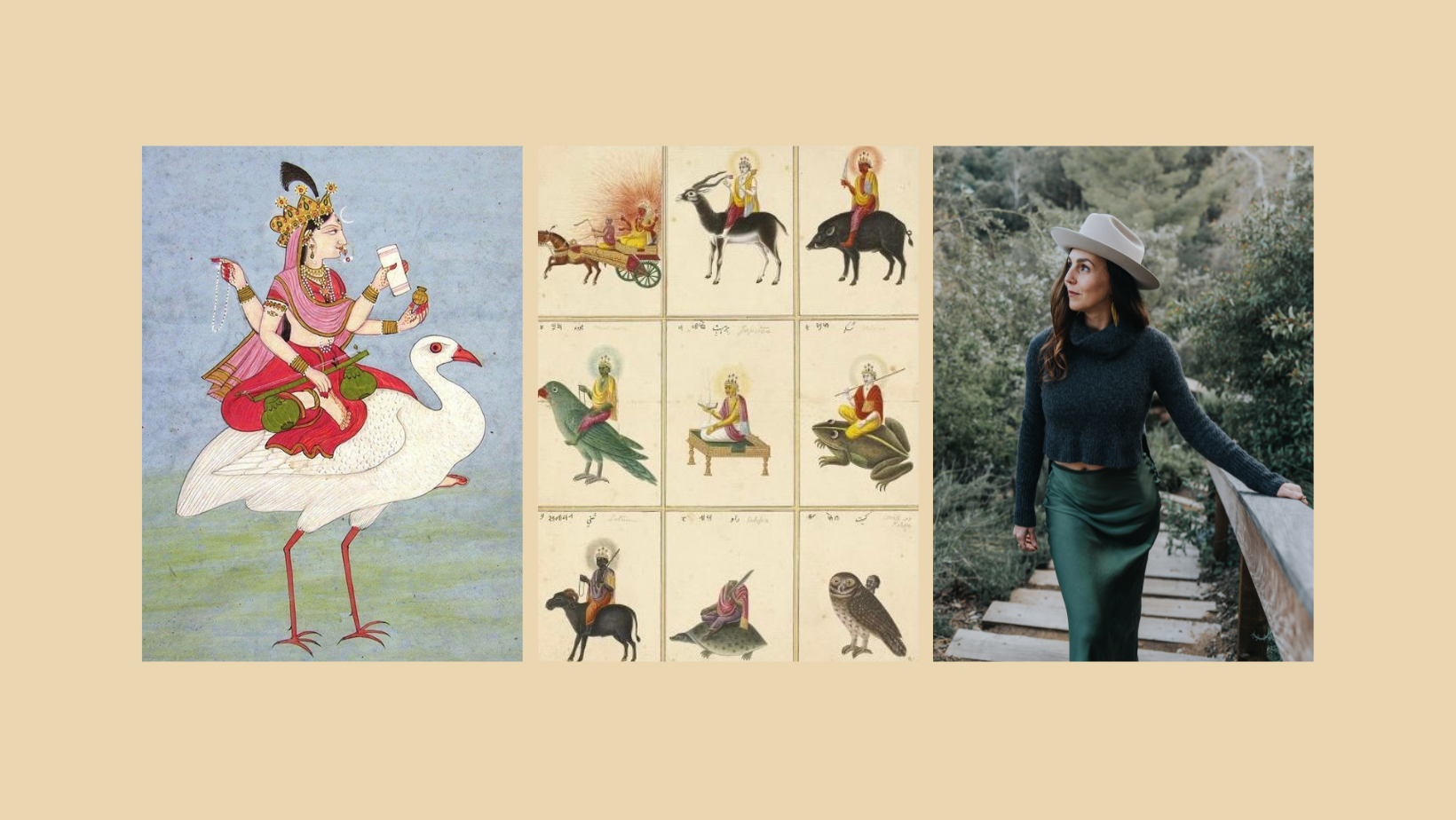
The chāyā (shadowy) graha Rāhu, depicted as mounted on a lion, bluish-black and smoke in color, residing in the forest, the renovator and eclipser of the luminaries, enters the Vedic Lunar Mansion of Pūrva Bhādrapadā पूर्वभाद्रपदा (Pisces), the Scorching Star, on March 16th.

To understand Rāhu graha a little more, we can look to the narrative of the hero’s journey and to the life of Varāha Avatār, the third incarnation of the daśāvatār of Lord Viṣṇu (the preserver and protector), the wild boar. Varāha Dev is one of the four full Paramātmās whose story narrates how Lord Viṣṇu came to rescue Bhūdevī (Pṛthvī), Earth, and restore her to her rightful place in the universe.

Rāhu is the karaka (significator) for justice, courage, truth, self-sacrifice, renovation, risking one’s life for a cause, going against the established order, the foreigner, and the protector of the Earth. With his tusks, Varāha is said to have the ability to dig up any impurities in the heart.

Pūrva Bhādrapadā is symbolized by metamorphosis, rebirth, tapas (penance), perseverance, and the undifferentiated fire energy that has the capacity to raise our consciousness. This constellation, being one of the birth stars of Mercury, represents the chaos and turmoil of fragmentation that births the wisdom of neutrality.

The Burning Pair’s deity (Aja Ekapāda) stands on one leg and has two heads—split yet able to see in both directions. Pūrva Bhādrapadā seeks to bridge heaven and earth, possessing the power to elevate and sacrifice (Yajamana Udyamana Śakti)

Pūrvabhādrapadā initiates an alchemical process where discipline and renunciation refine raw potential into awakened wisdom. This nakṣatra does not merely demand confrontation with duality; it invites us into a dance of integration, where material ambition and spiritual transcendence find their rightful place. 

How we manage vast reservoirs of life force energy becomes the defining arc of this cycle, shaping our capacity to channel intensity into focused intention. Yet, the cultivation of inner contentment amidst this dynamic flux is equally vital.

This sacrifice channels energy that can produce and draw down spiritual blessings. Through tapasya (austerity), this energy rises to melt and dissolve the veils obscuring the hidden moon within our minds, showering us with grace.

As Rāhu enters Pūrvabhādrapadā, symbolized by a funeral pyre, we stand at the precipice of transformation, where the purifying fire of Rūdra (fierce form of Śiva) dissolves illusion. While Rāhu’s presence here may manifest through sudden and unpredictable karma-phala (fruits of action), it ultimately compels a dismantling of rigid ideologies, allowing limitation to be transmuted into higher understanding.

Artwork: Pinterst

This is a cycle of intensity, yet not one of inevitable destabilization. The presence of Rāhu here is the ascetic who must temper his fire, the revolutionary who must refine his vision. Discernment (Viveka) becomes paramount, guiding us to differentiate between the higher call of dharma and the consuming hunger for dominion—whether material, intellectual, or ideological.

Rāhu amplifies an insatiable drive for knowledge, power, and ultimate truth, compelling us to navigate the razor’s edge of profound revelation and self-mastery. Those attuned to this energy may find themselves positioned at the forefront of social reform, philosophical inquiry, or disciplined spiritual practice.

The challenge—and the opportunity—is to ensure that transformation does not become an all-consuming blaze, but rather a luminous beacon. When tempered with humility, this fire does not devour but illuminates, revealing the path to higher realization and authentic awakening.

Those running a Dasha or sub-period of Jupiter or Rāhu, or with natal planets in Pūrva Bhādrapadā, will feel this transit's transformative energy even more profoundly.

This cycle will be defined by the goals you set for yourself and what you are willing to give away.

In the planetary protection mantras, we invoke Rāhu to protect our tongue.

For those navigating the depths of this transit, I offer one-on-one Vedic Astrology readings—guiding you through its unfolding with clarity and support. You can book here:

ॐ राम राहवे नमः | ॐ वराहाय नमः

All My Relations