
NARASImHA CATURDAŚĪ
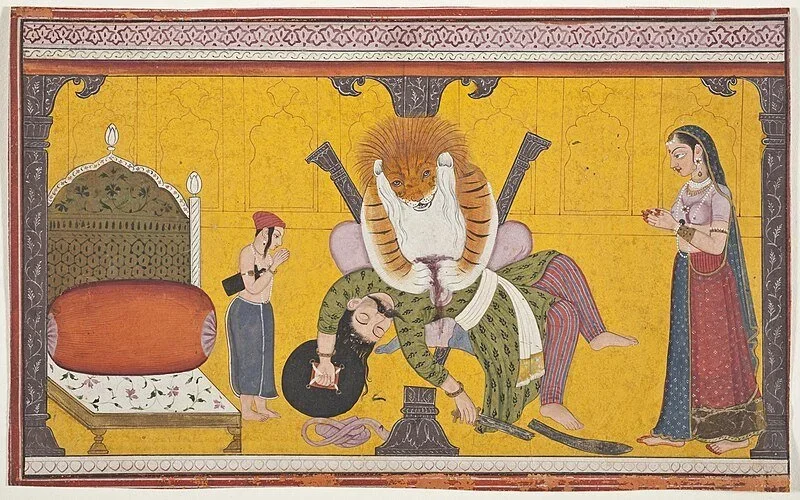
Artwork: Nasli and Alice Heeramaneck Collection, India, Himachal Pradesh, Nurpur, circa 1760-1770
नरसिंहचतुर्दशी | 04.29.2026
On the fourteenth (caturdaśī) day of the bright half of the month of Vaiśākha, the festival honoring Narasiṃha Avatār, the fourth incarnation of the daśāvatāra of Lord Viṣṇu, the man-lion, is celebrated.
Narasiṃha’s story begins with King Hiraṇyakaśipu’s brother being killed by Śrī Varāha, the boar. Seeking revenge, Hiraṇyakaśipu performs deep penance to obtain immortality. Pleased, Lord Brahmā (the creator) grants him a boon, rendering him invulnerable to any man or animal, among other stipulations. Arrogant and enraged, Hiraṇyakaśipu conquers the three worlds to avenge his brother.
The āsura king had a son, Prahlād, who was born a great bhākta of Lord Viṣṇu, having heard stories of him from Nārada Muni while in the womb. Hiraṇyakaśipu was outraged that his son would not accept him as God and tried many ways to convince him otherwise. After numerous failed attempts, he ordered his soldiers to torture and kill Prahlād.
Being a great devotee of Mahāviṣṇu, Prahlād surrendered completely, and the lord saved him from every attempt on his life. When Hiraṇyakaśipu questioned his son, while kicking a pillar, “Is your lord in the pillar too?” The pillar split, and the fierce half-man, half-lion Narasiṃha emerged — at dusk, upon the threshold, neither fully within nor without, neither by day nor by night — defying the very categories specified by Hiraṇyakaśipu’s boon, and thereby subduing him, to vanquish the oppressive āsura king and protect Prahlād.
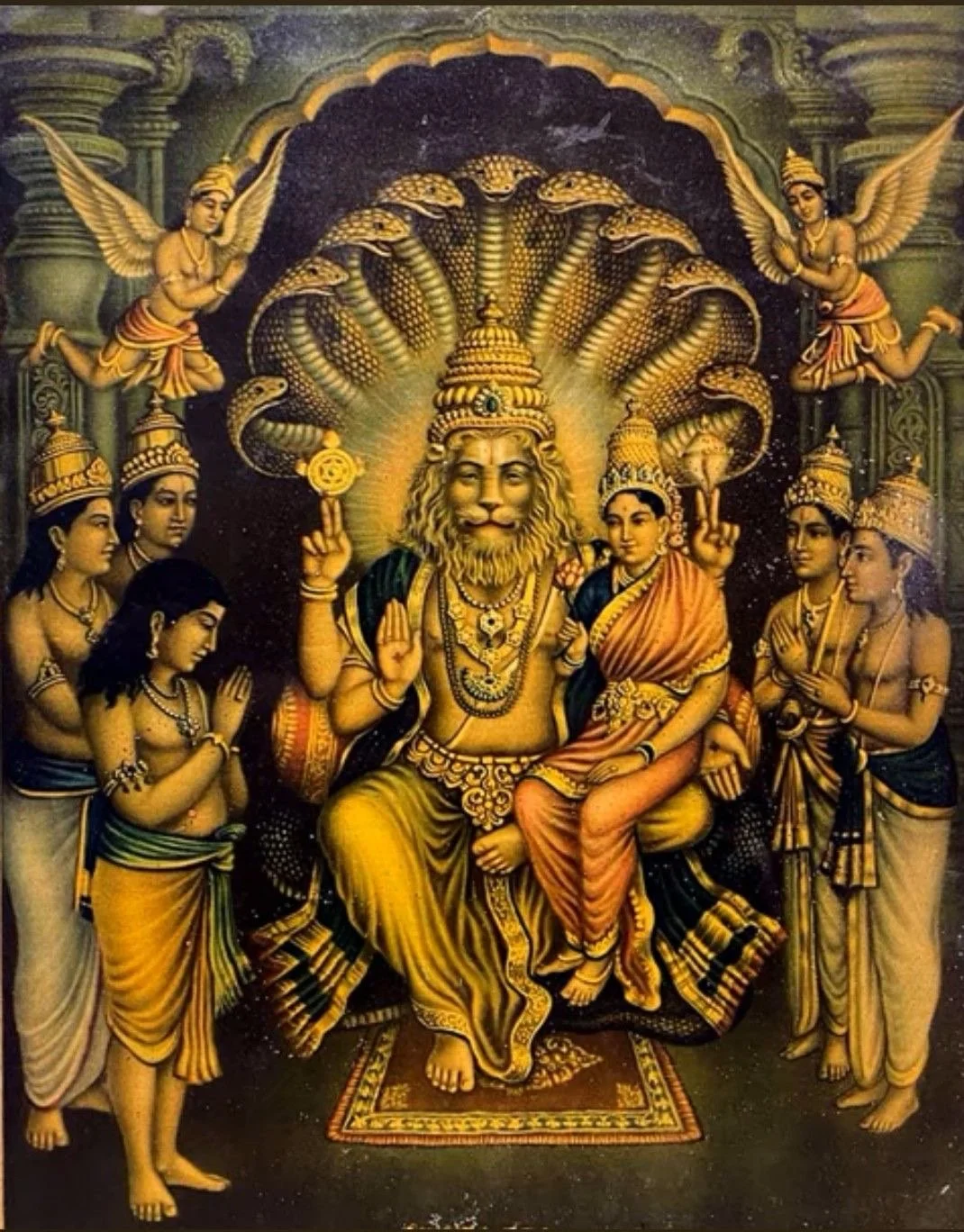
Artwork: Pinterest
He who is Ugra, the ferocious, and simultaneously Śānta, the tranquil — Narasiṃha embodies the supreme paradox of divine wrath deployed in the service of pure love. His terror is not cruelty; it is the unflinching protection of the surrendered soul. It is Prahlād’s unwavering devotion, his complete and total surrender, that draws forth the lord from the very pillar — and it is that same surrendered heart that instantly pacifies the lord’s fierce form.
The lord incarnates age after age to restore balance, protect the virtuous, and vanquish the wicked. Allegedly born from the sweat of Lord Śiva during his tapas, Maṅgal Graha (planet Mars) is said to be associated with the story of Narasiṃha.
Maṅgal is Deha Karaka or the indicator of the body, the heart, and the immune system, as he is the defense system within our bodies. He is the carrier of Agni (fire) tattva, the significator of one-pointed focus, the lord of logic, power, preservation, and violence. He represents protection, particularly the protection of the innocent.
He is further Ṛṇa Karaka, the indicator of debt — for it is Maṅgal who governs what is owed, what must be repaid, and the burdens carried across lifetimes through action and obligation. He is equally Roga Karaka, the indicator of sickness and disease — for when his Agni burns without discipline or direction, it turns inward, inflaming the body and disturbing the vital equilibrium he is otherwise sworn to protect.
Like Narasiṃha himself, Maṅgal is both Ugra and Śānta — fierce in the face of violation, steady in the protection of the devoted. On this Narasiṃha Caturdaśī, one may offer prayer to Lakṣmī-Narasiṃha not only for courage and protection, but for the dissolution of all Ṛṇa and Roga — that the lord who emerged from stone to answer the cry of his devotee may equally dissolve what binds us and restore what has been disturbed.
ॐ श्री लक्ष्मीनृसिंहाय नम:
Chinnamastā Jayantī
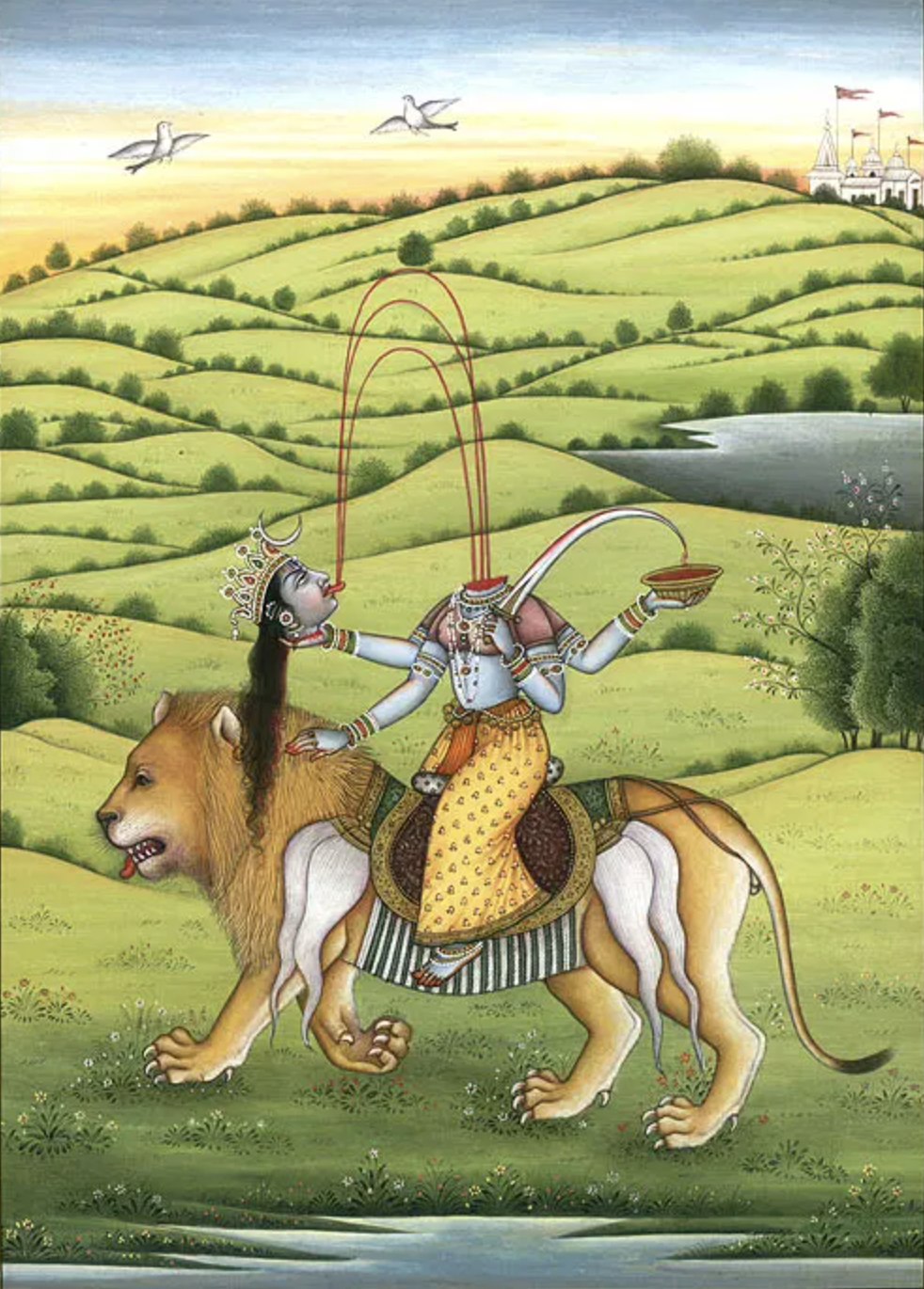
Mahāvidyā Chinnamastā Riding Lion by Kailash Raj
Today also marks Chinnamastā Jayantī, honoring the sixth of the Daśa Mahāvidyā—the self-decapitated Goddess who reveals the hidden movement of prāṇa and the deeper alchemy of the guṇas; severing her own head, she drinks from the central stream while two currents nourish her attendants, illuminating how life sustains itself through offering and how consciousness awakens when identification is cut—standing upon the union of desire, she makes clear that the very force that binds can liberate when seen—deeply linked to Rahu, she governs the threshold where hunger, desire, and dissolution converge, transmuting tamas into grounded potency, rajas into conscious circulation, and sattva into a clear channel that must also be released, revealing that true freedom arises not from refinement alone, but from moving beyond all three into the unbound Self.
ॐ ह्रीं श्रीं क्लीं ऐं वज्रवैरोचनीयै हुँ हुँ फट् स्वाहा ॥
All my Relations, Tulsi