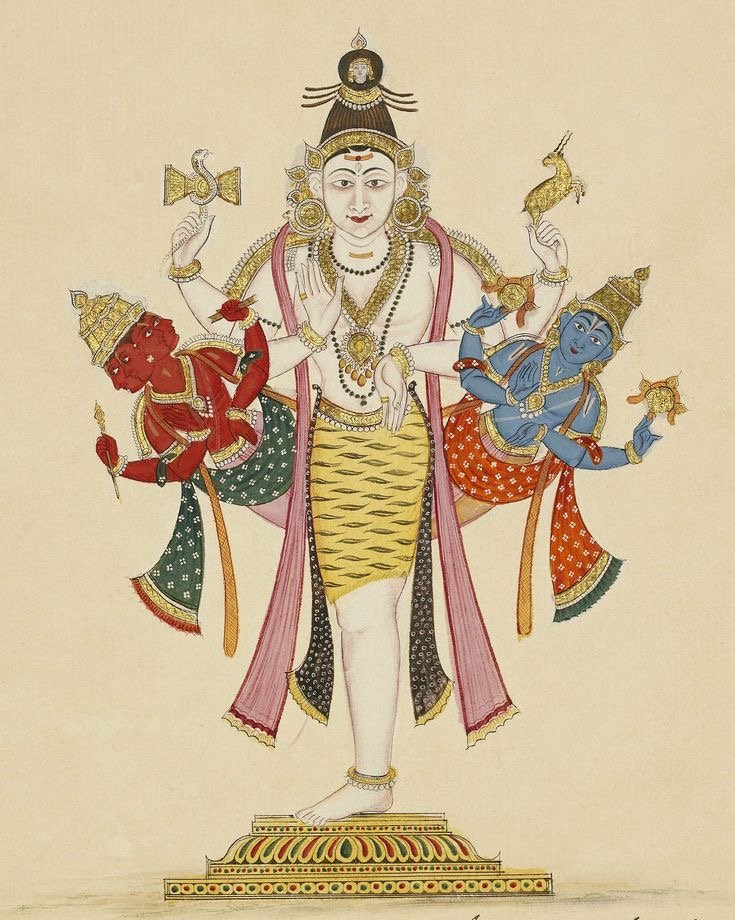
Yugādi & Gudhi Pāḍavā: The Vedic New Year

Gudhi Pāḍavā: Vedic New Year

Artwork: Pinterest

Falling on March 30th, Ugadi and Gudhi Pāḍavā and mark the Vedic New Year, aligning with the lunisolar calendar and heralding a time of renewal and auspicious beginnings. Commencing on Chaitra Śukla Pratipadā—the first lunar day after the new moon closest to the vernal equinox—this day reflects the harmony of lunar and solar cycles, with the Sun and Moon positioned in Pisces.

The panchāṅga, the Vedic almanac, designates this astronomical new year based on the new moon in Pisces or the one nearest to the vernal equinox. This moment marks the start of a new Samvatsara, the 60-year cycle in the Hindu lunar calendar.

In Maharashtra and beyond, this day is observed as Gudhi Pāḍavā, while in Andhra Pradesh, Telangana, and Karnataka, it is celebrated as Yugādi—derived from Yuga (era) and Ādi (beginning), symbolizing the dawn of a new epoch. It is believed that Lord Brahmā commenced the creation of the universe on this day, making it a sacred threshold for fresh beginnings.

Recognized as one of the Sāḍhe Tīn Muhūrtas—a highly auspicious time requiring no additional muhurta for initiating significant ventures—this day holds immense spiritual, cultural, and agricultural significance. The chart of this day is believed to set karmic trends for the year ahead, with this year’s alignment placing six grahas in Pisces in the first house at sunrise (location: India).

Traditionally, Gudhi Pāḍavā is celebrated with vibrant rituals, including raising a gudi dvaja (victory flag) adorned with flowers, mango leaves, and neem leaves—symbolizing prosperity and triumph. Homes are decorated with colorful rangoli, and special sweets are prepared to mark the occasion.

Yugādi is welcomed with panchāṅga śravaṇa (almanac reading), symbolizing the wisdom of aligning with natures rhythms. Homes are cleaned and adorned with toranas of mango leaves, and families wear new clothes to mark the fresh beginning.

A significant tradition is the preparation of Yugādi Pachadi—a unique blend of six flavors: neem (bitterness), tamarind (sourness), jaggery (sweetness), green mango (tanginess), chili (heat), and salt—each representing the varied experiences of life. This ritual serves as a reminder to embrace the full spectrum of existence with equanimity.

Symbolically, this day represents new beginnings, prosperity, and spiritual evolution. Along with the omen of the Solar eclipse, this rare astrological alignment and convergence is signalling that start of a new era.

All My Relations.

"In order to establish order, disorder has to be shaken; and for shaking to remain under control, we who are at the basis, at the level of Para, have to be Para – that is, unreachable by the surface turmoil. In that integrated state, the fast moving chaos and change will pass away in a steady manner.

So, we have to be very steady. We have to be very careful not to get upset by little or big things. If we lose our basis, our dignity, the phase transition will take much longer.

Don't give importance to things which may upset us. This is a very precious time for the world. Everything depends on how our awareness is; just don't let it be shaken. Our awareness is the basis of all these transformations. 

More than ever before, time demands we remain completely ourselves. It is a very tender, delicate time for us - we should not become angry, indifferent, or sad; we should just be like an ocean. The evolutionary power is waking up.

We shake it, then leave it; then after some time shake it again. Each time a new level of purity, awakening, is added.”

~ Maharishi Mahesh Yogi

New Moon Solar Eclipse in Uttara Bhādrapadā: The Warrior Star

SOLAR ECLIPSE

Artwork: Edit by @turiyacollection

Eclipse season culminates with the new moon (amāvásyā) and a partial solar eclipse (Sūrya Grahaṇam सूर्य ग्रहण ) in the heart of Pisces, within the Vedic Lunar Mansion of Uttara Bhādrapadā (उत्तरभद्रपदा), known as the Warrior Star. 

This powerful asterism resides at the heart of the last water sign, in a mokṣa house, ruled by ākāśa tattva and Ahirbudhnya (the Serpent of the Deep)—one of the eleven Rūdras, fierce forms of Lord Śiva. We are being led towards the end of the zodiac, where dissolution and transformation become inevitable.

As the seat of Mahā Lakṣmī, this asterism is deeply connected to the fertility of both earth and sky, dreamtime, excavating the unconscious, and harmonizing universal mind. Its śakti is both karmic and transformative, beckoning us to uncover hidden wisdom through humility, experience, and self-sacrifice.

Crossing the Threshold

Solar eclipses act as triggers—revealing what has been hidden and setting the tone for the next six months. This is our final eclipse in the Pisces/Aries axis, amplified by the presence of six grahas (planets) plus Neptune (Vāruṇa) — including Shanis (Saturn) 30 year transit into Pisces. We find ourselves in a time outside of time, where perception and reality may not align. The eclipse confronts us with the unknown, bringing buried patterns to the surface for dissolution. This is an important time to peer into yourself.

The recent lunar eclipse may have already revealed something significant, shifting your understanding of where your energy is best invested. There is an awakening—as if emerging from a deep sleep, where illusions dissolve and clarity begins to form. While clarity may still elude you as you gather truth, this moment calls for guarding your energy, stabilizing your emotions, and postponing major decisions.

The Alchemy of Eclipses

Artowork: Edit by @turiyacollection

A solar eclipse occurs when the Moon passes between the Earth and the Sun, momentarily veiling the solar light. In Vedic astrology, this is catalyzed by the nodal axis—Rāhu and Ketu—the great awakeners. As the Sun is obscured, old cycles dissolve, and new ones emerge. This celestial alignment calls for deep transformation, urging you to realign with your highest path and embrace unseen possibilities.

Friction arises to stir duality for purification. Through this process, self-knowledge becomes stabilized. The turbulence you may feel is the necessary alchemy to draw you deeper into your own psyche.

Uttara Bhādrapadā calls for surrender, inviting us to expand our vision and perceive the greater design held within Universal mind and the collective consciousness. This phase demands simplicity—staying grounded and rested is essential. Reflect on what is being revealed and what longs to be untangled. This is not a time for grasping or control. Instead, allow the unexpected to unfold.

Not My Monkeys, Not My Circus

You can only change and work on yourself. No matter how deeply you feel the need to hold on or piece together something that is unraveling, you may not be able to. Allow yourself to be surprised. This is an opportunity for profound growth—don’t bypass it simply because it’s uncomfortable. Observe what is unfolding and step powerfully into taking responsibility for your own spiritual evolution.

What would it take for you to stop resisting that which you don’t prefer? Welcome it all—the beauty, the terror, the rapture, and the turbulence. Be with it and let it go. It may not be comfortable or easy, but it will undoubtedly be worth it.

Sacred Timing & Ritual

The ancients taught that any practice undertaken during an eclipse bears fruit a thousandfold. In this sacred window, they consumed less—physically and mentally—to keep their channels clear. With the Sun and Moon—our sources of prāṇa—obscured, this becomes a potent time for:

  • Mantra chanting

  • Meditation & breathwork

  • Prayer & fasting

  • Turning inward, rather than outward

It is also recommended to bathe (in salt water if possible) before and after the eclipse to decompress the spine and cleanse both body and mind, allowing for a smoother energetic transition.

Trust the Process

Trust that this cycle holds the initiation necessary to bear seeds of a positive resolution in time, which will birth you into the next journey. Take your time to process things and allow the story to continue unfolding.

Those experiencing a daśā or sub-period of Saturn, or with natal planets (Sun, Moon, Rising) in Uttara Bhādrapadā, will feel this transit’s transformative energy even more profoundly.

Eclipse Timing

⟐ March 29th, 2005
⟐ 1:51 AM - 5:44 AM PDT | 2:21 PM - 6:14 PM IST

During this eclipse window, emotions may intensify, and uncertainty may surface. Engage in practices that anchor you—mantra, meditation, and prayer, these will help navigate the energies, allowing the eclipse to pass without unnecessary entanglement. Postpone major decisions for about a week and listen for what is being revealed. (ideally beyond mercury stationing direct on 4/7)

This eclipse portal beckons us toward deeper understanding and spiritual growth—allow yourself to be surprised by what unfolds.

Should You Seek Deeper Guidance

For those drawn to deeper exploration or seeking illumination on their personal journey, know that Tulsi does offer private consultations. You may inquire or schedule a session here.

Om Tatpurushaya Vidmahe
Mahadevaya Dhimahi
Tanno Rudraḥ Prachodayāt

ॐ तत्पुरुषाय विद्महे महादेवाय धीमहि।
तन्नो रुद्रः प्रचोदयात्॥

 "In search of yourself, you'll lose yourself.

Leave the little river and join the big river.

Why do you carry the burden of the world on your shoulders like an ox?

Change your direction and become one with the Universe." 

~ Jalāluddīna Rūmī 

All My Relations

Tulsi specializes in Vedic Astrology & Compatibility readings, personalized Vedic Couture and Yoga Sādhana. @turiyacollection | Jyotish Consultations

Rahu into Pūrvabhādrapadā: The Scorching Star

Rahu in Pūrvabhādrapadā

Artwork: Pinterest

March 16 — November 23rd

The chāyā (shadowy) graha Rāhu, depicted as mounted on a lion, bluish-black and smoke in color, residing in the forest, the renovator and eclipser of the luminaries, enters the Vedic Lunar Mansion of Pūrva Bhādrapadā पूर्वभाद्रपदा (Pisces), the Scorching Star, on March 16th.

To understand Rāhu graha a little more, we can look to the narrative of the hero’s journey and to the life of Varāha Avatār, the third incarnation of the daśāvatār of Lord Viṣṇu (the preserver and protector), the wild boar. Varāha Dev is one of the four full Paramātmās whose story narrates how Lord Viṣṇu came to rescue Bhūdevī (Pṛthvī), Earth, and restore her to her rightful place in the universe.

Rāhu is the karaka (significator) for justice, courage, truth, self-sacrifice, renovation, risking one’s life for a cause, going against the established order, the foreigner, and the protector of the Earth. With his tusks, Varāha is said to have the ability to dig up any impurities in the heart.

Pūrva Bhādrapadā is symbolized by metamorphosis, rebirth, tapas (penance), perseverance, and the undifferentiated fire energy that has the capacity to raise our consciousness. This constellation, being one of the birth stars of Mercury, represents the chaos and turmoil of fragmentation that births the wisdom of neutrality.

The Burning Pair’s deity (Aja Ekapāda) stands on one leg and has two heads—split yet able to see in both directions. Pūrva Bhādrapadā seeks to bridge heaven and earth, possessing the power to elevate and sacrifice (Yajamana Udyamana Śakti)

Pūrvabhādrapadā initiates an alchemical process where discipline and renunciation refine raw potential into awakened wisdom. This nakṣatra does not merely demand confrontation with duality; it invites us into a dance of integration, where material ambition and spiritual transcendence find their rightful place. 

How we manage vast reservoirs of life force energy becomes the defining arc of this cycle, shaping our capacity to channel intensity into focused intention. Yet, the cultivation of inner contentment amidst this dynamic flux is equally vital.

This sacrifice channels energy that can produce and draw down spiritual blessings. Through tapasya (austerity), this energy rises to melt and dissolve the veils obscuring the hidden moon within our minds, showering us with grace.

As Rāhu enters Pūrvabhādrapadā, symbolized by a funeral pyre, we stand at the precipice of transformation, where the purifying fire of Rūdra (fierce form of Śiva) dissolves illusion. While Rāhu’s presence here may manifest through sudden and unpredictable karma-phala (fruits of action), it ultimately compels a dismantling of rigid ideologies, allowing limitation to be transmuted into higher understanding.

Artwork: Pinterst

This is a cycle of intensity, yet not one of inevitable destabilization. The presence of Rāhu here is the ascetic who must temper his fire, the revolutionary who must refine his vision. Discernment (Viveka) becomes paramount, guiding us to differentiate between the higher call of dharma and the consuming hunger for dominion—whether material, intellectual, or ideological.

Rāhu amplifies an insatiable drive for knowledge, power, and ultimate truth, compelling us to navigate the razor’s edge of profound revelation and self-mastery. Those attuned to this energy may find themselves positioned at the forefront of social reform, philosophical inquiry, or disciplined spiritual practice.

The challenge—and the opportunity—is to ensure that transformation does not become an all-consuming blaze, but rather a luminous beacon. When tempered with humility, this fire does not devour but illuminates, revealing the path to higher realization and authentic awakening.

Those running a Dasha or sub-period of Jupiter or Rāhu, or with natal planets in Pūrva Bhādrapadā, will feel this transit's transformative energy even more profoundly.

This cycle will be defined by the goals you set for yourself and what you are willing to give away.

In the planetary protection mantras, we invoke Rāhu to protect our tongue.

For those navigating the depths of this transit, I offer one-on-one Vedic Astrology readings—guiding you through its unfolding with clarity and support. You can book here:

ॐ राम राहवे नमः | ॐ वराहाय नमः

All My Relations