Holi, Mahā Lakṣmī Jayantī & Gaura Pūrṇimā

Holi, Mahā Lakṣmī Jayantī & Gaura Pūrṇimā
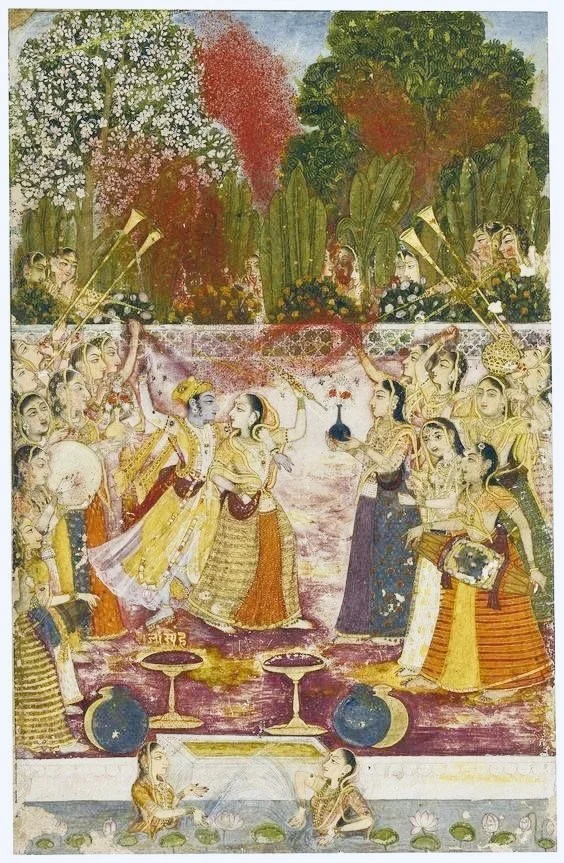
Artwork: Pinterest

This full moon marks the occasion of several auspicious Vedic festivals—Holi, Mahā Lakṣmī Jayantī, and Gaura Pūrṇimā—each marking a unique spiritual significance.

Holi, the Festival of Colors, occurs on the Pūrṇimā (पूर्णिमा) day of the month of Phālguṇa. It is deeply intertwined with the theme of the eternal and divine love between Rādhā and Kṛṣṇa (the 8th avatāra of Lord Viṣṇu), symbolized by the playful act of adorning each other's faces with vibrant colors. 

This festival not only marks the arrival of Spring but also signifies the triumph of dharma over adharma—good over evil—and the ascendancy of sattva (the creative, harmonious force) over tamas (ignorance and destruction).

The night before Holi, known as Holikā Dahan, commemorates the legend of Prahlāda and his aunt, Holikā. Enraged by the young devotee’s unwavering faith in Viṣṇu, his father, the tyrant Hiraṇyakaśipu, conspired to destroy him. Holikā, who possessed a boon rendering her immune to fire, attempted to burn Prahlāda by carrying him into the flames. Yet, her protection failed, and she perished, while Prahlāda emerged unscathed, shielded by his devotion. 

This night stands as a powerful testament to the supremacy of bhakti (devotion) and the inevitable downfall of arrogance and tyranny, setting the stage for Holi’s jubilant celebration of love, renewal, and divine play.

More than just its mythological roots, Holi stands as a celebration of love, unity, and renewal. It is a time for relationships to be reaffirmed, for healing fractured bonds, and for fostering harmony within communities. Holi's spirit of shared joy bridges social divides, creating a vivid tapestry of collective togetherness that celebrates humanity’s interconnectedness.

Artwork: Pinterest

Mahā Lakṣmī Jayantī honors the divine manifestation of Goddess Lakṣmī during the Samudra Manthan, a pivotal episode in Hindu mythology. The churning of the Ocean of Milk by the Devas and Asuras to obtain Amṛta (the nectar of immortality) signifies a profound spiritual endeavor, revealing treasures and divine beings, including Goddess Lakṣmī. 

 When Mahā Lakṣmī emerged from the ocean, she immediately took residence in Lord Viṣṇu’s (The Preserver, Protector of the Universe) heart. Her appearance bestows eightfold blessings, embodying abundance, grace, and devotion, guiding devotees toward both prosperity and spiritual well-being.

ॐ नमो भगवते वासुदेवाय | ॐ श्रीं महा लक्ष्म्यै नमः

Artwork: Anonymous

Gaura Pūrṇimā commemorates the birth of Śrī Chaitanya Mahāprabhu, a pivotal figure in the spiritual traditions of India. Born during a Lunar Eclipse in West Bengal, Mahāprabhu is considered a combined incarnation of Lord Kṛṣṇa  and His beloved devotee, Śrīmati Rādhārāṇī. His divine purpose was twofold: to experience the profound love that Śrīmati Rādhārāṇī holds for Him and to show the path of complete surrender and love for Kṛṣṇa during our eath walk.

हरे कृष्ण हरे कृष्ण, कृष्ण कृष्ण हरे हरे
हरे राम हरे राम, राम राम हरे हरे

“Mind becomes absorbed in the mantra, and then the mantra becomes absorbed in the mind.” — Ramana Maharshi

Full Moon Lunar Eclipse in Uttaraphalgunī: The star of Patronage

FULL MOON total LUNAR ECLIPSE

Artwork: Edit by Tulsi with @turiyacollection

March 13th 23:55 PST | March 14th 12:25PM IST

As the sun and saturn oppose the full moon (Pūrṇimā पूर्णिमा) of March, our first eclipse (Candra Grahaṇam - चन्द्र ग्रहणं) season of the year commences in the Vedic Lunar mansion of Uttaraphalgunī उत्तरफल्गुनी (Leo), the star of Patronage. This dynamic cycle is ripe for accelerated spiritual growth — urging us to refine our inner compass, to untangle and release an old karmic pattern.

As the Earth passes between the Sun and Moon, a shadow is cast on the lunar surface, initiating the beginning of a new chapter and welcoming opportunities for personal growth and transformation. We are stepping into a realm beyond time, where things may not be as they appear. Lunar eclipses serve as triggers, offering sudden exposure to hidden truths and heightened emotions.

The points where the Sun and Moon intersect the ecliptic plane, positioned exactly 180 degrees apart, are known as the lunar nodes, or Rāhu and Ketu in Vedic Astrology. These shadowy grahas, often called the "great awakeners," govern the eclipses and symbolize the eternal dance between light and darkness, offering us the opportunity to confront our shadows, disrupt old patterns, and awaken to deeper truths along our journey.

With the moon eclipsed, you may find yourself at a turning point in your life, on the verge of a major decision, in the grips of exhaustion, or dancing with uncertainty — rest assured this potent eclipse brings with it a promise to shift you into the next phase.

A breakthrough may be within reach now. An old pattern may surface that is ready to be released — don’t touch it — let go of the past. Some questions may be answered within this window of time.

The cards are being reshuffled, with soul contracts now ripe for fruition at the forefront. Some of us might be hesitant to release our current agreements and embrace this higher calling. This shift in awareness may feel sentimental, as we've invested our hearts into our current familiar situations. Yet, a part of us knows that to gain what we truly desire, we must be willing to release what we think we have. The courage required of us now is to stay connected to our true selves, leading with our whole, authentic hearts. ⠀⠀⠀⠀⠀⠀⠀⠀⠀ 

Ultimately, as we untangle ourselves from unaligned situations incapable of co-creating our dreams, a doorway opens, revealing a new path forward. On this path, we can weave the blessings of this cycle and shed toxic patterns and habits. The choice is presented to pivot and sow our seeds in fertile soil, ready to bear the fruits we've longed for—an aligned union based on reciprocity, clear communion, and collaboration towards a higher offering. Reflect, refine, and prepare yourself to step into a new timeline.

Uttaraphalgunī calls us to build authentic connections through acts of service, generosity, and mutual support. As the patron of contracts and agreements, this nakshatra, steeped in the qualities of hospitality and protection, encourages us to honor our commitments and nurture relationships that foster both personal and collective growth.

Holding the energy and śakti of prosperity and the accumulation of wealth through partnership, this is a powerful window for collaboration that ignites a fresh perspective and creative growth. There is a desire here to place what you desire into the palm of your hand. This energy is fulfilled through the art of patience and becoming life Tvaṣṭar, the celestial architect who shapes all beings into form.

To breathe life into new architecture, we become most in need of balance. The fine-tuning point between self and other — anchoring into and committing fully to self-sovereignty and radical self-love, while practicing the grace of presence and participation within this co-created dream.

We’re encouraged here to lean into logical, illumined discernment, guided by an understanding of the right support and the correct partner, to choose what we’re creating wisely — in the direction of that which is truly beneficial. The transformation of material into beauty holds great significance here. ⠀⠀⠀⠀

Just as a diamond is formed under pressure, beautiful people aren’t born — they’re forged in the fires of deep transformation. You may feel as though multiple alluring directions are being presented to you. Choose wisely how you’re spending your energy now, as it’s easy to identify with or get lost in form. Resist any urgency to initiate projects, and don’t get distracted in chasing the next shiny object in an attempt to fill some void. ⠀⠀⠀⠀⠀⠀⠀⠀⠀ 

Artwork: Pinterest

You may be feeling restless and emotionally sensitive. We must act now from a place of discipline and responsibility, moving in the direction of illuminating the kind of intelligence that awakens from within. Loosen your grip on the illusion that you have control over the outcome of your actions. Slow down, anchor yourself in the inner stillness of your heart, surrender to the unknown and allow the eclipses to have their way with you.

Pay close attention if you have major planets — your Sun, Moon, or Lagna (rising sign) — in Uttaraphalgunī, as this cycle could bring sudden change, bring forward something you didn’t plan for, or reveal something deeper about yourself. Also, take note if you are currently running a dāśā (cycle) or antar dāśā (sub-cycle) of Sun.

Shifting narratives, heightened emotions, uncertainty, and building intensity call for inward attention and one-pointed focus on grounding. Keep life simple during the eclipse hours (March 13 2025 7:57 pm - March 14 2025 02:00 am PDT | March 14 2025 09:27 am - 15:30 pm IST). The ancients revered this portal as a sacred time to tune into their own divinity, tending to eclipses with care and consuming less — both physically and mentally — to keep their channels clear.

Fasting, meditation, japa, and bathing during this time are sacred practices recommended to optimize this shift. This is an important time to recalibrate and peer deeper into yourself. Ideally, it is advisable to postpone travel, major decisions, surgeries, and commitments during this time.

What familiar holding patterns are you ready to transcend?

Do know that i’m here to support you as we step into a power reset time. For personalized guidance on how this transit influences you personally, I offer one-on-one consultations which you can book here.

Totality Begins: March 13 at 10:26 PM PDT / March 14 at 11:56 AM IST.
Maximum Eclipse: March 13 at 10:58 PM PDT / March 14 at 12:28 PM IST.
Totality Ends: March 13 at 11:32 PM PDT / March 14 at 1:02 PM IST.

“Write all that worries you on a piece of parchment;
Offer it to God Even from the distance
of a millennium I can lean the flame in my heart Into your life And turn All that frightens you
Into holy Incense Ash." 

~Hafiz

Venus Retrograde in Uttara Bhādrapadā: The Warrior Star

Venus Retrograde in Uttara Bhādrapadā

Artwork: Pinterest | Edit by @turiyacollection

March 1st - April 11th

Today, Venus retrogrades (vakrī वक्री) in the Vedic lunar mansion of Uttara Bhādrapadā (sidereal Pisces) उत्तरभद्रपदा, the Warrior Star. This mystical asterism is connected to the fertility of both earth and sky, the realm of dreamtime, and the excavation of the unconscious. It harmonizes universal mind, beckoning us to uncover hidden wisdom through humility, experience, and self-sacrifice—an energy that is transformative and karmic.

Śukra Graha, the revered planet of devotion, divine love, justice, restoration, relationships, and virility, is one of the three Jñāna Kārakas (significators of knowledge) and the Kāraka of union (yoga) and transportation.

In this retrograde through Uttara Bhādrapadā, Venus invites us to reflect on our emotional patterns and relationships, urging us to examine whether they align with our highest self. It is a time to reassess, reimagine, and review our connection to love, provisions, creativity, and self-worth.

The retrograde cycle offers us a sacred pause, encouraging us to consider how we might balance our lives by harmonizing the internal and external worlds. As Śukra transits this deeply transformative space, it becomes a moment to ask: Are the connections we are nurturing authentic, or are we simply repeating old patterns from the past?

Guru Śukrācārya, the holder of Sanjīvinī Vidyā, possessed the sacred wisdom to revive the dead. This knowledge aligns with the synodic cycle of Venus, which spans 584 days. Venus follows a rhythm of life, death, and rebirth: it is visible on the eastern horizon at sunrise for 263 days (symbolizing birth), disappears for 50 days (symbolizing death), and reappears as the evening star on the western horizon for another 263 days (resurrection/regeneration), only to disappear again for 8 days before the cycle repeats.

As Venus prepares to relinquish its reign as the evening star, we enter a rite of passage, confronting and healing old shadows and wounds. This transition, known as the inferior conjunction, occurs when Venus passes between the Earth and the Sun, disappearing from view for approximately 8 days. It then reemerges as the morning star, marking a symbolic rebirth.

Venus will be last visible as the evening star on March 19th. After this, it will disappear until March 23rd, when it enters its inferior conjunction and remains invisible for 8 days. The planet will then reappear as the morning star on March 26th. This pivotal transition mirrors the process of death and rebirth, offering us an invitation to reflect on our own cycles of transformation.

Venus follows a distinct rhythm, retrograding every eighteen months as part of an eight-year cycle. Reflecting on the lessons of the last Venus retrograde in 2017, we are invited to revisit themes from that time, particularly concerning relationships, creative projects, and emotional healing. Much like its celestial dance in 2017, this retrograde prompts us to assess whether our relational dynamics and emotional patterns have truly evolved since then.

On February 27th, Mercury entered Pisces, where it is debilitated—a position that can present as confusion, miscommunication, and difficulty maintaining clarity of thought. Adding complexity, Mercury will conjunct Venus retrograde on March 2nd, amplifying the need for introspection in matters of love, communication, and creativity. This alignment calls us to look inward, particularly regarding past relationships and unspoken thoughts that need to be aired or healed.

On March 15th, Mercury will also turn retrograde, amplifying the energies of reflection, review, and rethinking—especially around how we express ourselves emotionally and intellectually. This upcoming Mercury retrograde cycle, lasting until April 4th, will further invite us to slow down, reevaluate communication, and revisit unresolved issues from the past. A more detailed blog post on this will follow soon.

Artwork; Pinterest

Śukrācārya, as the Guru of the Āsuras, was known for his protection of his people. He is also associated with Paraśurāma, the sixth incarnation of Lord Viṣṇu. Paraśurāma's story is among the most violent of the incarnations, as he wielded an axe against the Kṣatriyas (warrior/political class) to rebuild a better society.

Pay close attention to where you draw lines between "your people" and others—and what you are willing to do to obtain and maintain your position or seat. Notice the actions that arise from a sense of injustice, particularly if fueled by vengeance or a desire for retribution.

Śukra's narrative is often linked to blindness or arrogance, reflecting a misalignment between one’s self-perception and the views of others. This can manifest as seeing oneself as either superior or inferior, diverging from reality.

Śukra Graha is the enjoyer—the one who delights in all sensory experiences: music, good company, fine food, mantra, and meditation. Venus imparts wisdom through experience, calling for complete absorption. He is the Samādhi maker, invoking unity with the divine at his highest octave.

This is beautifully exemplified in the story of MahāLakṣmī, who resides in Viṣṇu’s heart, as well as in the lives of saints born with Śukra in Pisces in their charts—embodiments of supreme devotion and the boundless grace of divine love.

As we navigate the deep waters of this transit, the energies associated with Śukra’s karakas will be amplified, requiring thoughtful self-reflection and a container for introspection. Pay close attention if you have major planets, your moon, or your Lagna (rising sign) in Pisces, or if you are currently running a cycle of Venus or Saturn.

This Venus retrograde in Uttara Bhādrapadā invites us to explore the depths of our relationships and creative pursuits, unraveling karmic patterns and allowing us to emerge transformed. Use this time wisely, for it is through wisdom, experience, and self-reflection that we can find clarity and renewal.


All My Relations | ॐ शुं शुक्राय नमः

Brene brown // “Vulnerability is not winning or losing; it's having the courage to show up and be seen when we have no control over the outcome. Vulnerability is not weakness; it's our greatest measure of courage. A lot of cheap seats in the arena are filled with people who never venture onto the floor.”

Venus Retrograde Key Dates and Transitions

  • January 28th: Venus enters Pisces

  • February 1st: Venus enters Uttarabhadrapada (Pisces)

  • March 1/2: Venus Retrogrades in Uttarabhadrapada (Pisces)

  • April 12/13: Venus Stations Direct in Purvabharapada (Pisces)

  • May 31st: Venus enters Aries


These dates mark the transition of Venus from an evening star to a morning star.

  • Last visible as an evening star: March 19, 2025

  • Inferior conjunction (invisible): March 23, 2025

  • First visible as a morning star: March 26, 2025