Mahāśivarātri: The Great Night of Śiva

Mahāśivarātri

महाशिवरात्रि

Pinterest

Tonight initiates the commencement of the sacred celebration marking the divine union and marriage of Śiva and Śaktī. According to the North Indian calendar, the great night of Śiva descends upon us on the caturdaśī tithi of kṛṣṇa pakṣa during the month of Phalguna.

Śiva, revered as Adiyogi, the primordial Yogi, embodies that mode of consciousness responsible for the inhalation—the withdrawal and destruction of this temporary reality of life—that which leads us from darkness to light, from illusion to realization and ultimately awakens us from this dream.

Legend has it that on this night, Lord Śiva bestowed upon Goddess Pārvatī the sacred wisdom of yoga, symbolizing the eternal union between the masculine and feminine energies, the dynamic interplay of creation and dissolution.

‘Shivam shāntam advaitam chatrutham manyante sa Ātmā sa vigyeyaha.’

Pinterest

“The peaceful, the blissful, the undivided is thought to be the fourth state of consciousness; that is the Self. This is to be known.”

Tonight, devotees converge in homage to the Lord and immerse themselves in great tapasyā (austerity), harnessing the heightened spiritual energies that permeate this sacred night. As we surrender to the sanctity of Mahāśivarātri, let us wholeheartedly embrace the profound teachings of Lord Śiva, transcending the limitations of the temporal world, and awakening to the eternal bliss of our true nature.

Oṃ Namaḥ Śivāya | ॐ नमः शिवाय

Full Moon in Māgha: The Star of Power

FULL MOON

पूर्णिमा

Artwork: @hvalor

The Full Moon (Pūrṇimā) of February reaches its zenith on the twenty-fourth at 4:31am PST | 18:01 IST, in the mystical and majestic Vedic Lunar Mansion of Māgha (Leo), The Star of Power. This lunation cycle illuminates a time of heightened self-expression, leadership, and deep connection to ancestral roots, encouraging individuals to shine in their unique glory while honoring traditions and legacy.

This is a time to remember our ancestors and reflect on our interdependency with all things — to shine light on our inherited habits, cycles, and reactions as well as the legacy we’re leaving behind with the imprint of our thoughts, speech, and actions — whether conscious or unconscious.

There is intergenerational work to be done during this window. For some of you, this may look like a baptism by fire that is requesting you to take a deeper look into healing your ancestral line and genetic code. We’re being requested to take personal responsibility for the cycles and habits that may have been left on repeat. Have the courage to utilize this cycle wisely.

When we look at the origin of the word courage, it stems from the Latin word cor, meaning heart, and the original definition is to tell the story of who you are with your whole heart.

Artwork: Mystic Mamma

In order to renounce and transcend, one must first fulfill the duties of their ancestors, which is now offering blessings on the material plane. You may feel as if you’re being presented with multiple paths to take and are not sure in which direction to move.

Rise above the collective narrative, put into practice the wisdom you’ve been cultivating that has now circled around front and center — step fully into your individuality. 

Use these next couple of weeks to set your plans into motion, as there’s extra emphasis for manifestation and accomplishment in the material world through March’s full moon, which initiates our first eclipse season in the Pisces/Virgo axis.

Place extra attention on staying rested and grounded during this cycle as there are four grahas (planets) aspecting this bright, royal moon in Māgha, which holds the power “to leave the body.” Lead with your whole heart and know that earthing and a physical practice will be of great service in assisting this process.

If you need assistance in tracking this shift on a personal level, please visit Jyotish Consulations to book a private consultation. Know that I’m here to support you.

All my Relations

https://www.instagram.com/chaya.collective/


Vijnana Bhairava Tantra // “Enter the bowl of vastness that is your heart. Give yourself to it with total abandon. Quiet ecstasy is there– And a steady, regal sense of resting in a perfect spot. Once you know the way, the nature of attention will call you, to return, again and again, and be saturated with knowing, 'I belong here, I am at home here.' Answer that call." 

Varāha Dvādaśī

VARĀHA DVĀDAŚĪ

वराह द्वादशी

Image: Pinterest

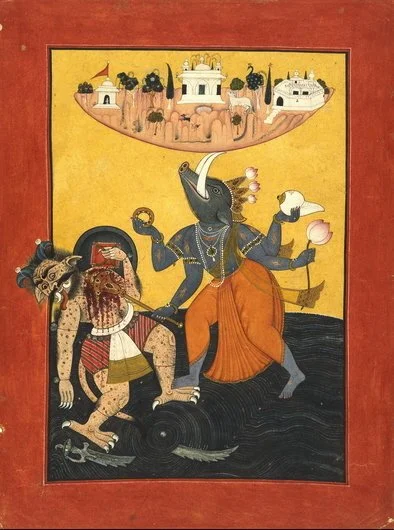
On the twelfth day of the bright half of Māgha marks the festival honoring Varāha Avatār, the third incarnation of the daśāvatāra (ten) of Lord Viṣṇu, the wild boar. Varāha Dev is one of the four full Paramātmās (supreme Self) whose story narrates how Lord Viṣṇu came to rescue Bhūdevī (Pṛthvī), Earth.

Varāha’s story begins with the doorkeepers of Lord Viṣṇu’s realm, Jaya and Vijaya, who were cursed by Lord Brahmā’s four sons to take human birth and incarnate on Earth. The curse would be lifted only if the two human forms were killed by the hands of Lord Viṣṇu himself, to which they agreed.

Image: Pinterest

One of the brothers, Hiraṇyākṣa, dragged Mother Bhūmi to the bottom of the cosmic ocean to attact Lord Viṣṇu’s attention. The Lord took the form of a boar in order to slay the demon king, rescue the Earth, and restore her to her rightful place in the universe.

Lord Viṣṇu, the maintainer of this world, takes birth age after age only when the balance on Earth has been disturbed. This incarnation of Varāha Dev is associated with the graha Rāhu (north node) in Vedic astrology, who is the karaka for justice, courage, truth, self-sacrifice, risking one’s life for a cause, going against the established order, the foreigner, and the protector of the Earth.

Image: Varaha with his consort Bhudevi, copper sculpture from Tamil Nadu. c. 1600

With his tusks, Varāha is said to have the ability to dig up any impurities in the heart. We ask Rāhu to protect our tounge.

ॐ वराहाय नमः।

Sarasvatī Vasanta Pañcamī

Vasanta Pañcamī

वसन्तपञ्चमी

Celebrated annually on the fifth day in the bright half of Māgha, today marks the festival honoring goddess Sarasvatī and the beginning of Spring.

Sarasvatī is known as the goddess of wisdom, language, music, and the arts. She symbolizes that creative intelligence who is invoked to awaken within us the memory of who we really are.

Consort to Lord Brahmā, she is that shakti (power) that embodies the original sound, the nād, which exists as the channels in our body, the invisible river whose impulse spurs Brahmā to breathe life into creation.

Many honor Vasanta Pañcamī or Sarasvatī pūjā by wearing yellow, offering and eating yellow foods, as it is said to be Sarasvatī’s favorite color. This is symbolic of the fertility of spring, with its budding flowers and ripening crops. Today is held auspicious to begin one’s studies, take initiation, and engage in the arts and learning of all kinds.

There are many legends associating this festival with the blossoming of love, passion, and emotional anticipation. One such legend recalls the day when Kama Dev (god of love) was said to have been approached by the Rishis (seers) to interrupt Lord Shiva’s meditation so that Parvati, after her arduous tapasya, could receive him as her husband. When Shiva awakened from his meditation, his third eye was said to burn Kama Dev to ashes. Making for a potent and dynamic Valentine’s day energy.

Aum Aim Sarasvatyai Namaha | ॐ ऐं सरस्वत्यै नमः

Image: Pinterest