NEW MOON IN PŪRVA PHĀLGUNĪ
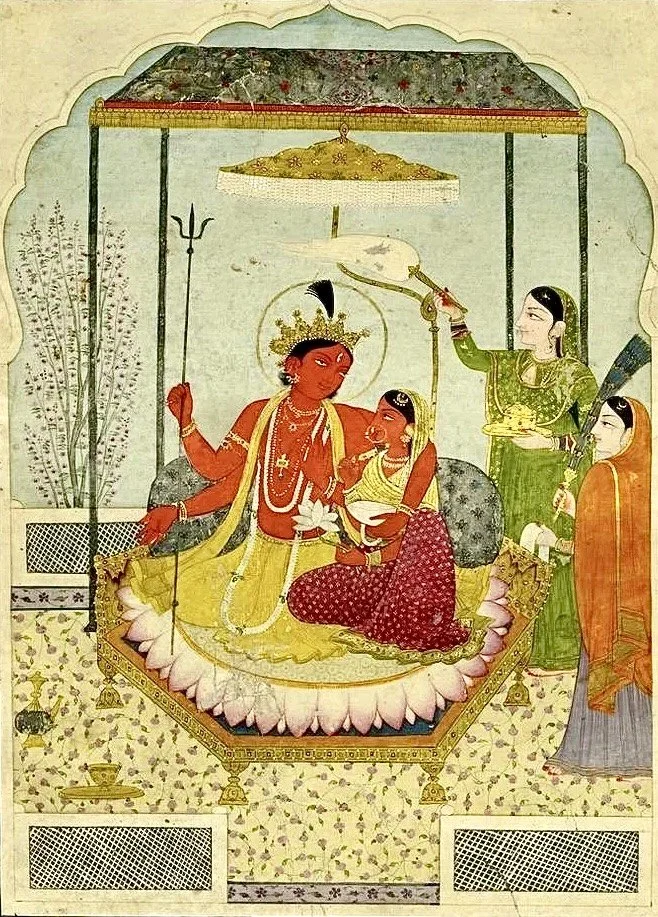
Śiva and Pārvatī. Pahari School, Kangra Style. 19thC(early)
September 10/11
The Sun and Moon align for the New Moon in the Vedic Lunar Mansion of Pūrva Phālgunī पूर्वफल्गुनी (Sidereal Leo), the Fruit of the Tree.
Pūrva Phālgunī, “the Former Reddish One,” evokes the first flush of spring, passion, fertility, and creative fruitfulness. Seated within Leo, vidyā sthāna, and counted among the birth stars of Guru, it carries psychological intelligence.
It is symbolized by the front legs of a bed, or a hammock, holding the promise of rest, pleasure, and the enjoyment of merit earned through past action.
This asterism is ruled by Bhaga, one of the twelve Ādityas, the bestower of delight, distributive fortune, and the capacity to savor what has been given.
The ancient Ṛṣis perceived this constellation in the two stars known today as Zosma and Chertan, their placement forming the legs of a resting couch in the night sky.
Pūrva Phālgunī carries Prajānanda Śakti, the power of procreation, the union of polar opposites embodied in the Śiva Liṅgam, where Śiva is inseparable from Śakti, and from which flows the fertilizing current that enlivens creativity.
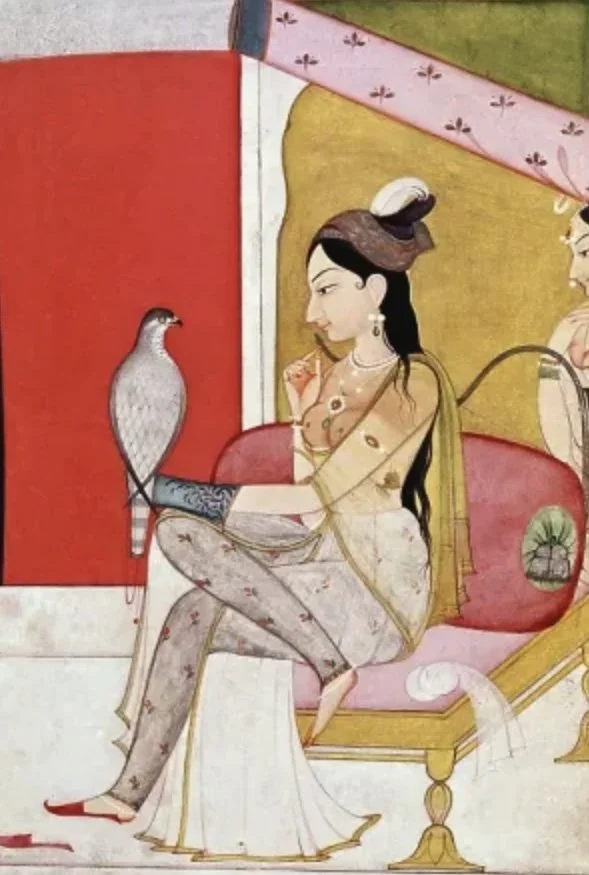
Women Pahari Style, Punjab Hills, c.1750
Within this field of union, the nature of our bonds becomes more visible. Personal prabhā intensifies, revealing where connection deepens into intimacy and where it becomes entanglement.
This star of fertility is also courageous and visionary, qualities reflected in the eagle, the bird who finds its seat here.
It is under this star that Devī Pārvatī began her tapasya to win Śiva as her husband. Pūrva Phālgunī is tīkṣṇa, a fierce nakshatra; her austerity here was no soft surrender, but a relentless, one-pointed longing, disciplined into devotion. Śiva remained absorbed in meditation, and even as her resolve was tested, Pārvatī did not waver. Her tapas bore its fruit.
Pūrva Phālgunī is Śukra’s seat in the heart of the dharma trine. Here, the challenge of Śukra is not desire itself, but abhimāna, the pride that demands justice. Dharma asks for the right use of our vīrya, gathered rather than spent, passion held with clarity of heart and vision, and the renunciation of vengeance. Through its trials and churning, what is birthed is Sūrya: action without claim upon its fruit, without entitlement to the result.
As we move toward what we truly desire, forces may arise that interrupt our course and test the steadiness of our aim. As a birth star of Maṅgala, Pūrva Phālgunī asks whether desire can hold its direction when met by resistance.
In the two weeks since the eclipse Full Moon, we have been assimilating all that was revealed, allowing its deeper implications to take form.
Pūrva Phālgunī reminds us that creation does not arise through effort alone. Just as nature moves between activity and repose, there are times when restoration itself becomes the creative act.
Under this New Moon, we are invited to examine what we are ready to plant. Where has desire been scattered, spent without direction? Where are we being asked to gather it, discipline it, and set it toward what truly matters?
All My Relations, Tulsi
New Moon in Pūrvaphālgunī: 20:16 PST | 11th 8:56 AM IST
If you're interested in going deeper in your Jyotiṣa studies, we are now halfway through Navagraha Kathā, which is fully recorded. On October 15th, we will also be starting Tattva: The Architecture of Consciousness — both serving as prerequisites for our upcoming Nakṣatra Jyotiṣa techniques and studies to come.
The Yogasūtra’s (2.47) states that it is in the relaxation of our effort and our capacity to become absorbed in the infinite, gives to effortless action — action which is established in being or yoga (union).